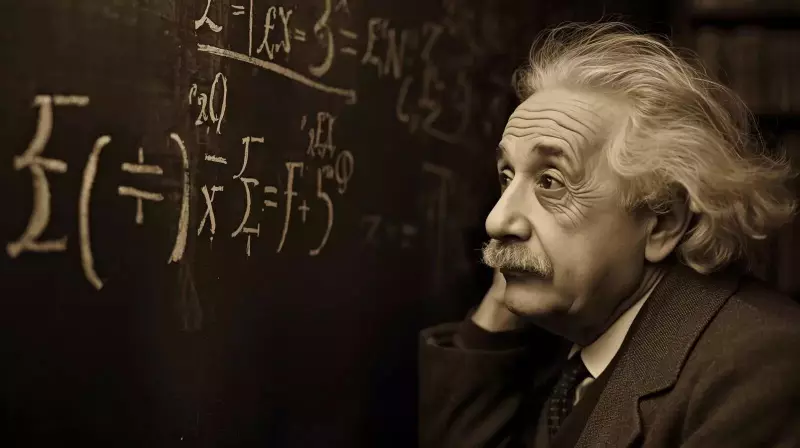
We often picture genius as a seamless flow of brilliant ideas. Yet, the reality, even for a mind like Albert Einstein's, was filled with missteps, blind spots, and puzzles that simply refused to be solved. One such curious episode involved a seemingly basic mathematical riddle about an old car on a hill—a problem that wasn't about the cosmos but about everyday logic, and it perfectly illustrates how our intuition can lead us astray.
The Deceptively Simple Car on the Hill
This puzzle reached Einstein not through a physics journal, but through informal correspondence with his friend, the psychologist Max Wertheimer. Their exchanges were playful intellectual jousts. The problem was designed to probe how Einstein thought, not to challenge his theories of relativity.
The scenario is straightforward: An old, clattering car needs to cover a total distance of 2 miles, going first uphill and then downhill. Due to its condition, it cannot average more than 15 miles per hour for the first, uphill mile. The question posed was: How fast must it drive the second, downhill mile to achieve an overall average speed of 30 miles per hour for the entire 2-mile journey?

At first glance, it seems simple. If the first mile is done at 15 mph, surely speeding up downhill should easily pull the average up to 30 mph. But Einstein quickly saw the trap.
Why the Puzzle Has No Solution
Let's break down the math, step by step. To average 30 mph over 2 miles, the total time for the trip must be exactly 4 minutes (2 miles ÷ 30 mph = 1/15 of an hour).
Now, consider the uphill leg. Traveling 1 mile at an average speed of 15 mph itself takes exactly 4 minutes (1 mile ÷ 15 mph = 1/15 of an hour).
This is the crux of the conundrum. The car uses up the entire allowed time just to complete the first mile. To achieve the desired average, it would have to cover the second mile in zero time—requiring infinite speed, which is impossible.
No matter how fast the car goes downhill, it can never reach an average of 30 mph for the whole trip. The slow uphill segment sets an unbreakable limit. This is a classic example of an average speed conundrum, where our instinct to "balance" speeds fails.
The Deeper Lesson in Thinking
Einstein, who was fascinated by the structure of problems more than mere calculation, appreciated this puzzle's elegance. It reveals a profound truth about problem-solving: sometimes the difficulty lies not in finding the answer, but in realizing the question itself is designed to be unsolvable under the given constraints.
The puzzle teaches us that averages can hide inherent limits, and that simply going faster later cannot always compensate for being slow initially. It underscores the importance of carefully reading and framing a problem before rushing to solve it. A tiny change—if the uphill speed limit were 16 mph—would make a theoretical solution possible. But at exactly 15 mph, the system hits a logical wall.
This moment from Einstein's life reminds us that even the greatest thinkers encountered simple questions that "refused to cooperate." It wasn't a failure of intellect, but a demonstration of it—the ability to accept when a problem, quietly and firmly, comes to rest with no answer.