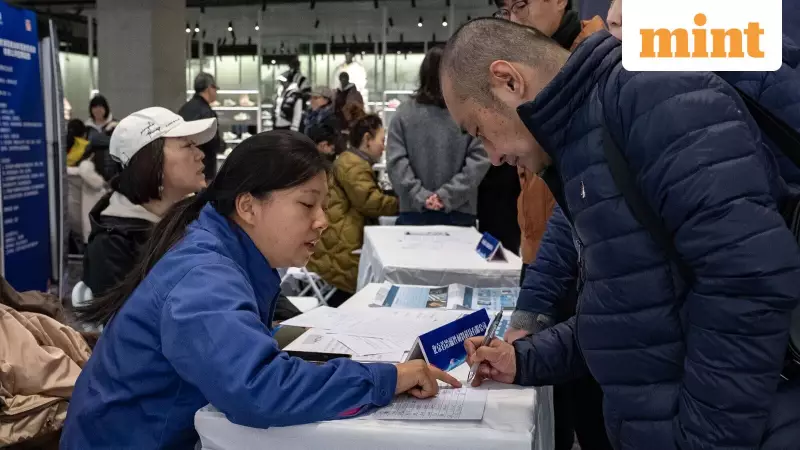
China is confronting a severe jobs crisis among its highly educated youth, with official data revealing that nearly 17% of Chinese aged 16 to 24 were unemployed as of October 2025. This alarming figure, which excludes current students, highlights a critical mismatch between the country's mass production of university graduates and the actual demands of its job market.
The Vocational Education Push
In response, the Communist Party is executing a massive strategic pivot towards practical, skills-based education. The epicenter of this shift is visible at institutions like the Hangzhou Technician Institute in Zhejiang province. Here, over 6,000 students aged 14 to 20 are being trained to operate drones, manufacture rare-earth magnets, and maintain electric vehicles and industrial robots.
The institute's director, Shao Weijun, employs a demand-driven model, consulting with more than 600 Chinese firms annually to tailor the curriculum to market needs. This practical approach yields impressive results, with nearly all graduates securing quality employment, a stark contrast to the struggles of many university degree holders.

Addressing the Skills Mismatch
The government's urgency stems from a dual problem: a surplus of university graduates who cannot find work, and simultaneous complaints from company bosses about an inability to hire staff with the right technical skills. While China needs brilliant scientists for future dominance, it also requires a massive army of technicians to maintain its advanced infrastructure of robots, data centers, and precision equipment.
Substantive policy changes are underway. In 2022, China revised its vocational education law, declaring practical qualifications "equally important" as academic ones. By December 2024, the education ministry launched 40 new vocational courses focused on high-tech fields like artificial intelligence and biomedicine.
A major campaign launched in June 2025 aims to upskill 30 million more workers by 2027, targeting "urgently needed" skills in deep-sea technology and the low-altitude economy, which includes drones and flying taxis. Notably, this initiative includes plans to send some university graduates back to college for marketable technical skills, a reverse trend known as benshengzhuan.
Shifting Perceptions and Realities
Accompanying these reforms is a significant propaganda effort to dismantle the deep-rooted cultural preference for white-collar jobs. State media, including the People's Daily, has actively campaigned against the notion that "white-collar workers are superior to blue-collar workers," arguing that the strong link between academic degrees and employment has broken down.
A Zhaopin recruitment agency survey found that 52% of university graduates now believe additional technical training would boost their job prospects. On the ground, attitudes are slowly shifting. Students like He Li, at the Xian Railway Vocational and Technical Institute, express confidence in their choice, citing strong employer connections and stable job prospects in fields like subway maintenance.
However, the transition is not seamless. Another student, Shen Kecheng at Beijing Polytechnic University, acknowledges the good job prospects from his vocational course in electrical automation but still plans to pursue a bachelor's degree, recognizing that companies often prioritize university graduates.
The long-term goal for China is to break down the rigid barriers between academic and vocational pathways, creating a more fluid system where learners can move between tracks or acquire hybrid qualifications. This fundamental restructuring is deemed essential for China to achieve the lofty economic objectives outlined in its latest five-year plan.