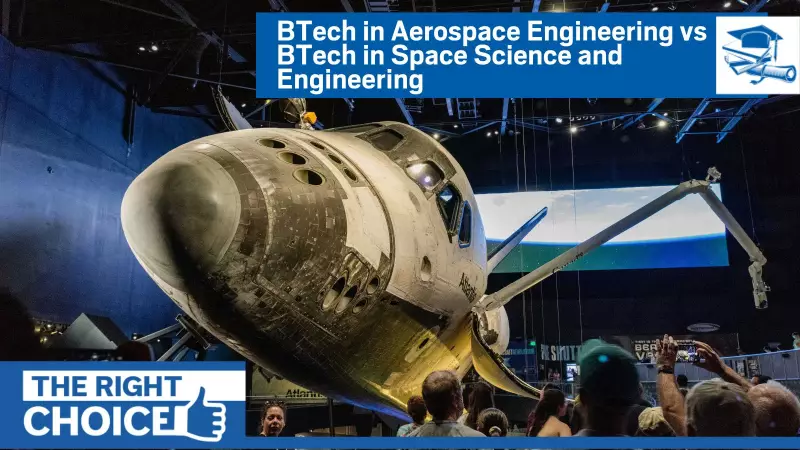
The landscape of higher education in India is witnessing a significant shift, with a surge of student interest in fields that conquer the skies and beyond. The rise of global private space giants like SpaceX and Blue Origin, coupled with homegrown players like LAT Aerospace and increased governmental focus, has propelled aerospace and space science into the mainstream. For aspirants looking at the stars, two prominent undergraduate pathways emerge: BTech in Aerospace Engineering and BTech in Space Science and Engineering. While both deal with objects that leave the ground, their core philosophy, academic rigour, and career trajectories are distinct. Choosing between them requires a clear understanding of whether one wants to build the vehicle or unravel the cosmic secrets it seeks.
Defining the Domains: Vehicle vs Voyage
Aerospace Engineering is fundamentally the discipline of creating machines that fly. It encompasses the research, design, development, testing, and maintenance of both aircraft (aeronautics) and spacecraft (astronautics). The curriculum is deeply rooted in engineering principles, covering subjects like fluid mechanics, propulsion systems, structural analysis, guidance and control systems, and advanced materials science. The primary objective is to engineer vehicles that are safe, efficient, and capable of withstanding extreme atmospheric and space environments.
In contrast, Space Science and Engineering orbits around scientific inquiry. It blends engineering with core sciences to understand space phenomena. The coursework leans towards astrophysics, orbital mechanics, satellite instrumentation, remote sensing, mission design and analysis, and planetary science. Here, engineering serves as a tool to achieve scientific goals—whether it's designing a sensor to study radiation belts or planning a satellite orbit to monitor climate change.
Career Prospects and Placement Landscape
The professional paths stemming from these degrees diverge significantly, reflecting their core focus.
Graduates in Aerospace Engineering find opportunities across a broad spectrum of industries. They are recruited by aviation majors, defence research organisations (like DRDO), aircraft manufacturers, and private space companies. Typical roles include Flight Dynamics Engineer, Propulsion Engineer, Structural Analyst, Systems Integrator, and UAV (Drone) Designer. The skill set is highly transferable across sectors that require robust mechanical and systems engineering.
Space Science and Engineering graduates often step into more specialised niches. Their careers are commonly found in satellite operations, mission planning and control, payload development, remote sensing data analysis, and scientific research institutions like ISRO. Roles such as Satellite Data Scientist, Payload Specialist, Space Mission Analyst, and Remote Sensing Expert are typical. The explosion in satellite applications for communication, navigation, and earth observation has particularly boosted demand in the space data and analytics sector.
Placement Trends: Breadth vs Specialisation
Placement scenarios for these two streams follow different patterns. Aerospace Engineering departments typically attract a larger and more diverse pool of recruiters from aviation, defence, and manufacturing, leading to a relatively predictable and broad-based recruitment cycle. The roles are clearly defined within traditional engineering frameworks.
Placements for Space Science and Engineering are often more research-oriented and can depend heavily on specific collaborations with space agencies, scientific organisations, and niche tech firms. While these positions can be exceptionally rewarding, they may sometimes require postgraduate studies or specialised internships to build the precise expertise needed. Students with strong analytical abilities often secure positions in satellite application companies, meteorological departments, and firms specialising in imaging and sensor technologies.
Who Should Choose What? A Guide for Aspirants
Making the right choice hinges on a student's inherent interests and problem-solving style.
Choose BTech in Aerospace Engineering if: You are fascinated by machines, enjoy hands-on applied engineering, and love solving problems related to design, mechanics, and performance optimisation. This path is ideal for those who want a comprehensive engineering degree with applications in both atmospheric and space vehicles and thrive in environments with strict safety and performance benchmarks.
Choose BTech in Space Science and Engineering if: Your curiosity is driven by the 'why' and 'what' of the cosmos. You enjoy scientific analysis, data interpretation, and want to use engineering principles to enable discovery and observation. This path suits those drawn to the scientific objectives of space missions—understanding planetary behaviour, cosmic radiation, or climate patterns—and see engineering as a means to that end.
In essence, the choice boils down to a fundamental question: Do you see yourself as the architect of the spacecraft, or as the scientist defining its mission of exploration? Both pathways, as highlighted by Renuka Devi Kakarla, PGT – Physics at Shiv Nadar School, Faridabad, in her January 3, 2026 analysis for The Indian Express, offer thrilling opportunities at the forefront of technology and discovery, contributing to India's growing prowess in the final frontier.