The recent archaeological excavation at Zehanpora in the Baramulla district of Jammu and Kashmir has brought the region's profound Buddhist heritage back into the national spotlight. This discovery of a site dating back nearly two millennia underscores Kashmir's integral position within the ancient civilizational tapestry of Bharat.
Prime Minister's Spotlight and Historical Significance
In the final episode of his Mann Ki Baat address for 2025 on December 28, Prime Minister Narendra Modi specifically highlighted the ongoing work at Zehanpora. He pointed out that the unearthed remains belong to the Kushan period, approximately 2,000 years ago, reaffirming Kashmir's stature in the ancient Buddhist world. The initial clue for this significant find came from an archival photograph housed in a French museum, which depicted three ancient stupas standing in Baramulla.
IAS officer Shah Faesal, in a detailed article, has elaborated on several lesser-known facets of Kashmir's Buddhist history. He notes that Emperor Ashoka of the Mauryan dynasty, who is credited with founding Srinagar, established numerous monasteries and stupas across the region. Kashmir's unique geographical location at the crossroads of the Indus-Gandhara region and the Himalayan corridor made it a natural conduit for cultural and philosophical exchange between the Indian heartland and the wider Asian continent.

Kashmir: A Seat of Learning and Philosophical Zenith
Ancient texts and chronicles consistently refer to Kashmir as Sharada Pitha, a land of learning and one of the foremost seats of knowledge in the ancient and early medieval periods. The Buddhist philosophical tradition found one of its highest expressions through Nagarjuna, the founder of the Madhyamaka or the Middle Way philosophy, which forms the bedrock of Mahayana Buddhism. Kashmir evolved into a critical centre for the study, preservation, and development of his profound thoughts.
The Kushan period, to which the Zehanpora relics are dated, marked a golden era for Buddhism in the region. Under the patronage of Emperor Kanishka, the faith received unprecedented royal support. It was during his reign that the Fourth Buddhist Council was convened in Kashmir. Presided over by the scholar Vasumitra and attended by luminaries like Ashvaghosha, this council was instrumental in systematising and propagating Mahayana Buddhism. This form emphasised compassion, the Bodhisattva ideal, and the goal of universal liberation.
The pivotal councils in Buddhist history are summarised below:
- First Buddhist Council: Rajgir, Patron: Ajatashatru
- Second Buddhist Council: Vaishali, Patron: Kalashoka
- Third Buddhist Council: Pataliputra, Patron: Ashoka
- Fourth Buddhist Council: Kashmir, Patron: Kanishka
Kashmir's Role as a Global Launchpad
From Kashmir, Mahayana Buddhist ideas travelled along trade routes to Gandhar, Kabul, and Bactria, influencing a vast swathe of Asia. This establishes Kashmir not as a peripheral outpost but as a crucial launchpad for global Buddhism. Further evidence of this scholarly tradition comes from the Gilgit Manuscripts, among the oldest surviving Buddhist texts in the world. Written in Sanskrit and Prakrit, these manuscripts confirm that Kashmir and its neighbouring regions served as vital custodians of Buddhist knowledge for centuries.
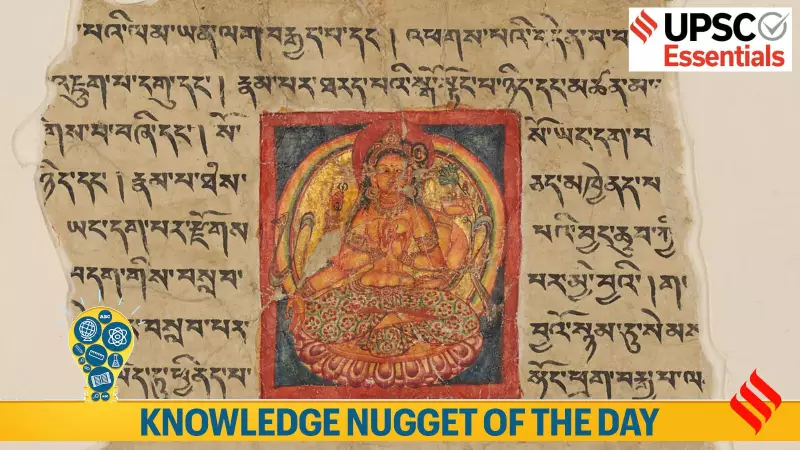
The artistic legacy of this era is also notable, exemplified by artefacts like an 11th-century painting depicting the personification of the Prajnaparamita (Perfection of Wisdom) text, showcasing the distinct Kashmir style with its swelling breasts and constricted waist. An 8th-century fragment of a Buddha bust, now in New York's Metropolitan Museum of Art, further attests to the region's artistic sophistication.
For UPSC aspirants, understanding this rich history is crucial from both Prelims and Mains perspectives. The topic connects archaeology, ancient history, cultural heritage, and India's civilisational links with Asia, making it a high-yield area for examination preparation.