In a significant development for aspirants of the Union Public Service Commission (UPSC) examination, a series of critical national and international events have unfolded, spanning geopolitics, judicial reforms, labour rights, environmental policy, and rural employment. The Indian Express UPSC Key for January 9, 2026, provides a comprehensive analysis of these topics, essential for both the Preliminary and Main stages of the civil services exam.
US Retreat from Global Stage: Implications for Multilateralism
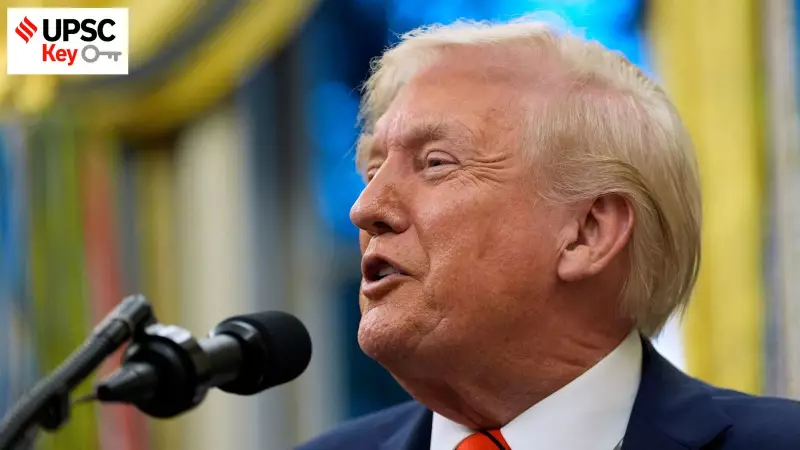
In a move with far-reaching consequences, President Donald Trump has formally withdrawn the United States from 66 international organisations. This action, executed through a presidential memorandum, targets bodies including key United Nations agencies and the India-France co-led International Solar Alliance (ISA). The Trump administration labeled these institutions as "redundant" and contrary to American interests.
The withdrawal creates an immediate funding and leadership crisis within these global groupings. As the largest donor to many, the US exit triggers significant financial shortfalls. Analysts in New Delhi assess that this vacuum presents a strategic opportunity for China to expand its influence, leveraging its capital and capacity to steer agendas in bodies like UNESCO and the World Health Organisation (WHO).

This development is particularly poignant for climate governance. The US had already initiated withdrawal from the 2015 Paris Agreement, effective January 20, 2026, and scaled down its climate research funding. By leaving the UN Framework Convention on Climate Change (UNFCCC) and the ISA—which it joined only in 2021—the US cedes leadership in the clean energy transition to China, a dominant force in renewable manufacturing.
For India, the US exit from the ISA is symbolic but not financially impactful, as the US was not a donor. However, it potentially reduces pressure on India to decarbonise rapidly and may affect collaborative clean energy projects established during the pre-Trump strategic partnership.
Artificial Intelligence Reshapes India's Judicial Landscape
While the Law Ministry informed Parliament that AI use in courts is under exploration, the technology is already making significant inroads. An indigenous transcription system, TERES (Technology Enabled ReSolution), is now used in Constitution Bench hearings in the Supreme Court, converting oral arguments to real-time text with high accuracy. This system is also being adopted by courts in Dubai, Abu Dhabi, and Singapore.
Another AI platform, Adalat AI, is operational in High Courts across nine states, with pilots in five more. In Kerala, its deployment is widespread, assisting in case management, filing scrutiny, and even developing voice-to-text tools for district courts. The Supreme Court is testing AI-assisted e-filing to flag document errors and uses SUVAS software to translate judgments into 18 regional languages.
These tools aim to address chronic challenges like case backlogs and administrative delays. AI applications like SUPACE and LegRAA assist in legal research by scanning judgments to identify relevant precedents. The judiciary emphasizes that these are assistive tools to enhance efficiency, not replace human judgment or court staff.
Monument Conservation Opens to Private Sector
In a policy shift, the conservation of centrally protected monuments will now involve private sector agencies. The Ministry of Culture is empanelling private conservation architects through a Request for Proposal (RFP), moving beyond the Archaeological Survey of India's (ASI) sole mandate.
Corporate donors can now directly engage these empanelled architects for core conservation work, funded through Corporate Social Responsibility (CSR) contributions to the National Culture Fund (NCF). This differs from the earlier 'Adopt a Heritage' scheme, which focused on creating tourist amenities. The move aims to expedite conservation, utilize specialized expertise, and create a larger talent pool, while ensuring ASI maintains supervisory oversight.

Gig Workers' Strike Highlights Labour Rights Debate
A nationwide strike by thousands of app-based delivery workers on New Year's Eve has ignited a debate on labour rights in India's growing gig economy. Workers demanded better pay, safety protections, and social security, facing immediate pushback from platform founders.
Experts argue that the fundamental issue is the opaque "partner" model that denies an employer-employee relationship, keeping workers outside the purview of traditional labour laws like the Code on Wages. While the Code on Social Security, 2020, defines gig workers and proposes a welfare fund with contributions from aggregators, it lacks enforceable rights. The strike underscores the tension between the flexibility touted by platforms and the economic insecurity faced by workers, calling for clearer government regulation on minimum protections and algorithmic transparency.
MGNREGA Overhauled into VB-G RAM G
The Mahatma Gandhi National Rural Employment Guarantee Act (MGNREGA) has undergone a major transformation into the Viksit Bharat Grameen Rozgar Aur Mazdoor Guarantee (VB-G RAM G). Key changes include increasing the employment guarantee from 100 to 125 days per rural household and shifting from a demand-driven to a normative funding model shared between Centre and states in a 60:40 ratio.
Proponents argue this ensures predictable funding for states and focuses on creating productive assets in water security, rural infrastructure, and climate resilience. Critics, however, worry about the increased fiscal burden on states and the potential undermining of the demand-driven right-to-work principle. The new framework aims to integrate asset creation with national platforms like PM Gati Shakti.
Legacy of the Gadgil Committee Report
The recent passing of ecologist Madhav Gadgil has brought renewed attention to his seminal Western Ghats Ecology Expert Panel (WGEEP) report. Submitted in 2011, the report recommended classifying the entire 1,29,037 sq km Western Ghats as an Ecologically Sensitive Area (ESA) with graded restrictions on development, and creating a Western Ghats Ecology Authority.
Facing strong opposition from state governments, the report was sidelined. A subsequent High-Level Working Group under K. Kasturirangan recommended a reduced ESA of 56,825 sq km. To date, consensus between the Centre and states on the final ESA notification remains elusive, even as ecological disasters in the region repeatedly highlight the need for the protections Gadgil advocated.
Also in News
The UN's World Economic Situation and Prospects 2026 report forecasts global growth at 2.7% for 2026. In a setback for space exploration, the collaborative ESA-NASA Mars Sample Return mission has been officially cancelled following budgetary cuts by the Trump administration.
These interconnected developments from geopolitics to grassroots governance form a crucial mosaic of current affairs for the discerning UPSC aspirant, testing analytical skills and understanding of India's evolving policy and international landscape.