For aspirants preparing for the Union Public Service Commission (UPSC) Civil Services Examination, the daily UPSC Key from The Indian Express for December 27, 2025, provides a critical analysis of current affairs and their syllabus relevance. This edition delves into significant issues ranging from electoral processes and constitutional doctrines to energy policy and economic trends.
Electoral Roll Revision and the Role of EROs
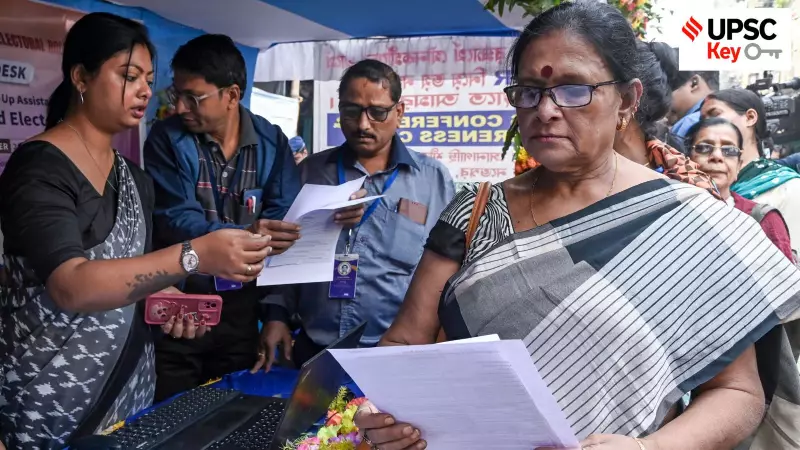
A major focus is on the ongoing Special Intensive Revision (SIR) of electoral rolls and the pivotal role of Electoral Registration Officers (EROs). According to the Representation of the People Act, 1950, EROs are the sole competent authority to issue notices if they doubt an elector's eligibility, including on grounds of citizenship.
However, concerns have been raised in states like West Bengal and Bihar. Reports indicate that during the SIR, notices are being generated centrally through the Election Commission of India's (ECI) software, not by the local EROs themselves. This has led to fears that large-scale, "system-driven" deletions could occur without the ERO's direct involvement, potentially leaving them accountable for actions they did not initiate.

The SIR, aimed at deleting duplicate and illegal voter registrations, is being rolled out across nine states and three Union Territories. This topic is crucial for both Prelims (Current Events, Polity) and Mains (GS II: Salient features of RPA, Constitution).
Separation of Powers: Judiciary vs. Legislature
Another key topic involves the doctrine of separation of powers. The Centre recently argued in the Delhi High Court that any judicial direction to reduce GST on air purifiers from 18% to 5% would violate this constitutional basic structure. The government contended that tax rate decisions fall within the legislative domain of the GST Council, and judicial intervention would "open a Pandora's box."
This highlights the ongoing tension and balance between the three organs of the state—Legislature, Executive, and Judiciary. Understanding this doctrine, its evolution through thinkers like Montesquieu, and its application in the Indian context is vital for Mains (GS II: Separation of powers).
Indus Waters Treaty and Hydel Projects
In the realm of international relations and geography, the Indus Waters Treaty (IWT) remains significant. Following its suspension by India in April 2025 after the Pahalgam terror attack, the government is expediting hydroelectric projects in the Indus basin.
The Environment Ministry's expert panel has recommended clearance for the 260 MW Dulhasti Stage-II project on the Chenab River in Jammu & Kashmir. The panel noted that while the project parameters were planned per the IWT, the treaty is currently suspended. This move is part of a broader push to harness the waters of the western rivers (Indus, Jhelum, Chenab), control of which was largely ceded to Pakistan under the now-suspended treaty. This is relevant for Prelims (Current Events) and Mains (GS I: Physical Geography).
Gujarat Regains 'Tiger State' Status
In environmental news, Gujarat has regained its 'Tiger State' status after 33 years. The National Tiger Conservation Authority (NTCA) confirmed the presence of a tiger in the Ratanmahal Wildlife Sanctuary, including Gujarat in the national Tiger Census. The last confirmed tiger presence was in 1989.
This makes Gujarat the only state to host three big cat species—lion, tiger, and leopard—simultaneously. Topics like Project Tiger, the role of NTCA, and tiger conservation's ecological and economic significance are perennial favorites for the UPSC examination.
The SHANTI Act: Unlocking Nuclear Energy
A major legislative development analyzed is the Sustainable Harnessing and Advancement of Nuclear Energy for Transforming India (SHANTI) Act. Hailed as the most significant nuclear sector reform since 1962, it aims to attract private and foreign investment by restructuring civil nuclear liability.

A key change addresses the contentious Section 17(b) of the 2010 Liability Act, which allowed operators to seek recourse from suppliers. The SHANTI Act aligns India with international norms, limiting supplier liability only to cases specified in contracts or intentional damage. This removes a long-standing hurdle for projects like Kovvada and Jaitapur.
The Act also promotes the development of Small Modular Reactors (SMRs) and is part of India's ambitious target of 100 GW nuclear capacity by 2047. However, the article cautions that ambiguities in defining "sensitive" activities and central government control over pricing could pose challenges. This is critical for Mains (GS II & III: Government Policies, Science & Tech).
Indian Economy: Weathering Global Tariff Storms
The economic analysis for 2025 presents a mixed picture. India entered the year hoping to avoid the worst of US tariff hikes and secure a trade deal. While it now faces the highest effective tariffs into the US, exports showed resilience in November, driven by pharmaceuticals, electronics, and market diversification.
Domestic reforms like GST tweaks, amendments to labour laws, the SHANTI Act, and allowing 100% foreign ownership in insurance have provided buffers. The RBI forecasts GDP growth at 7.3% for FY26. However, uncertainties loom: a widening Current Account Deficit (CAD), potential foreign investment outflows, and the broader impact of global trade tensions and AI on the economy. This comprehensive overview is essential for Mains (GS III: Indian Economy).
The UPSC Key also included snippets on the 100-year history of the CPI and provided answers to previous years' Prelims questions related to the ECI, basic structure doctrine, and the Indus Waters Treaty, offering a well-rounded package for serious aspirants.