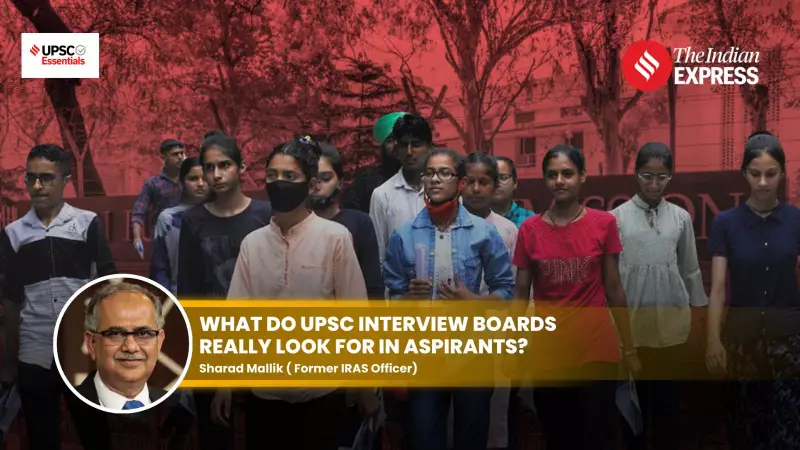
Navigating the UPSC Civil Services Personality Test, often considered the final and most daunting hurdle, requires more than just knowledge. It demands poise, strategic thinking, and emotional intelligence. In an exclusive conversation, retired Indian Railway Accounts Service (IRAS) officer Sharad Mallik, with over three decades of administrative experience, demystifies the process for aspirants, offering invaluable insights drawn from his own journey and extensive mentoring.
Mastering the Mind: Handling Pressure and Unknowns
According to Mallik, the interview board deliberately poses tricky questions not to trick candidates, but to evaluate core administrative traits. "Tricky questions are designed to test your balance of judgment, ability to reason under uncertainty, ethical grounding, and temperament," he explains. His key advice is to avoid extreme positions and embrace moderation.
When faced with a complex, opinion-based query, candidates should take a brief pause and deconstruct the question. For instance, on a topic like 'Should India ban social media?', discuss the context, present a balanced view of pros and cons, and then arrive at a reasoned conclusion. Using phrases like "In my view," or "A balanced approach would be..." demonstrates maturity.

Perhaps the most critical lesson is how to handle ignorance. "Never bluff," Mallik warns emphatically. Experienced board members can easily detect dishonesty, which reflects poorly on ethical values. Instead, a calm and confident admission is far superior. Use dignified statements like, "I'm not aware of the specific fact at the moment," and pivot gracefully to related knowledge you possess. "Honesty is valued more than perfection," he asserts.
The Unspoken Language: Why Body Language is Paramount
Non-verbal communication forms a significant part of the assessment. Mallik breaks down its importance into four key areas: it reflects emotional stability under pressure, signals balanced confidence (not arrogance or nervousness), shows respect and maturity, and reveals authenticity.
The first five seconds upon entering the room are crucial. Candidates should walk in with a positive demeanor, relaxed shoulders, a genuine smile, and a polite greeting. During the interview, maintain a balanced posture—back straight but not stiff—and lean slightly forward while listening to show attentiveness. Natural eye contact, controlled gestures, and a clear, steady voice at a moderate pace are all indicators of composure.
"Listen like an administrator," Mallik advises. This means not interrupting, nodding gently to show understanding, and allowing the speaker to finish. The board often observes listening skills as closely as speaking abilities.
Learning from Experience: A Veteran's Personal Story
Sharad Mallik shares a poignant anecdote from his own interview, held around 40-45 years ago, which serves as a powerful lesson. Hailing from a state then considered backward, he had listed the Indian Foreign Service (IFS) as his first preference and the IAS as his second.
After he confidently answered a question on his state's backwardness, a board member remarked that his IFS preference suggested a desire to "escape abroad" rather than serve his home state. "I lost my composure and argued with the board member, which negatively affected my marks," Mallik recalls. This experience underscores the vital need to stay calm, not take comments personally, and respond with reasoned arguments instead of emotion.
The Final Stretch: Current Affairs and Opinion-Based Answers
In the final weeks before the interview, Mallik recommends prioritizing depth over breadth for selected topics. Focus deeply on major national developments, about 15-20 critical global issues, and governance-related subjects, especially those connected to your Detailed Application Form (DAF) and home state.

For opinion-based questions on governance or society, the mantra is to "think in shades of grey." Start by acknowledging the complexity and multiple viewpoints. Then, crucially, add a practical administrative perspective. Use phrases like, "A feasible administrative solution could be..." to shift the response from mere opinion to policy-oriented thinking. Always avoid extreme positions, political commentary, and blaming institutions.
Sharad Mallik's insights, culminating in the advice to structure answers concisely and maintain grace under pressure, provide a comprehensive blueprint for UPSC aspirants aiming to conquer the personality test. The ultimate goal is to project oneself as an emotionally stable, respectful, and thoughtful future officer.