For aspirants preparing for the Union Public Service Commission (UPSC) Civil Services Examination, staying updated with current events and understanding their syllabus linkage is crucial. The Indian Express UPSC Key for January 4, 2026, curated by Roshni Yadav, dissects several high-impact stories relevant for both the Prelims and Mains stages. This analysis covers the dramatic US capture of Venezuelan President Nicolas Maduro, the return of sacred Buddha Piprahwa relics, environmental concerns over a hydro project in Arunachal Pradesh, a historical anecdote on parliamentary privilege, and new draft rules under the Social Security Code for gig workers.
US Captures Venezuelan President Nicolas Maduro: Global Repercussions
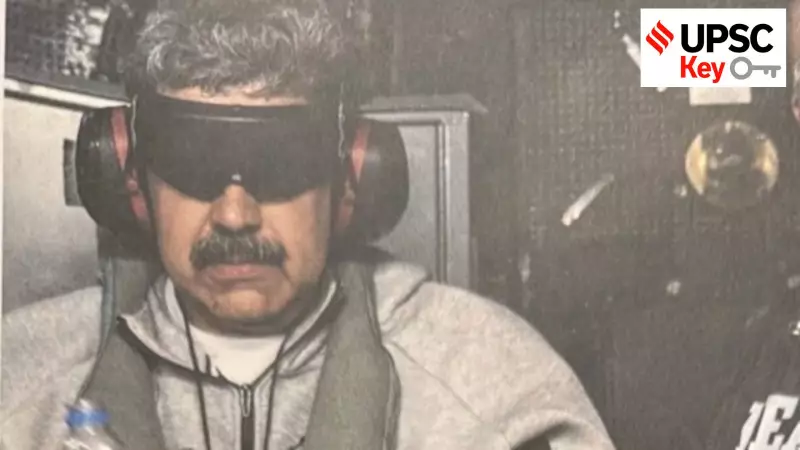
In an unprecedented military operation, the United States forces captured sitting Venezuelan President Nicolás Maduro from a military base in Venezuela and flew him out of the country. US President Donald Trump announced that the US would temporarily run the country and tap into Venezuela's vast oil reserves. Maduro and his wife were transported to New York to face "narco-terrorism" conspiracy charges.
UPSC Syllabus Linkage and Key Points
This event is significant for Prelims (Current Events) and Mains GS-II (International Relations). Aspirants must ponder its implications on global norms.

Key areas for analysis include:
- The concept of narco-terrorism and the public health crisis caused by fentanyl trafficking.
- The principle of non-intervention in international relations and its violation.
- The strategic importance of Venezuela's oil reserves for global energy markets.
- The status of India-Venezuela relations, particularly how US sanctions have drastically reduced bilateral trade, especially in oil imports.
- India's diplomatic dilemma, balancing its call for a rules-based international order with its strategic ties with the US.
This development tests the framework of international law and puts countries like India in a delicate position, weighing strategic partnerships against foundational principles of sovereignty.
Piprahwa Buddha Relics: A Cultural Homecoming
Prime Minister Narendra Modi inaugurated an exposition of the sacred Piprahwa relics in New Delhi, marking their return to India after 125 years. These ancient gem and bone fragments, discovered in 1898 at a stupa in Uttar Pradesh near the India-Nepal border, are directly linked to Lord Buddha and are associated with ancient Kapilavastu.
UPSC Syllabus Linkage and Key Points
This topic is vital for Prelims (Current Events) and Mains GS-I (Indian Culture).
Key areas for analysis include:
- The historical and archaeological significance of the Piprahwa discovery for studies on early Buddhism.
- Core Buddhist doctrines: the Four Noble Truths, Eightfold Path, and the Triratna (Three Gems).
- The architecture and purpose of stupas as relic repositories.
- Government efforts to promote Buddhist heritage, including granting classical language status to Pali and hosting international summits.
The return of these relics, prevented from being auctioned in Hong Kong, underscores India's role as the custodian of a shared global spiritual heritage.
Kalai-II Project & The Endangered White-Bellied Heron
A Union Environment Ministry panel has recommended environmental clearance for the 1,200-MW Kalai-II hydroelectric project on the Lohit River in Arunachal Pradesh. Environmentalists have flagged a critical omission: the project's Environmental Impact Assessment (EIA) report failed to mention the presence of the critically endangered white-bellied heron in the river basin.
UPSC Syllabus Linkage and Key Points
This issue touches Prelims (Environment & Ecology) and Mains GS-II (Governance) & GS-III (Environment).
Key areas for analysis include:

- The flawed Environmental Impact Assessment (EIA) process and its importance in protecting biodiversity.
- Conservation status: The heron is listed under Schedule I of the Wildlife Protection Act and is Critically Endangered on the IUCN Red List.
- The conflict between development (hydropower) and conservation of fragile riverine ecosystems.
- The specific habitat needs of the heron, which depends on free-flowing rivers with rapids for fishing.
This case highlights the ongoing tension between infrastructure development and ecological preservation, questioning the rigor of India's environmental clearance mechanisms.
Parliamentary Privilege: The Case of the MP in a Tent
An opinion piece recounts the 1964 incident of MP Mani Ram Bagri, who avoided arrest by staying on Parliament grounds, leveraging parliamentary privilege. He famously pitched a tent on the lawns after the Speaker allowed him sanctuary, as police could not arrest him within the precincts without the Speaker's permission.
UPSC Syllabus Linkage and Key Points
This is central to Prelims (Polity) and Mains GS-II (Parliament).
Key areas for analysis include:
- Constitutional basis: Article 105 defines parliamentary privileges, though many remain uncodified.
- The distinction between collective and individual privileges.
- The extent and limitations of the privilege from arrest within the parliamentary precincts.
- The role of the Speaker in adjudicating matters of privilege.
This historical example brings to life the abstract concept of parliamentary privileges, demonstrating their practical application and limits.
Social Security Code: New Rules for Gig Workers
The Labour Ministry has published draft rules for the Social Security Code, 2020. A key proposal sets a 90-day annual work threshold with a single aggregator (or 120 days with multiple) as the eligibility criteria for gig and platform workers to access social security benefits.
UPSC Syllabus Linkage and Key Points
This is important for Prelims (Current Events) and Mains GS-II (Social Justice) & GS-III (Economy).
Key areas for analysis include:
- Definition and challenges faced by gig and platform workers in India's informal economy.
- The overarching framework of the four new Labour Codes aimed at simplifying laws and extending social security.
- Potential impacts and criticisms of the 90-day eligibility rule on workers with intermittent engagement.
- The mechanism for registration and data sharing between aggregators and the government portal.
The rules represent a significant step towards formalizing social security for a growing but vulnerable workforce, though the eligibility criteria may exclude some.
Also in News: Quick Prelims Facts
Arctic Virus in Whales: Researchers using drones have detected cetacean morbillivirus in Arctic whales for the first time. This deadly virus causes mass strandings and is transmitted via respiratory droplets.
INSV Kaundinya Voyage: The Indian Navy's 'stitched' ship, modelled on a 5th-century design from Ajanta paintings, began its maiden voyage from Porbandar to Muscat, retracing ancient maritime trade routes.