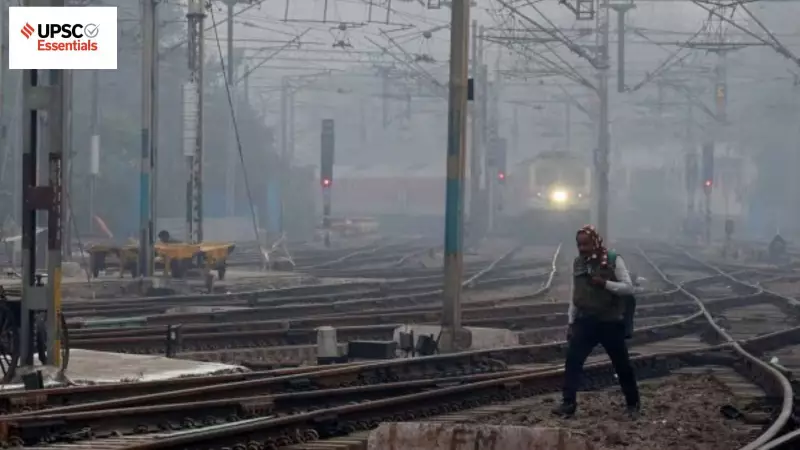
For aspirants preparing for the Civil Services Examination 2026, consistent answer writing practice is paramount. UPSC Essentials presents its weekly initiative focused on Mains answer writing, covering essential static and dynamic topics from the General Studies syllabus. This week's questions for GS Paper 1 delve into two distinct yet crucial areas: the physical geography behind winter fog in North India and the historical geography of Kashmir's influence on Buddhism.
Question 1: Analysing Fog-Induced Transport Disruptions
Relevance: This question tests the candidate's ability to interlink physical geography phenomena with their tangible socio-economic and infrastructural impacts, a key skill for the UPSC Mains.
Introduction: The winter season in North India is synonymous with severe fog, a recurring meteorological challenge that brings travel chaos. This dense blanket of fog drastically reduces visibility, creating significant hurdles for the safe and punctual movement of both aircraft and trains. The operational challenges faced by Indian Railways and airlines highlight a critical intersection of climate and modern infrastructure.

Physical Causes of Dense Winter Fog
The primary type of fog affecting North India is radiation fog. It forms under specific conditions prevalent during winter nights: clear skies, rapid ground cooling, and high moisture levels near the surface. As the ground loses heat quickly, the air close to it cools and condenses the available moisture, forming fog. The situation is exacerbated by stagnant wind conditions, which prevent the dispersal of this condensed moisture, allowing the fog to persist and thicken.
In recent years, the problem has been intensified by anthropogenic smog. High pollution levels, particularly in regions like Delhi, add particulate matter to the fog. This combination creates a denser, more persistent smog-fog mixture that lingers closer to the ground for longer durations, unlike pure fog which dissipates relatively quickly with morning sunlight.
Why Transport Bears the Brunt
The impact on transport operations is disproportionate due to the fundamental reliance on visibility. For aviation, when visibility drops below certain thresholds, airports must implement Low Visibility Procedures (LVP). These involve specialized protocols like Low Visibility Take-Off (LVTO) and landings using the Instrument Landing System (ILS) CAT IIIB. While CAT IIIB allows landings in visibility as low as 50 meters, it requires specially trained pilots and increases the time gap between aircraft movements for safety, reducing the airport's overall capacity and causing cascading delays.
For railways, fog disrupts signaling systems and forces drivers to operate at drastically reduced speeds to ensure safety, leading to widespread schedule delays across the network. The official fog window identified by the DGCA is from December 10 to February 10, during which airlines and airports leverage predictive analytics and AI tools for better forecasting, but complete immunity from disruptions remains elusive.
Question 2: Kashmir's Pivotal Role in Buddhism's Expansion
Relevance: This question connects ancient Indian history with cultural and political geography, exploring how Kashmir acted as a conduit for India's civilisational influence across Asia.
Introduction: While the sacred sites of Lumbini, Bodh Gaya, Sarnath, and Kushinagar form Buddhism's spiritual core, its transformation into a world religion was propelled by intellectual traditions, translations, and institutional support. Kashmir emerged as a critical epicenter for this propagation beyond the Indian subcontinent.
Geographical and Political Catalysts
Geographical Factors: Kashmir's location was its greatest asset. Situated at the crossroads of the Indus-Gandhara region and the Himalayan corridor, it served as a natural bridge connecting the Indian plains to Central Asia, Tibet, and China. This strategic position made it an ideal hub for the exchange of ideas, goods, and missionaries.

Political and Intellectual Patronage: The region's association with Buddhism strengthened under the Mauryan Emperor Ashoka, who is credited with founding Srinagar and building stupas. However, it was during the Kushan Empire, particularly under Emperor Kanishka (c. 127–150 CE), that Kashmir's role became definitive. Tradition holds that Kanishka convened the Fourth Buddhist Council in Kashmir. This council was instrumental in systematizing Mahayana Buddhist philosophy and scriptures, giving doctrinal coherence that facilitated its spread.
Kashmir earned the title Sharada Pitha, a premier seat of learning. Its scholars, like the famed Nagarjuna who developed the Madhyamaka philosophy, engaged in deep analytical and dialectical traditions. The discovery of ancient texts like the Gilgit Manuscripts in the region underscores its role as a custodian of Buddhist knowledge. Monks and scholars from Kashmir travelled along the Silk Road, carrying these refined philosophies to Tibet, China, and other parts of East Asia.
Interestingly, Kashmir's Buddhist legacy subtly permeated its later spiritual landscape, influencing the moderate and compassionate ethos of the Sufi-Rishi movement led by figures like Lal Ded and Sheikh Noor-ud-din Noorani.
Note for Aspirants: The provided points are a thought process to incorporate into your answers. Focus on structuring your response with a clear introduction, a well-argued body with geographical and political sub-points, and a concise conclusion that ties the historical significance to a broader civilisational context.
This answer-writing practice is designed by Nitendra Pal Singh and published on January 3, 2026. Aspirants are encouraged to attempt these questions and share their answers in the comment section for constructive feedback.