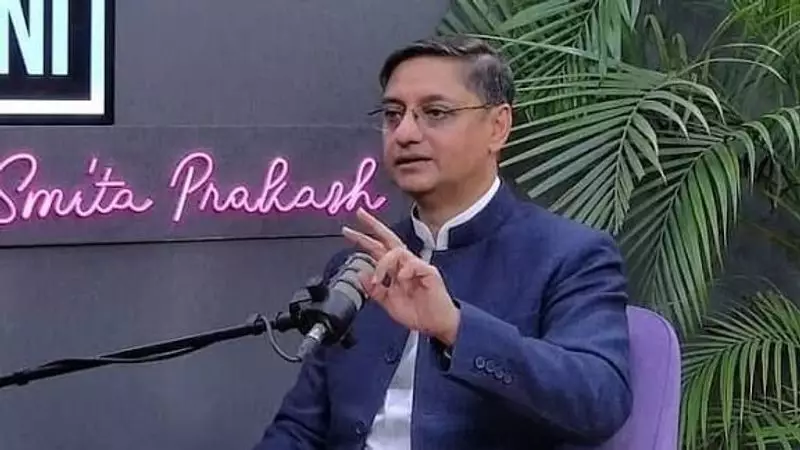
In a provocative statement that has ignited a fresh debate on India's prestigious civil services examination, a key member of Prime Minister Narendra Modi's Economic Advisory Council has called the Union Public Service Commission (UPSC) process a "waste of time" in the current era of Artificial Intelligence (AI). The remarks were made by Sanjeev Sanyal, a prominent economist and the council's member, during a public discussion.
The Core Argument: Rote Learning vs. AI Capabilities
Sanjeev Sanyal articulated his critique by questioning the fundamental premise of the UPSC examination in its present form. He argued that the extensive syllabus, which often requires candidates to memorize vast amounts of information over several years of preparation, is becoming increasingly obsolete. His central point hinges on the rapid advancement of AI tools, which can now access, process, and recall information with far greater speed and accuracy than any human.
The economist suggested that the current system rewards rote memorization and the ability to reproduce information under exam conditions—skills that are directly challenged by modern AI. Instead, he implied, the focus should shift towards evaluating skills that AI cannot easily replicate, such as critical thinking, ethical judgment, leadership, complex problem-solving, and creative innovation. This perspective challenges the decades-old structure of one of the world's toughest competitive exams.

Context and Reaction to the Controversial View
Sanyal's comments were made during an event where he was discussing broader economic and governance reforms. While his remarks were pointed, they are situated within a larger, ongoing conversation about modernizing India's administrative machinery and the methods used to select its officers. The UPSC exam is the gateway to the Indian Administrative Service (IAS), Indian Police Service (IPS), and other central civil services, attracting hundreds of thousands of aspirants annually.
The statement has predictably drawn mixed reactions from various quarters. Supporters of reform argue that Sanyal has highlighted a critical issue. They believe the exam pattern, last overhauled significantly in 2013, needs another review to align with 21st-century demands. They advocate for a process that assesses a candidate's analytical abilities and decision-making skills in dynamic, real-world scenarios rather than static knowledge.
However, many former civil servants, current aspirants, and coaching institutes have defended the examination's rigor and comprehensiveness. They contend that the UPSC process, especially the interview and personality test stages, already evaluates qualities beyond textbook knowledge. They argue that a deep understanding of subjects like history, polity, and economics is essential for informed policy-making and cannot be merely outsourced to an AI tool. For them, the discipline and broad understanding gained through preparation are invaluable for a career in public service.
Implications and the Future of Competitive Exams
This debate touches upon a fundamental question facing education systems and recruitment processes globally: how to assess human potential in an age where machines excel at information retrieval and certain analytical tasks. The discussion initiated by Sanyal is not about eliminating the UPSC but about critically examining its content and methodology.
Potential future shifts could include:

- Greater emphasis on applied knowledge: Scenario-based questions that test application over recall.
- Evolving the interview stage: Designing the personality test to more effectively gauge leadership, ethical grounding, and adaptive thinking.
- Incorporating technology awareness: Evaluating a candidate's understanding of how to leverage tools like AI for governance, rather than testing against them.
Ultimately, Sanjeev Sanyal's comments serve as a catalyst for a necessary conversation. As AI continues to reshape professions, the criteria for selecting the country's top administrators must also evolve. The goal is to ensure that the civil services remain a repository of not just knowledge, but of wisdom, empathy, and innovative leadership—qualities that define effective governance in any era, AI or otherwise.