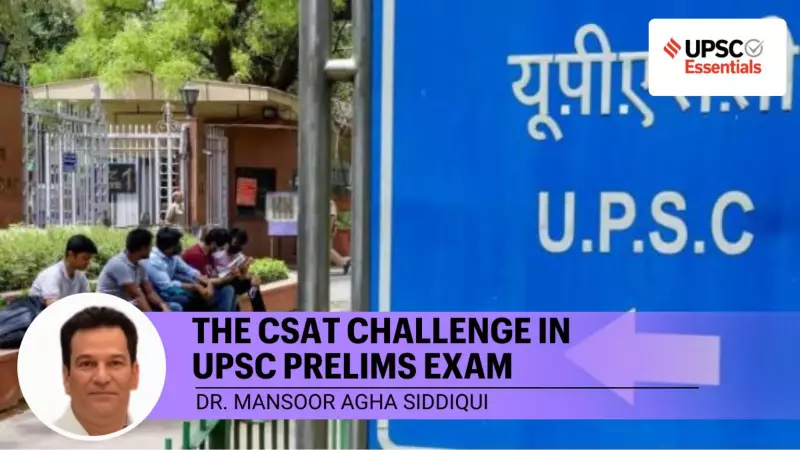
As the January window opens and applications for the UPSC Civil Services Preliminary Examination 2026 loom, a familiar anxiety grips lakhs of aspirants. The focus sharpens on the decisive first stage, where one paper has quietly shaped destinies for over a decade: the Civil Services Aptitude Test (CSAT). Despite being a qualifying paper with a minimum 33% threshold, CSAT continues to derail the ambitions of thousands, often undoing months of rigorous General Studies preparation.
The Core Misconception: Aptitude Test vs. Assessment Test
In an exclusive conversation with UPSC Essentials of The Indian Express, renowned CSAT expert Dr. Mansoor Agha Siddiqui pinpointed the fundamental error in approach. "CSAT will remain challenging as long as aspirants, teachers, and institutes treat it as a school-level assessment test for Mathematics and English," he stated. Dr. Siddiqui, with over three decades of experience mentoring students for exams like GMAT, CAT, GRE, and UPSC, emphasizes a critical distinction.
CSAT is not an assessment test; it is an aptitude test, essentially a modified IQ test designed to evaluate the sharpness, reasoning ability, and specific attitude required for a civil servant. The questions are framed by psychometricians using the language of Mathematics and English, but they are not testing subject prowess. This paradigm shift in understanding is the first step to conquering the paper.

Common Pitfalls That Lead to Unexpected Failure
Dr. Siddiqui outlined the most frequent mistakes that trip up even well-prepared candidates, leading to the estimated 80% of Prelims failures attributed to CSAT.
Firstly, aspirants often neglect CSAT, focusing disproportionately on General Studies, despite its proven make-or-break role.
Secondly, they apply school-exam strategies to an aptitude test. CSAT evaluates decision-making, problem-solving speed, and the ability to decode tricky language, not just rote knowledge.
Thirdly, inadequate practice under simulated exam conditions with Previous Year Questions (PYQs) leaves aspirants unprepared for the actual test environment and its pressures.
Finally, many build mental barriers around foundational Mathematics and English, avoiding the systematic practice needed to master the easy concepts tested in confusing formats.
Strategic Preparation for the Evolving CSAT (2026 Onwards)
Contrary to popular belief, Dr. Siddiqui clarifies that CSAT is not becoming "more analytical" but is increasingly aligning with its true purpose as a psychometric test. Since being made qualifying in 2015, UPSC has ensured its rigour by employing trickier language and testing reasoning in ways far removed from direct school assessments.
For the Comprehension section, which is growing more challenging, he advises a two-pronged approach: build a strong foundation through wide reading to improve vocabulary and grammar, followed by technical mastery. Aspirants must learn to identify and apply specific strategies for the 45 different types of Reading Comprehension questions, including Specific, General, and Perception-based queries.
For aspirants from non-mathematics backgrounds grappling with Quantitative Aptitude, the key is to overcome fear. Basic Numeracy and Data Interpretation test easier Class 10-level concepts but present them in deceptive language. Dr. Siddiqui suggests a focused study plan, noting that topics like Partnership, Pipes and Cisterns, or Algebra have barely been asked and can be safely deprioritized.
The Irreplaceable Role of Previous Year Questions (PYQs)
While no PYQ will be repeated, they remain the most vital diagnostic tool. "After preparing a topic, if you cannot solve related PYQs, it signals that your preparation method needs correction," explains Dr. Siddiqui. They help gauge whether an aspirant has developed the requisite aptitude to crack the questions, not just memorized procedures.

As the countdown to UPSC Prelims 2026 begins, the expert's counsel is clear: respect CSAT as a unique challenge. Move beyond subject-centric coaching, embrace its nature as an intelligence and attitude test, and prepare with targeted strategies. This shift in perspective could be the key to transforming this daunting hurdle into a qualifying gateway.