For aspirants of the Union Public Service Commission (UPSC) Civil Services Examination, staying abreast of current affairs and their analytical dimensions is paramount. The Indian Express UPSC Key for December 31, 2025, distilled crucial developments spanning diplomacy, governance, defence, science, and environment. This analysis provides a comprehensive, rewritten overview of those key topics, essential for both the Preliminary and Main stages of the exam.
Diplomacy in Focus: India at Khaleda Zia's Funeral
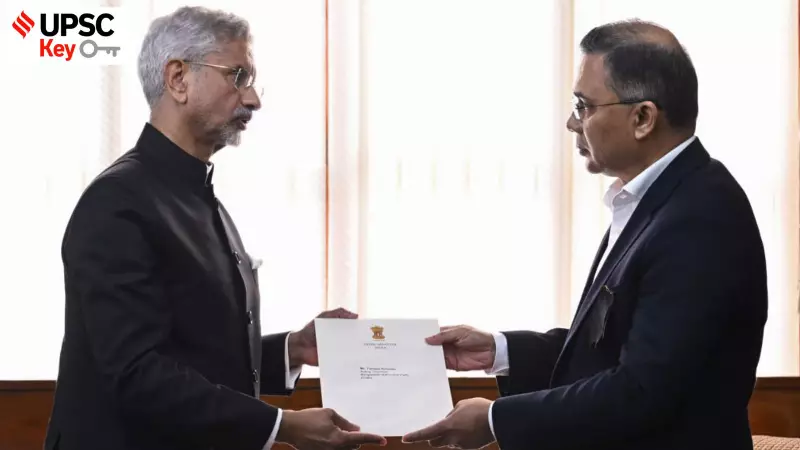
External Affairs Minister S. Jaishankar represented India at the state funeral of Bangladesh's first woman Prime Minister, Khaleda Zia, in Dhaka. In a significant diplomatic gesture, he handed over a personal letter from Prime Minister Narendra Modi to Tarique Rahman, the acting chairman of the Bangladesh Nationalist Party (BNP) and Khaleda Zia's son, conveying the condolences of the people and Government of India.
Khaleda Zia, a three-time prime minister and a dominant figure in Bangladesh's politics for decades, passed away at 80 after a prolonged illness. Her political career was instrumental in restoring parliamentary democracy after military rule and was marked by landmark policies like free primary education and free education for girls up to Class 10.

For UPSC aspirants, this event ties directly to the syllabus. For Prelims, it falls under 'Current events of national and international importance'. For Mains (GS-II), it critically engages with 'India and its neighbourhood- relations'. Key points to ponder include the history of India-Bangladesh bilateral relations, areas of cooperation like water sharing, security, and trade, and persistent challenges. The political transition in Bangladesh, including the 2024 ouster of Sheikh Hasina and the interim government under Nobel laureate Muhammad Yunus, underscores the importance of India's 'Neighbourhood First' policy and the need for consistent diplomatic engagement with a crucial regional partner.
Governance & Policy: Lateral Entry Scheme in Limbo
A key governance reform initiative, the lateral entry scheme for recruiting private sector experts into government, has hit a roadblock. Over a year after the government directed the UPSC to withdraw an advertisement for 45 lateral entry posts, the scheme remains stalled. The Department of Personnel and Training (DoPT) is still in consultations with various ministries.
The scheme, introduced in 2018, aims to bring in domain specialists at the Joint Secretary, Director, and Deputy Secretary levels to infuse fresh expertise into policy-making. While about 63 individuals have been appointed in earlier rounds, the 2024 advertisement was cancelled following backlash, notably from BJP ally Chirag Paswan, over the lack of reservation provisions in the recruitment process.
This topic is vital for GS-II (Governance). Aspirants must understand the concept of lateral entry, its pros and cons for the civil service, the roles of UPSC and DoPT, and the debate around reservation in such appointments. Previous recommendations by the Administrative Reforms Commission (ARC) and NITI Aayog supporting lateral entry add depth to the analysis. The stalemate highlights the complexities of reforming India's entrenched bureaucratic recruitment system.
Science & Environment: The Invisible Threat of Delhi's Air
A startling revelation for environmental policy: a third of Delhi's annual PM2.5 pollution comes from 'secondary aerosols' formed in the atmosphere, not directly emitted. The dominant component is ammonium sulfate, created when sulfur dioxide (SO2) from sources like coal-fired power plants oxidizes and reacts with ammonia from agriculture and other sources.
This scientific insight explains why Delhi's air quality can deteriorate sharply even when local pollution sources like vehicles or dust appear controlled. Humidity and winter conditions accelerate these chemical reactions, allowing gases from hundreds of kilometers away to transform into deadly fine particles over the capital. India's status as the world's largest SO2 emitter, coupled with the government's July 2025 decision to exempt 78% of coal plants from installing mandatory Flue Gas Desulphurization (FGD) systems, has direct implications for this transboundary pollution challenge.

For GS-III (Environment & Science), this is a high-yield topic. It moves beyond listing pollution sources to understanding complex atmospheric chemistry. Aspirants should differentiate between primary and secondary pollutants, grasp the formation process of secondary aerosols, and evaluate policy measures like FGD. The issue connects local environmental health with national energy and industrial policy.
Defence Indigenisation & Quantum Leap
The UPSC Key also highlighted two other significant areas. In defence, Hindustan Aeronautics Limited (HAL) completed the maiden flight of the Dhruv New Generation helicopter, aiming for the civil aviation market with orders from Pawan Hans. Concurrently, the Defence Ministry signed contracts worth Rs 4,666 crore for Close Quarter Battle Carbines and heavyweight torpedoes, underscoring the push under 'Atmanirbhar Bharat'.
In science, an editorial marked 100 years of quantum physics, tracing its journey from Heisenberg's foundational work to modern applications like semiconductors, lasers, and MRI machines. It emphasized the promise of emerging quantum technologies—computing, communication, sensing—and the importance of India's National Quantum Mission with its Rs 6,003.65 crore outlay. This underscores the long-term dividends of investing in basic science, a crucial point for GS-III (Science & Technology).
Strategic Outlook for a Fragmented World
A final key takeaway came from an Ideas Page article analyzing the shifting global order. It argued that the post-Cold War era is ending, replaced by fragmented coalitions and great-power rivalry. For India, the way forward involves strategic flexibility, leveraging its demographic dividend, multi-alignment in foreign policy, and aligning climate action with economic growth. This macro-perspective is essential for Mains answers on international relations (GS-II) and India's economic strategy (GS-III).
In conclusion, the December 31 UPSC Key wove together disparate current events into a coherent tapestry relevant for the aspirant. It demonstrated how a political funeral in Dhaka, a stalled recruitment reform in Delhi, and complex atmospheric chemistry are not isolated news items but interconnected facets of governance, diplomacy, and policy that define the contemporary challenges an Indian civil servant must be prepared to address.