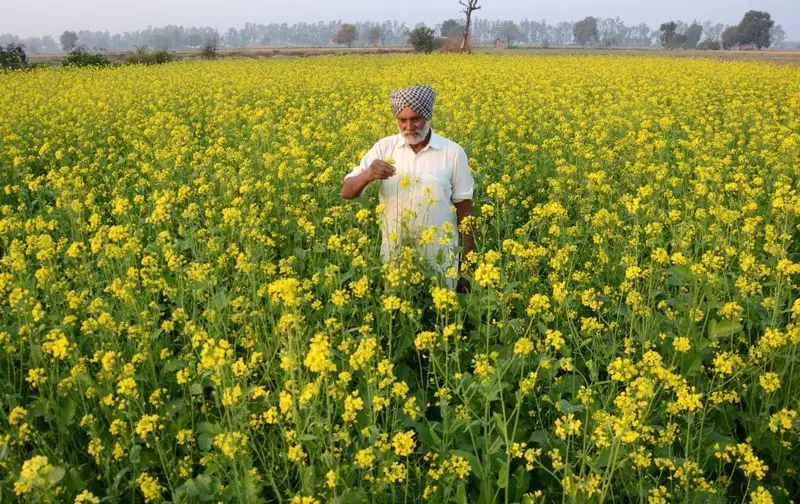
Punjab, India's agricultural heartland, faces a paradoxical situation where a golden opportunity in the form of mustard cultivation is being largely ignored by its farming community. Despite a soaring national demand for edible oils and government pushes for self-sufficiency, farmers in the state are hesitant to sow this oilseed crop. The primary reason is a simple economic calculation: low profitability compared to traditional staples like wheat and paddy.
The Economics of Avoidance: Why Mustard Loses Out
The core of the issue lies in the comparative economics of farming. Data from the 2023-24 season reveals a stark picture. The average yield of rapeseed-mustard in Punjab stands at approximately 11.5 quintals per acre. With a minimum support price (MSP) of ₹5,650 per quintal, the gross income per acre hovers around ₹65,000. However, when farmers deduct the high input costs—including seeds, fertilizers, pesticides, and irrigation—the net profit shrinks dramatically.
In contrast, the assured returns from wheat and paddy, backed by a robust procurement system, present a far less risky proposition. Farmers like Jagseer Singh from Fatehgarh Sahib district articulate this dilemma clearly. He points out that the government's focus on procuring wheat and paddy at MSP creates a safety net absent for mustard. "Unless mustard procurement is ensured at MSP, why would a farmer take the risk?" he questions, echoing a sentiment widespread across the state's agrarian landscape.

Government Efforts and Ground Realities
Recognizing the critical need to reduce India's massive edible oil import bill, which exceeds ₹1.5 lakh crore annually, central and state authorities have initiated schemes to promote oilseeds. The Centre's National Mission on Edible Oils - Oil Palm (NMEO-OP) is one such flagship program. In Punjab, the state government provides a ₹4,000 per acre subsidy to farmers who diversify from paddy to oilseed crops like mustard.
Yet, these incentives seem insufficient to trigger a large-scale shift. The subsidy, while helpful, does not bridge the significant profitability gap. Furthermore, the lack of a dedicated, reliable procurement mechanism for mustard leaves farmers anxious about market fluctuations. The area under mustard cultivation in Punjab, though it saw a slight increase to 39,000 hectares in 2023-24 from 32,000 hectares the previous year, remains a fraction of the state's total cultivable area, highlighting the persistent reluctance.
Agronomic Challenges and the Water Crisis Factor
Beyond economics, agronomic factors also play a role. Mustard is typically sown after the harvest of paddy in October. However, delayed paddy harvesting, often linked to state government directives aimed at conserving groundwater, can push the sowing window past the optimal date of October 25th. Late sowing adversely affects yield, further diminishing the crop's appeal for farmers already wary of its returns.
This ties into Punjab's larger environmental crisis. Promoting water-efficient crops like mustard is crucial for the state's long-term sustainability, given its rapidly depleting water tables. The crop requires significantly less water than paddy. Therefore, the failure to make mustard cultivation attractive is not just an economic loss but a missed opportunity for ecological conservation.
The Path Forward: Need for a Holistic Policy Push
Experts and farmer unions agree that a piecemeal approach will not work. Making mustard cultivation viable in Punjab requires a concerted, multi-pronged strategy. First and foremost is the establishment of a guaranteed procurement system for mustard at MSP, similar to wheat and paddy. This would provide the fundamental risk assurance farmers seek.
Secondly, there is a need for enhanced support. The current subsidy may need to be increased, and coupled with incentives for the adoption of high-yielding, climate-resilient seed varieties. Extension services must be strengthened to educate farmers on best practices to maximize yield. Finally, creating and promoting a local brand for Punjab's mustard oil could add value and improve marketability.

The stakes are high. With India importing over 60% of its edible oil needs, domestic production of oilseeds like mustard is a national priority. Punjab, with its fertile land and skilled farmers, has the potential to be a major contributor to this mission. However, unlocking this golden mustard opportunity hinges on making the crop financially golden for the farmer. Until the profit equation changes, the fields of Punjab will continue to crave the yellow bloom of mustard, while farmers stick to their familiar green of paddy and wheat.