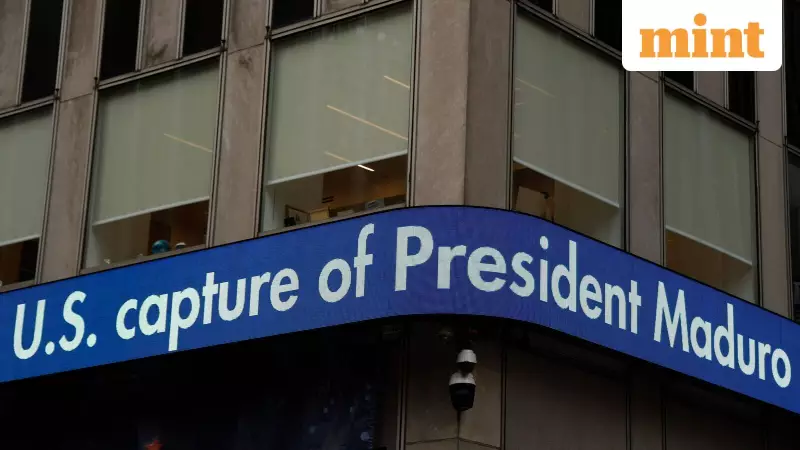
A potential takeover or restructuring of Venezuela's oil industry under US direction could deliver significant strategic and financial benefits to India, according to industry analysts and sources. The move is seen as a chance to unlock close to USD 1 billion in long-pending dues owed to India's flagship overseas producer, ONGC Videsh Ltd (OVL), while also accelerating the revival of crude production from Indian-operated fields in the sanctions-hit nation.
India's Stakes and Stalled Assets in Venezuela
India was once a major buyer of Venezuelan heavy crude, with imports peaking at over 400,000 barrels per day. This trade was abruptly halted in 2020 due to sweeping US sanctions and associated compliance risks. OVL, the overseas arm of India's Oil and Natural Gas Corporation (ONGC), holds a 40 per cent stake in the San Cristobal oilfield in eastern Venezuela, which it operates jointly with the state-owned Petroleos de Venezuela SA (PdVSA).
However, US restrictions have severely crippled operations by blocking access to vital technology, equipment, and services. Consequently, output has plummeted to a mere 5,000-10,000 barrels per day from a potential of 80,000-100,000 bpd. Financially, Venezuela owes OVL approximately USD 536 million in unpaid dividends up to 2014, plus a nearly equivalent amount for subsequent years where audits have been blocked, effectively freezing the settlement.

Pathway to Revival and Debt Recovery
Analysts suggest that a dramatic US operation leading to oversight of Venezuela's vast oil reserves could pave the way for easing sanctions. Officials familiar with the matter state that once sanctions are relaxed, OVL could swiftly deploy rigs and equipment from its parent ONGC's fields in Gujarat to the San Cristobal field to boost production. The onshore field has the capacity to produce 80,000-100,000 barrels per day with adequate investment.
More crucially, US control could restart Venezuelan oil exports to global markets. OVL could then recoup its past dues of around USD 1 billion from the revenues generated by these renewed exports. OVL had previously sought a specific sanctions waiver similar to the one granted to US giant Chevron, which could now become feasible.
Broader Opportunities for Indian Energy Security
The realignment extends beyond San Cristobal. India has interests in another major heavy oilfield, Carabobo-1, where OVL holds an 11 per cent stake, and Indian Oil Corporation (IOC) and Oil India Ltd (OIL) hold 3.5 per cent each. Analysts believe Indian firms could take on more fields and revive production, especially if PdVSA undergoes restructuring under US influence.
For India, the world's third-largest oil importer, renewed access to Venezuelan crude offers a strategic alternative. Nikhil Dubey, Senior Research Analyst at Kpler, noted that if sanctions ease, trade could resume rapidly, allowing "Venezuelan barrels to again return to Indian refineries." This aligns with India's active efforts to diversify its crude basket, reducing dependence on Russian oil and Middle Eastern supplies while mitigating geopolitical risks.
Major Indian refiners like Reliance Industries, Nayara Energy, IOC, HPCL-Mittal Energy, and Mangalore Refinery possess the complex configurations needed to process Venezuelan heavy crude efficiently. Before sanctions crippled exports in 2019, Venezuela shipped 707 million barrels annually, with India and China accounting for 35 per cent of the total.
Geopolitical Reshuffle and Market Impact
The US move is viewed as part of a broader strategy to decouple its economy and secure energy independence, potentially reducing reliance on OPEC producers like Saudi Arabia. For the global oil market, a US-directed overhaul bringing capital and technology could significantly lift Venezuelan production within a year, adding supply and promoting price stability, albeit within a band that protects US shale economics.

Geopolitically, a US-dominated oil sector in Venezuela would dilute China's current leverage, which enjoys priority access through debt-repayment deals. Any renegotiation of these arrangements could open the door for India to secure long-term supply contracts. While challenges like legal disputes and infrastructure decay remain, analysts argue these are manageable under a US-backed framework, presenting a clear opportunity for India to recover assets and enhance its energy security.