Indian Textile Exporters Sound Alarm Over US Tariffs, Warn of Job Losses and Market Erosion
In a stark warning to the government, Indian apparel exporters have stated that continued US tariffs in the absence of a trade agreement could inflict permanent damage to India's market share and lead to significant job losses. The industry, having already absorbed substantial shocks, claims it has no further capacity to withstand additional pressure.
Tiruppur Cluster Bears the Brunt of US Market Dependence
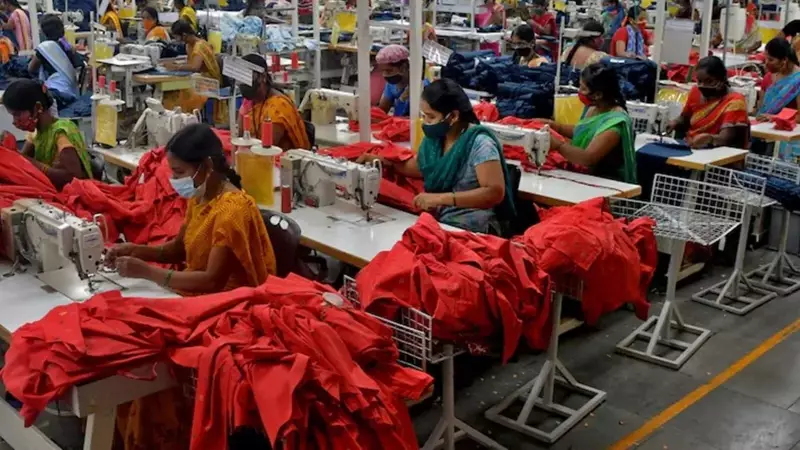
The Tiruppur textile hub in Tamil Nadu, which exports garments worth nearly Rs 14,000 crore to the United States annually, is identified as the hardest-hit region due to its heavy reliance on the American market. In a letter addressed to Vice President C P Radhakrishnan, the Apparel Export Promotion Council (AEPC) highlighted the severe disruption caused by recent US actions imposing 25 per cent tariffs and an additional 25 per cent oil-related penalty on imports.
"Without immediate resolution, the sector faces order stoppages, job losses, and permanent loss of market share," the AEPC cautioned. The council emphasized that the US is India's largest single export market for textiles, making the situation particularly critical.

Buyer Hesitation and Commercial Impossibility of Further Absorption
Exporters report that the threat of prolonged or additional tariffs has led US buyers to withhold or cancel new orders, as they are unwilling to risk mid-cycle tariff escalations. "Even with 25 per cent discounts, further tariff absorption is commercially impossible, and passing costs to buyers is not viable," the letter stated.
The industry has already taken significant losses in the national interest to protect exports and employment, leaving no buffer for further shocks. The exporters warned that a delay of even 3-6 months could result in permanent damage to this strategic export sector.
Market Diversification Not a Short-Term Solution
Seeking immediate governmental support, the apparel exporters clarified that market diversification is not a feasible short-term option. Textile sourcing is deeply embedded in long-term buyer supply chains, and developing alternative markets requires 2-3 years for processes such as buyer onboarding, compliance audits, and volume scaling.
"Abrupt loss of the US market will lead to permanent customer displacement and allow competitor nations with preferential access to replace India," the AEPC noted, urging interim protective measures for textile exports while trade negotiations continue.
Stalled Negotiations and Shifting Orders to Competitors
As reported earlier, negotiations between Indian apparel manufacturers and US importers for summer orders worth approximately $2 billion have stalled due to uncertainty surrounding the trade deal. Consequently, orders have begun migrating to competitors like Bangladesh, Vietnam, and China, which face lower tariffs compared to the 50 per cent imposed on India.
This development is significant given that India exported $10.3 billion of textiles and apparel (T&A) to the US in 2024, with T&A accounting for 8.21 per cent of India's global exports in 2023-24.
Research Highlights Severe Impact of Tariffs
An Indian Institute of Foreign Trade (IIFT) research report authored by Professor Sunitha Raju projects that a 50 per cent tariff on India would result in a $6.6 billion or 67.8 per cent decline in US import demand for Indian T&A. The negative effect is most pronounced for:
- Fibre: -95.8 per cent
- Yarn: -87.5 per cent
- Fabrics: -82.9 per cent
In absolute terms, made-ups and apparel would account for a $5.7 billion or 85 per cent fall in T&A exports to the US. With a 25 per cent tariff, the negative demand effect is estimated at $2.1 billion, translating to a 21.6 per cent drop in imports across product groups.

Competitive Disadvantage and Sectoral Vulnerabilities
The report further indicates that India's higher tariffs relative to competitors like China, Vietnam, and Bangladesh will lead to significant market share gains for these nations in apparel, and for Pakistan, Mexico, and China in made-ups. These tariff differentials are adversely reshaping the competitive landscape in the US market.
Despite the coexistence of small and large firms in the textile industry, exports are dominated by larger entities. However, the impact of US tariff shocks affects all producers and is transmitted through domestic suppliers, with nearly 70 per cent of sectoral value derived from intermediate inputs. First-order indirect effects are substantial, totaling $4.6 billion, including $1.4 billion within the textile sector itself.
Government Measures and Sector Characteristics
The apparel and textile supply chain is largely domestic, with about 90 per cent of inputs sourced locally, underscoring the labour-intensive nature of the sector. In response to the crisis, the government has implemented several supportive measures, including:
- Easing duties on key raw materials like cotton.
- Revoking quality control orders affecting the textile supply chain.
- Addressing MSMEs' access to input materials.
Nevertheless, exporters stress that without a swift resolution to the tariff issue, these efforts may be insufficient to prevent long-term damage to one of India's key export sectors.