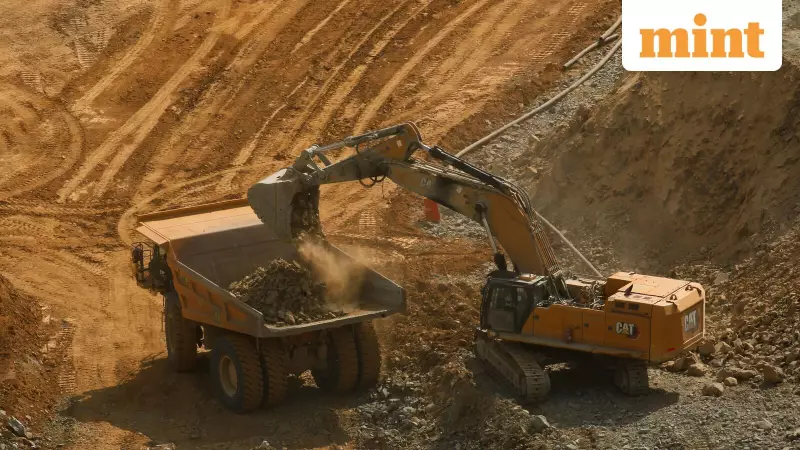
The recent US-led military action to oust Venezuelan President Nicolás Maduro is not solely about controlling global oil flows. A deeper, more strategic motive lies beneath the surface: securing the critical minerals essential for the United States' dominance in the artificial intelligence race.
The AI Imperative and the Mineral Crunch
While the United States possesses abundant oil reserves, it faces a significant shortfall in the raw materials needed to power its AI ambitions. Throughout 2025, the US government has taken direct steps to intervene in sectors crucial for AI leadership, as noted by Bank of America analysts. A pivotal move came in July 2025, when the Department of War awarded a $900 million package to rare-earths producer MP Materials. This funding aims to build a new domestic magnet-manufacturing facility and expand the company's mining and processing operations.
This push for mineral security gained extreme urgency after China, which controls roughly 85% of global processing capacity, imposed restrictions on rare earth exports last year. This vulnerability has prompted the US to look towards resource-rich regions, including Greenland and South America, to build a resilient supply chain free from Chinese dominance.

Venezuela: A Rusty Treasure Chest?
In this context, Venezuela entered the strategic calculus. Commerce Secretary Howard Lutnick recently highlighted the country's "great mining history that’s gone rusty," pointing to its reserves of steel and critical minerals. However, experts caution that Venezuela's mineral wealth may be more challenging to harness than it appears.
Mining strategist Christopher Ecclestone of Hallgarten & Company notes that, apart from gold, Venezuela's confirmed minerals like nickel, bauxite (for aluminum), and coltan (for electronics) are relatively cheap. Their value pales compared to the copper, lithium, or tin found in neighbors like Chile and Brazil. Furthermore, the primary mineral deposits are located in the remote, jungle-covered Orinoco Mining Arc, an area largely controlled by illicit networks and armed groups, making any foreign investment highly risky with no guaranteed returns.
"If you think you’re going to find a pot of gold or the pot of rare earths at the end of the rainbow, you could spend a lot of time roaming around in the jungle," Ecclestone warned.
The Broader South American Prize
The action in Venezuela signals a broader US strategy to re-establish influence across Latin America and displace China from the region. According to Jack Lifton, co-chair of the Critical Minerals Institute, an administration focused on controlling trade cannot ignore South America, which is "loaded with critical materials and minerals and metals."
The continent is indeed a treasure trove. Brazil is a major iron ore source and has vast, underdeveloped rare earth deposits. Bolivia and Argentina are rich in lithium, while Peru and Chile operate a significant portion of the world's copper mines. The surge in copper and lithium prices has already boosted Chile's equity market, with shares of giant Sociedad Quimica y Minera de Chile (SQM) soaring nearly 90% in the past year.
HSBC strategists believe Chilean equities will continue to benefit from rising lithium and copper prices in 2026. For value, they point to miners like Freeport-McMoRan and Hudbay Minerals, which have major projects in Peru and are expanding in Chile. FactSet polls project strong earnings growth for both companies by the end of 2026.
Investment Avenues Beyond the Mines
Lifton suggests that turning a profit in pure mining is tough, and investors might find better opportunities in companies further down the processing chain. While many innovative domestic refiners like Gadolyn and Phoenix Tailings are private, public pure-play options exist, such as MP Materials and USA Rare Earth. Government backing has made MP Materials a market darling, with its stock more than tripling in 12 months. All 16 analysts covering the stock rate it a Buy, with a mean target price suggesting a nearly 30% upside.

While Venezuela's mineral industry might prove to be fool's gold for investors, the rest of Latin America holds the potential to be the golden goose, offering the critical resources to fuel the next phase of technological supremacy.