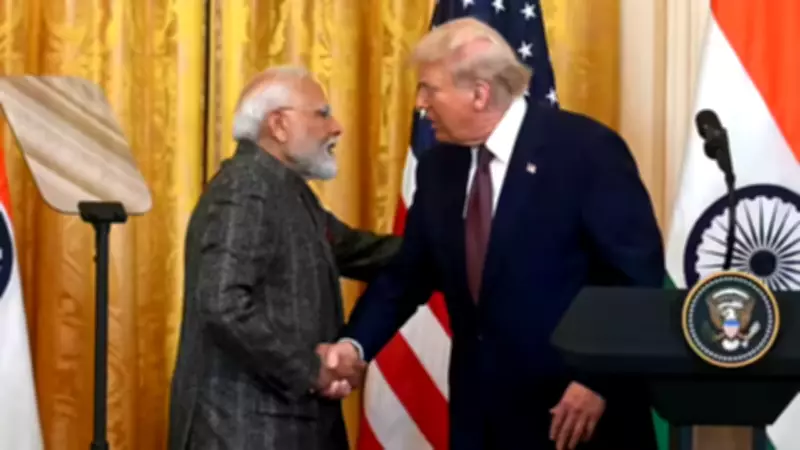
In a significant development for international commerce, US President Donald Trump announced a comprehensive trade agreement with India on Monday. This announcement comes after months of complex negotiations and follows Washington's imposition of steep tariffs of up to 50 percent on Indian goods, including penalties linked to New Delhi's purchase of Russian crude oil.
Announcement and Key Provisions
President Trump revealed the agreement on his social media platform Truth Social, stating that the United States would reduce reciprocal tariffs on Indian exports to 18 percent from the previous 25 percent. He further claimed that India had agreed to lower tariffs on US goods and halt imports of Russian oil as part of the arrangement.
Prime Minister Narendra Modi acknowledged the tariff reduction, describing it as a substantial boost for "Made in India" products. However, New Delhi has not officially commented on the oil-related assertions made by the US president, leaving some aspects of the deal open to interpretation.

Negotiation Timeline: Key Moments
The Ambition Is Set (February 13, 2025)
Prime Minister Narendra Modi and US President Donald Trump agreed to deepen bilateral trade ties, setting an ambitious target of more than doubling trade to $500 billion by 2030. Both sides announced plans to negotiate the first phase of a multi-sector Bilateral Trade Agreement by fall 2025, laying the groundwork for future discussions.
Negotiations Begin — Then Stall (March–April 2025)
Commerce Minister Piyush Goyal made multiple visits to Washington, engaging with US Trade Representative Jamieson Greer and Commerce Secretary Howard Lutnick. However, on April 2, Trump imposed a 26 percent import duty on Indian goods, which jolted the talks. Although this tariff was suspended for 90 days on April 9, uncertainty continued to linger over the negotiations.
Formal Talks Progress (April–June 2025)
India's chief negotiator Rajesh Agrawal led delegations to Washington, while a US team headed by Additional USTR Brendan Lynch visited India. Negotiators agreed on the framework of talks spanning 19 chapters, including critical areas such as tariffs, market access, digital trade, and regulatory barriers.
Deadline Pressure (June 2025)
With the July 9 tariff deadline approaching, India sent another delegation to Washington to bridge remaining differences. Days later, Trump publicly stated that the US was headed towards a "very big" trade deal with India, signaling strong political intent even as technical differences persisted.
Tariff Escalation (July–August 2025)
On July 31, the US announced a 25 percent duty on Indian goods, followed days later by an additional 25 percent penalty tariff linked to India's continued purchase of Russian oil. This escalation raised tariffs on most Indian exports to 50 percent, sharply increasing the stakes and urgency for both nations.
Backchannel Push to Salvage Talks (September–December 2025)
After months of escalation, negotiators returned to the table with renewed determination. USTR officials visited India in September, followed by high-level engagements in New York and Washington. By December, six formal rounds of talks had been completed, with Deputy USTR Rick Switzer leading a delegation to New Delhi to finalize details.
The Deal Is Sealed (February 2026)
In January, both sides signaled growing momentum, with Commerce Minister Piyush Goyal stating that India was working diligently to close what he termed the "father of all deals." On February 2, following a crucial phone call with Prime Minister Modi, President Trump announced that Washington would reduce the reciprocal tariff on Indian goods to 18 percent, effectively sealing the agreement and marking a new chapter in US-India trade relations.