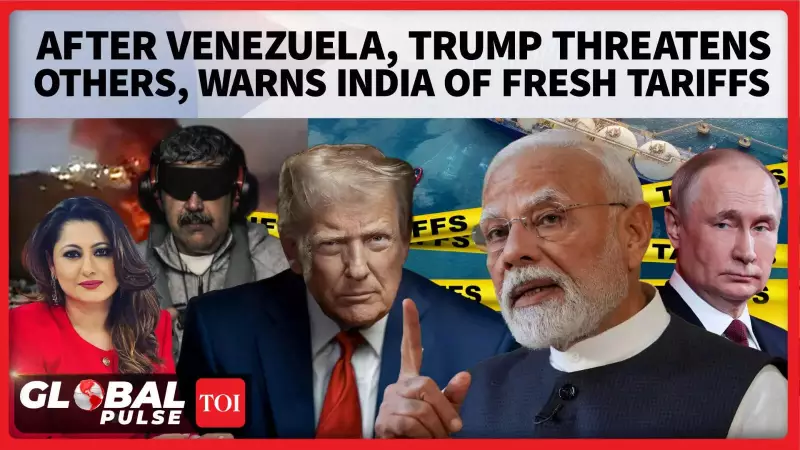
The new year of 2026 has opened with a dramatic and aggressive foreign policy stance from the United States, with direct implications for India. President Donald Trump, following a bold military action in Venezuela, has now turned his attention to trade, issuing a fresh tariff threat against New Delhi.
From Caracas to New Delhi: A Cascade of Warnings
Donald Trump began 2026 on a belligerent note by authorizing an operation that led to the capture of Venezuelan President Nicolas Maduro. However, the Republican leader signaled he was far from done. The U.S. President has extended threats to several other nations, including Cuba, Colombia, Mexico, and even Greenland.
Significantly, his warnings were not confined to the Caribbean and Latin American region. In a move that dashes hopes for a warmer bilateral chapter, Trump explicitly threatened India with new import tariffs. He stated that Washington could impose these fresh trade barriers, adding that Indian Prime Minister Narendra Modi was aware of his dissatisfaction.

The Diplomatic Backchannel and Senator's Claim
The tension was further highlighted by U.S. Senator Lindsey Graham, who made a notable claim regarding diplomatic efforts to ease the situation. Graham asserted that India's envoy to the United States, Vinay Kwatra, had personally requested President Trump for relief from the existing tariff structure.
This revelation points to behind-the-scenes anxiety in New Delhi regarding the potential economic impact of Trump's protectionist policies. The threat comes at a time when both nations, often called the world's two largest democracies, have been navigating a complex trade relationship.
Broader Implications for Global Stability
The sequence of events—starting with the capture of a sitting head of state and followed by economic threats against allies and partners—marks a significant escalation in Trump's approach to international affairs. The warning to India is particularly striking, as it targets a major strategic partner in the Indo-Pacific.
Analysts suggest that this combative posture could lead to increased global instability and force nations like India to recalibrate their economic and diplomatic strategies. The direct mention of PM Modi knowing about Trump's unhappiness indicates that trade friction is a persistent and unresolved issue on the bilateral agenda.
As the situation develops, the international community is watching closely to see if these threats materialize into concrete policy actions, potentially triggering a new wave of trade disputes and geopolitical realignments in 2026.