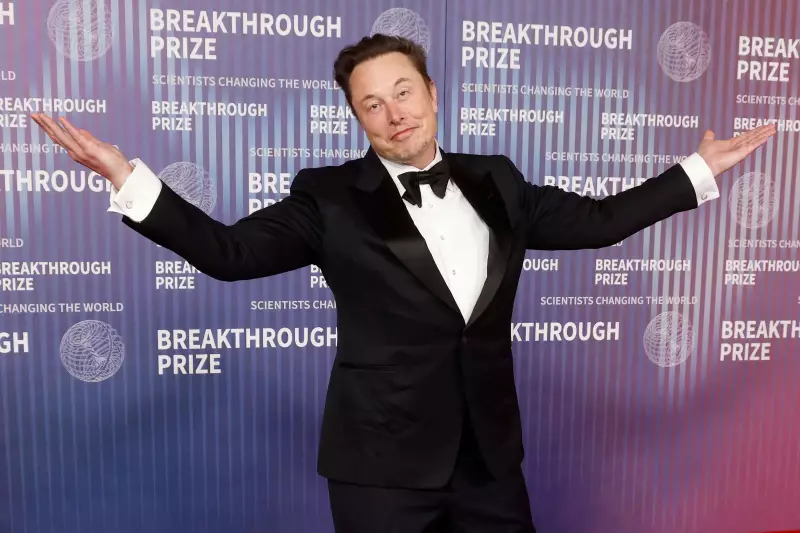
In a stark warning that has sent ripples through the tech and energy sectors, Tesla and SpaceX CEO Elon Musk has highlighted a growing crisis in America's energy infrastructure. He labelled the United States' lagging power generation capacity a "major competitive disadvantage" on the global stage, particularly as China accelerates ahead in what is being termed the global power race.
The Staggering Numbers Behind the Energy Gap
The alarm was raised by Musk in response to a detailed analysis by market expert Adam Kobeissi on December 19. The data reveals a startling disparity: China currently commands a massive 3.75 terawatts of power generation capacity. This figure is nearly three times the United States' capacity, which stands at approximately 1.30 terawatts.
This gap is not a static one. Over the past eight years, China has managed to double its power generation capabilities, while growth in the US has remained relatively flat. The scale of China's expansion in 2024 alone is monumental, with the addition of 429 gigawatts of new capacity. To put that in perspective, this is equivalent to adding the entire power infrastructure of multiple countries in a single year. Impressively, wind and solar energy constituted 83% of these new additions, showcasing a committed push towards renewables.

Beyond Renewables: China's Nuclear Dominance and US Stagnation
The energy race extends far beyond solar and wind. China is pursuing an aggressive strategy to bolster its nuclear power infrastructure, a move that further widens the gap. Currently, 34 nuclear reactors are under construction in China—a number greater than the next nine countries combined. Plans are also in place for nearly 200 additional reactors in the future.
The situation in the United States presents a sharp contrast. The US has no large commercial nuclear reactors under construction. This lack of investment in base-load, clean energy raises serious concerns about America's ability to meet the skyrocketing power demands of future technologies, particularly the energy-hungry data centers required for artificial intelligence (AI) development.
Direct Impact on the Future of AI and Technology
The consequences of this energy capacity gap are immediate and severe for technological supremacy. Advanced AI development is critically dependent on abundant, reliable, and affordable electricity to run vast computing clusters and data centers. Financial giants like Goldman Sachs have previously warned that limitations of the US power grid could severely restrict AI growth, a prediction that now seems increasingly prescient.
Research indicates that power demand from US data centers is rising at a pace the current grid cannot sustainably handle, with transmission bottlenecks remaining a persistent issue. Meanwhile, China's rapid grid expansion and massive investments—Morgan Stanley estimates over $80 billion in 2024 alone, heading towards $560 billion by 2030—are providing it with a strategic edge to support large-scale AI development and advanced manufacturing.
Elon Musk also took a moment to acknowledge China's progress, stating, "Incredible progress by China in solar power! America needs to do the same." His comments reflect a growing unease among technology leaders about the US falling behind in a fundamental area that underpins all future innovation.
The message is clear: in the race to define the next century of technology, energy infrastructure is not just a supporting player—it is the foundational battlefield. Without a significant and urgent overhaul, America risks ceding its competitive advantage in AI, manufacturing, and technological innovation to a rival that has made power generation a national priority.