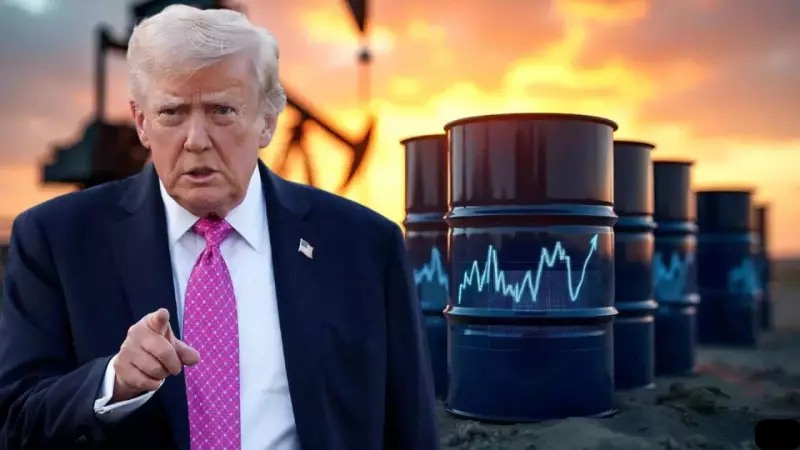
India is observing the escalating geopolitical developments in Venezuela with a cautious and concerned eye. The potential for the United States to take control of the oil-rich nation's vast reserves has raised critical questions about global supply stability, price volatility, and long-term energy security for major importers like India.
Trump's Bold Move and Venezuela's Oil Prize
Driving the latest wave of uncertainty, former US President Donald Trump stated on a Saturday that the United States intends to take temporary control of Venezuela. He announced plans to tap the country's enormous oil reserves for sale internationally. While designating cabinet members to oversee the operation, Trump offered scant details but made a startling suggestion about potential military deployment, asserting Washington was "not afraid of boots on the ground."
This move has revived long-held expectations that Venezuela's oil sector, home to the world's largest proven crude reserves, might finally open up after years of economic isolation and plummeting production. A report by the Global Trade Research Initiative (GTRI) underscores the strategic prize: Venezuela holds about 18% of the world's oil reserves, more than Saudi Arabia (~16%), Russia (~5-6%), or the United States (~4%). In fact, its reserves surpass the combined total of the US and Russia.

Trump outlined a vision where large US oil companies would invest billions to repair the country's broken infrastructure, leading to the sale of "large amounts of oil." However, analysts from Reuters temper this optimism, pointing out that Venezuela is unlikely to see a meaningful production boost for years. Political instability, sanctions uncertainty, decaying infrastructure, and legal risks continue to deter the large-scale capital inflow needed for a revival.
Why Reviving Venezuelan Oil is a Daunting Task
The decline of Venezuela's oil industry is structural, not a temporary slump. Output has collapsed over two decades due to nationalization, chronic underinvestment, and the hollowing out of its state oil company, PDVSA. Critical infrastructure in the prolific Orinoco Belt is severely degraded, skilled workers have fled, and essential supply chains are broken.
Energy strategist Thomas O'Donnell told Reuters that a peaceful transition could lead to a significant production ramp-up in five to seven years. However, he warned of significant risks, including armed resistance, a prolonged political transition, and the perception of US dominance, which could delay investment decisions well into the future.
Currently, Chevron is the only American major operating in Venezuela under specific sanctions waivers, exporting roughly 150,000 barrels per day. Experts like Francisco Monaldi from Rice University suggest Chevron is best positioned to benefit from any opening, while others, like ConocoPhillips—which is owed over $10 billion from past expropriations—would proceed with caution. History offers a sobering lesson, as noted by Ed Hirs of the University of Houston: past US-backed regime changes in oil-rich states have often yielded zero tangible oil benefits for American companies.
India's Insulated Position: A Strategic Analysis
For India, the key transmission channel from this crisis is global crude prices, not direct imports from Venezuela. Fortunately, India's direct exposure has become marginal. According to the GTRI report, India's crude imports from Venezuela collapsed by 81.3% in FY2025 to just $255.3 million, down from $1.4 billion the previous year. Total bilateral trade is minimal, with exports led by pharmaceuticals at a modest $95.3 million.
This is a stark contrast to the 2000s and early 2010s when India was a major buyer of Venezuelan heavy crude and companies like ONGC Videsh held stakes in the Orinoco Belt. US sanctions post-2019 forced India to drastically cut imports to avoid secondary penalties, effectively severing major energy ties.
Three main factors currently shield India's economy and energy security:

- Low Trade Base: With bilateral trade already negligible, disruptions in Venezuela have little material effect on India's import basket.
- Diversified Sourcing: India has successfully diversified its crude supplies across the Middle East, Russia, the US, and Africa, reducing dependence on any single producer.
- Price Transmission, Not Volume: Any impact would come indirectly via global prices, which are more sensitive to OPEC+ decisions and Middle East tensions than Venezuelan politics.
The GTRI concludes that "given the low trade volumes, existing sanctions constraints, and the large geographical distance, the current developments in Venezuela are not expected to have any meaningful impact on India’s economy or energy security."
Nevertheless, the Venezuela episode highlights a hardening global energy geopolitics landscape, where access to resources increasingly dictates actions. For India, it reinforces the paramount importance of strategic autonomy—securing energy and critical mineral needs without becoming entangled in or vulnerable to great-power rivalries.