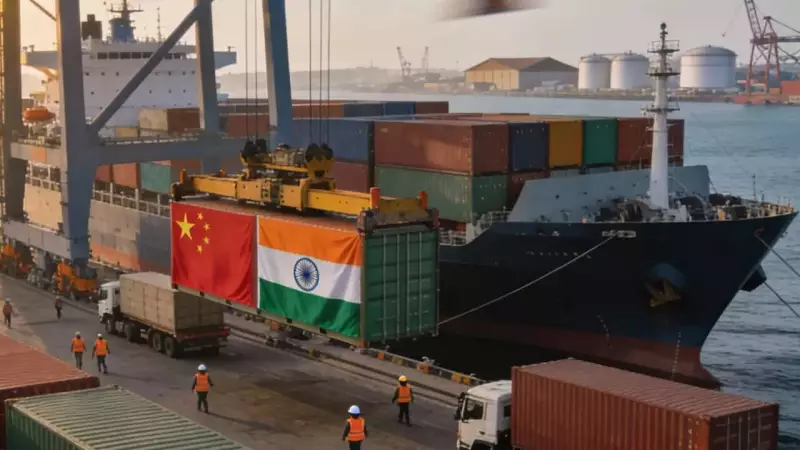
India's exports to China witnessed a dramatic surge of 90% year-on-year in November 2025, reaching $2.2 billion, according to the latest data. However, a new report from the Global Trade Research Initiative (GTRI) cautions that this sharp spike masks the underlying volatility and a deepening trade imbalance that is set to reach a worrying new record.
The Spike in Exports: Concentrated and Volatile
The impressive headline number for November is part of a broader trend, with exports from April to November growing by 33% to $12.2 billion, up from $9.2 billion in the same period last year. Despite this growth, the GTRI analysis strikes a note of caution, stating that India’s trade relationship with China is marked by sharp contrasts.
The export growth is not broad-based, according to GTRI. It is heavily concentrated in a few products rather than spread across India's traditional export basket. The primary driver is naphtha, a petrochemical feedstock, whose exports skyrocketed by 512% in October alone. From April to October, naphtha exports rose 172%, contributing a massive $1.4 billion due to strong Chinese demand.

Certain electronics items also showed unusual surges. Exports of printed circuit boards exploded by 8,577% year-on-year in October to $296.5 million. Shipments from April to October rose over 2,000% to $418 million. Exports of mobile phone components also grew by 82% to $362 million, which is notable given India's heavy reliance on importing these very components from China.
In stark contrast, exports of iron ore continued to decline, falling by 30% from April to October, while shrimp exports saw only modest growth.
The Devil in the Details: Erratic Export Patterns
The GTRI report highlights the extreme year-to-year fluctuations in India's top three exports to China—naphtha, iron ore, and shrimps—indicating a lack of a stable export strategy.
Naphtha exports rose from $1.83 billion in FY2022 to $1.91 billion in FY2023, then plunged to about $1.26 billion in FY2024 and remained flat in FY2025. Iron ore exports were even more erratic, dropping from $2.49 billion in FY2022 to $1.40 billion in FY2023, soaring to $3.64 billion in FY2024, before falling again to $1.89 billion in FY2025.
Shrimp exports, while relatively more stable, still varied from $823 million in FY2022 to $924 million in FY2023, then down to $798 million in FY2024 and $773 million in FY2025.
"This uneven pattern shows that India’s key exports to China lack consistency and largely rise or fall with shifts in Chinese demand, prices and policy," the GTRI analysis states, noting it does not reflect sustained market access or diversification.
Mounting Imports and a Soaring Trade Deficit
While exports show volatile spikes, India's imports from China are massive, concentrated, and steadily rising. Nearly 80% of imports fall into four categories: electronics, machinery, plastics, and organic chemicals.
From January to October 2025, electronics imports led at $38 billion, including mobile phone components ($8.6 billion) and integrated circuits ($6.2 billion). Machinery imports stood at $25.9 billion, organic chemicals at $11.5 billion, and plastics at $6.3 billion. This reliance on Chinese capital goods, intermediates, and components is difficult to substitute quickly.
This dynamic has led to a ballooning trade deficit. India's exports to China have stagnated, falling from $23.0 billion in 2021 to around $15-17 billion in recent years. Imports, however, have surged from $87.7 billion in 2021 to an estimated $123.5 billion in 2025.
Consequently, the trade deficit has widened substantially from $64.7 billion in 2021 to $94.5 billion in 2024. For 2025, the deficit is projected to hit a record $106 billion based on Indian data. Alarmingly, China's own trade data suggests an even larger gap of $115.2 billion.
The report also points to a data discrepancy, where India's reported imports from China are lower than China's reported exports to India. GTRI founder Ajay Srivastava suggests this "may point to under-invoicing of imports to reduce customs duties—an issue that warrants investigation."

Conclusion: A Fundamentally Imbalanced Relationship
The GTRI report concludes that India's recent export gains are narrow, volatile, and dependent on Chinese demand cycles. Without a sustained strategy to boost competitive manufacturing, reduce import dependence in critical sectors like electronics and machinery, and strengthen trade monitoring, short-term export spikes will not alter the fundamental imbalance.
"India’s trade with China remains extremely imbalanced, and it is characterized by weak exports and increasing imports," the report warns, calling for a closer examination of this skewed economic relationship.