The year 2025 has firmly established itself as the era of global "Tariff Walls," presenting India with a profoundly reshaped international trade environment. Confronted by a resurgence of Western protectionism and complex shifts in the global energy market, India's economic interactions worldwide are now punctuated by a series of critical flashpoints. While official statements maintain that the external sector remains robust, a detailed examination of the data reveals a intricate web of challenges and opportunities that will decisively influence the economy in 2026.
The US Challenge: Tariffs, Russia & Strategic Strains
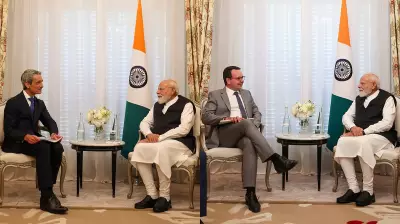
India's strategic partnership with the United States is undergoing one of its most turbulent economic phases, despite outwardly cordial political ties. Government sources frequently highlight the strong working relationship between Prime Minister Narendra Modi and US President Donald Trump. However, trade negotiations have stalled under the weight of punitive tariffs, stringent market-access demands, and newly linked immigration policies. Currently, Indian exports face US tariffs as high as 50%, placing India among the most heavily tariffed nations.
What originated as an American effort to reduce its trade deficit with India has evolved into a broader economic and geopolitical standoff. Washington's initial tariff rationale focused on trade imbalances but swiftly expanded to encompass India's continued procurement of Russian crude oil, significantly hardening the US negotiating stance.

The Russia complexity has moved from a diplomatic concern to a direct economic pressure point. Indian officials defend these energy imports as vital for national energy security and inflation control. In response, the Trump administration has imposed additional tariffs of up to 25% on top of existing duties, explicitly tying trade penalties to India's engagement with Moscow.
Further complicating talks, immigration policy is now entangled with trade. A sharp increase in H-1B visa fees to $100,000 and mandatory social media screening for applicants threaten to impact India's IT services sector, a key channel for services trade. While the two nations signed a new decade-long defence partnership framework in 2024, this strategic cooperation has not yet broken the deadlock in trade negotiations, which remain ongoing but without a major breakthrough.
Unexpected Shocks & Technical Barriers: Mexico & the EU
A significant and unexpected jolt came from Mexico in December 2024. To curb Chinese trans-shipments, Mexico imposed a blanket tariff hike of up to 50% on imports from countries without a Free Trade Agreement (FTA). This move impacts approximately 75% of India's $5.75 billion exports to Mexico, with automobiles, auto components, and motorcycles bearing the brunt. Indian commerce officials are now in urgent talks with Mexico City, seeking a country-specific exemption or a limited trade pact to mitigate the damage.
Meanwhile, the European Union is deploying a more technical, yet equally challenging, form of protectionism. The Carbon Border Adjustment Mechanism (CBAM), heading for full implementation in 2026, is already affecting Indian exports. Mandatory carbon emissions reporting, initiated in October 2023, has contributed to a 24.4% drop in India's steel and aluminium exports to the EU in FY2025. The mechanism forces Indian exporters to bridge the gap between India's low domestic carbon price (under $10/tonne) and the EU's price of roughly €65 per tonne, adding a significant cost burden.
Strategic Gains: New FTAs Provide a Counterbalance
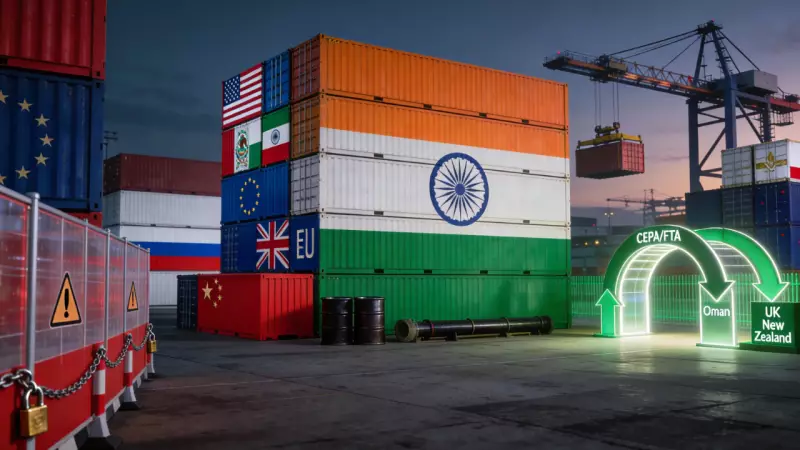
Amid these headwinds, India has secured crucial free trade agreements to diversify and strengthen its market access.
The India-UK FTA, signed in July 2025, is a landmark deal. It grants duty-free access to the UK for nearly 99% of Indian exports, benefiting labour-intensive sectors like textiles, leather, and gems. In return, India will phase out tariffs on 90% of UK goods, including a major reduction on Scotch whisky from 150% to 40% over ten years. The pact also includes a three-year social security contribution waiver for Indian professionals in the UK, boosting services trade.

Similarly, the India-New Zealand FTA offers Indian exporters zero-duty access across most products and opens 118 service sectors. It facilitates easier mobility for students and professionals, though it faced internal opposition in New Zealand over dairy sector protections.
A quiet success has been the India-Oman Comprehensive Economic Partnership Agreement (CEPA). Oman will eliminate duties on over 98% of tariff lines, covering 99% of India's export value. This pact solidifies India's trade gateway to the Gulf region, promising growth in textiles, engineering goods, and pharmaceuticals.
Key Bilateral Relationships: Imbalance & Volatility
Trade with Russia continues to grow but is starkly imbalanced. In FY2024-25, imports from Russia (primarily crude oil) soared to $63.8 billion, while Indian exports languished at only $4.9 billion. This oil dependency remains a central friction point in US-India talks. New Delhi is now identifying hundreds of products to boost exports and narrow this gap, targeting Russia's $9.7 billion pharmaceutical import market.
Trade with China shows headline growth but underlying volatility. While exports jumped 90% month-on-month in November 2025, they are concentrated in a few items like naphtha and electronics. The structural imbalance is severe, with India's trade deficit with China expected to hit $106-$115 billion in 2025. Tensions persist, with China challenging India's solar sector tariffs at the WTO and India imposing anti-dumping duties on Chinese products.
The 2026 Outlook: Execution & Insulation
The events of 2025 set the stage for a 2026 trade strategy focused on execution, insulation, and selective engagement. The immediate priority will be to operationalise the newly signed FTAs with the UK, New Zealand, and Oman to deliver tangible export gains. Concurrently, India must manage unresolved tariff threats from the US and Mexico, likely through tactical negotiations for exemptions and relief rather than comprehensive resets.
In essence, 2026 will be a year of measured trade diversification. Success will hinge on India's ability to defend existing market access, absorb regulatory shocks like the EU's CBAM, and extract maximum value from its new agreements. In a world where trade openness is increasingly conditional, India's economic resilience will be tested by its skill in navigating this fragmented and transactional global system.