

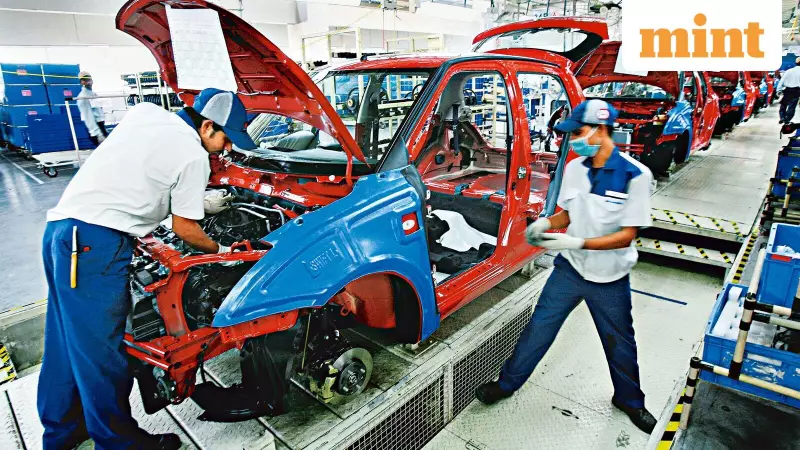
Global automobile manufacturers are strategically positioning their Indian operations to protect export markets against the rising dominance of Chinese electric vehicle makers. Major players including Suzuki Motor Corp., Hyundai Motor Corp., and Volkswagen Group are accelerating exports from India with focused attention on emerging markets where Chinese competition remains limited.
Emerging Markets: The New Battleground
The strategic shift comes as Chinese automakers are projected to lead global vehicle exports for the third consecutive year. Chinese manufacturers exported 5.62 million vehicles in the first ten months of 2025, representing a significant 16% growth compared to the previous year. This surge is primarily driven by electric and hybrid vehicles that are gaining popularity in developed markets.
However, global automakers have identified a crucial advantage in markets where electrification hasn't yet taken root. Regions including the Middle East, South America, and Africa present substantial opportunities for internal combustion engine (ICE) vehicles, where Indian manufacturers maintain strong competitive positioning.

Suzuki's Cautious Export Expansion
Suzuki Motor Co. is establishing India as its global export hub, targeting over 100 countries worldwide. The company's president, Toshihiro Suzuki, expressed caution about direct competition with Chinese manufacturers during the Japan Mobility Show last month.
"Chinese players are lowering their prices. The way they are growing, the future growth for them will be difficult," Suzuki stated, emphasizing the company's strategy to focus on markets with minimal Chinese competition.
Maruti Suzuki, Suzuki's Indian subsidiary, exported more than 332,000 units in 2025, marking an impressive 17% increase. Key export destinations included South Africa, Saudi Arabia, Chile, Japan, and Mexico. The company is leveraging its popular ICE models like Fronx, Jimny, Baleno, and Swift while gradually expanding exports of its first electric vehicle, the e-Vitara, with Europe as a primary focus.
Maruti has set an ambitious target to increase exports to 750,000 units by 2030-31, demonstrating strong confidence in India's manufacturing capabilities.
Hyundai's Dual Strategy for Emerging Markets
Hyundai Motor India is implementing a sophisticated approach to capitalize on the current market dynamics. Unsoo Kim, Hyundai India's managing director and CEO, explained that emerging markets remain predominantly focused on ICE vehicles.
"In the emerging market, electric vehicles are at an early stage. In the Middle East and Africa, and Latin America, electric vehicles are at a very early stage. So most of them are the ICE model at the moment," Kim stated in an interview.
Hyundai's strategy involves focusing on ICE models in the current pipeline while preparing 26 models that include dedicated EV variants for emerging markets. The company plans to increase exports to 30% of its total annual sales, up from 21% in FY25. Key export markets for Hyundai India include Saudi Arabia, Mexico, Chile, South Africa, and Peru.
Volkswagen Group's India Focus
The Volkswagen Group, through its marquee brand Skoda in India, recognizes the country's strategic importance in global operations. Ashish Gupta, brand director at Skoda India, emphasized that exports play a crucial role in growth, with significant opportunities in the global south.
"Globally, we have gone out and said, India is our most important market outside Europe," Gupta noted. The Volkswagen Group recorded a 20% growth in exports from India in 2024, reaching approximately 53,000 units. Their primary export markets span Africa, ASEAN countries, Middle Eastern nations, and North America.
Analyst Perspective and Future Outlook
Industry analysts highlight both opportunities and challenges for Indian automakers. Puneet Gupta, director at S&P Global Mobility, acknowledged that Indian carmakers' strong presence in ICE models provides immediate advantages in emerging markets.

However, he cautioned that "with how Chinese carmakers are gaining ground, the competition will become intense for EVs and hybrid vehicles in international markets. Increasingly, global markets will shift towards EVs and hybrids, so Indian carmakers will have to adapt to the competition."
According to an AlixPartners report from June 2024, Chinese carmakers are expected to capture 13% of the global market share by 2030, up from just 3% in 2024. Much of this growth is anticipated in regions where Indian exports currently dominate, including the Middle East, Africa, and Central and South America, where Chinese market share could increase more than fourfold.
The Indian automotive market itself showed modest growth of 2% in FY2025, reaching 4.3 million units, with projections of 5% growth for FY2026. Exports are becoming increasingly vital for automakers operating in India, providing stability amid volatile domestic market conditions.





