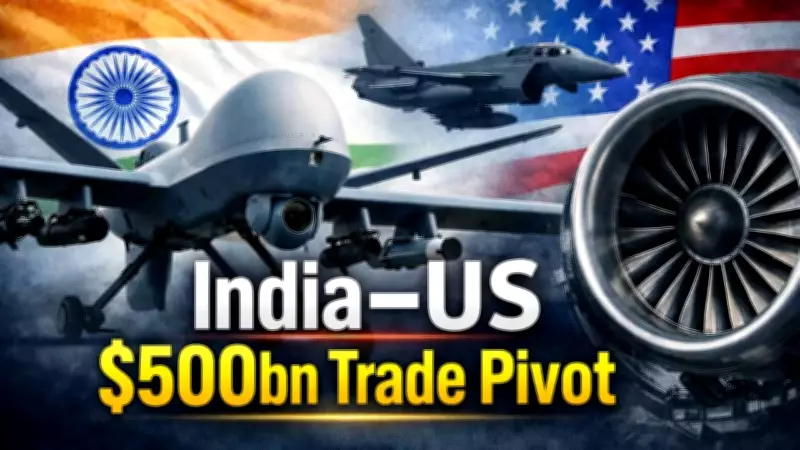
India and US Forge Landmark Trade Agreement with $500 Billion Purchase Commitment
In a significant development for bilateral relations, India has pledged to substantially increase its acquisitions of American petroleum, defense systems, and commercial aircraft through a newly announced trade arrangement. US President Donald Trump presented this agreement as a tariff-reducing initiative that could potentially boost American exports by an impressive $500 billion.
Tariff Reductions and Strategic Purchases Define the Agreement
President Trump revealed the details of this trade pact on Monday, highlighting that the United States would decrease tariffs on Indian goods from 50% to 18%. In return, India has committed to lowering its trade barriers, ceasing imports of Russian oil, and expanding its purchases of American products across multiple sectors.
"India has agreed to buy more American goods, with purchases rising to as much as $500 billion spanning energy, coal, technology, agricultural and other products," Trump stated during the official announcement. Officials from both nations have celebrated this agreement as a transformative milestone that redefines their economic partnership, particularly emphasizing long-term procurement in defense and aviation sectors.

Beyond Tariffs: Reshaping India's Defense and Energy Landscape
This agreement represents far more than simple tariff adjustments. It possesses the potential to fundamentally alter India's defense capabilities and energy strategies for years to come while strengthening economic alignment with the United States during a period of global realignments, especially amid ongoing US-Russia tensions and the conflict in Ukraine.
"The commitment to buy US products covers sectors like pharmaceuticals, telecom, defense, petroleum and aircraft. It will be done over the years," a senior Indian official informed Reuters. Particularly noteworthy is how this agreement positions American defense and aerospace companies as long-term contributors to India's national security framework, featuring deeper industrial collaboration and high-value platform sales ranging from jet engines to surveillance drones as central components.
Defense Procurement: Drones, Helicopters, and Jet Engines
While neither government has released detailed purchase breakdowns, the general framework becomes evident through recent and ongoing transactions:
- Drone Technology: India's 2024 agreement to acquire 31 MQ-9B SeaGuardian and SkyGuardian drones from General Atomics marked significant progress in maritime intelligence and continuous border surveillance. The new trade deal could accelerate these deliveries and potentially expand acquisitions to include additional systems, weaponry, base support, and long-term maintenance services.
- Naval Aviation: India's expanding fleet of MH-60R Seahawk helicopters, manufactured by Lockheed Martin, already benefits from US-approved sustainment packages. Under this trade-linked commitment, analysts anticipate India will negotiate faster spare-part supply chains and extended lifecycle support agreements.
- Helicopter Fleet: Rotary-wing assets are likely to see expanded purchases. India already operates substantial numbers of US helicopters, including the AH-64E Apache attack platform and CH-47F Chinook heavy-lift helicopters, both produced by Boeing. Their operational versatility and phased acquisition patterns make them ideal for multi-year procurement structures.
- Jet Engine Cooperation: One of the most strategically significant developments in recent India-US defense relations is GE Aerospace's 2023 memorandum with Hindustan Aeronautics Limited to co-produce F414 engines in India for the Tejas Mk2 fighter program. This represents industrial collaboration extending to spare parts, production technology, upgrades, and potential future engine development for Indian platforms.
The defense component of this agreement will likely integrate drones, helicopters, engines, and maintenance support into a comprehensive roadmap rather than focusing on individual contracts.

Commercial Aviation: Beyond Military Applications
The civilian aviation sector presents substantial opportunities within this agreement. Indian airlines have already made global headlines with significant aircraft orders. Air India recently confirmed adding 30 Boeing 737 MAX aircraft to its growing order portfolio, following a record-breaking 2023 order that included both Boeing and Airbus aircraft as part of its fleet modernization and international market expansion strategy.
These commercial aircraft purchases, driven by route expansion, fuel efficiency, and delivery schedules, also carry considerable political significance. They represent some of the most visible, high-value imports any country can make from the United States. Within the $500 billion framework of this agreement, privately negotiated commercial aircraft acquisitions could be combined with state-led defense purchases to achieve headline targets.
Geopolitical Implications: The Russian Oil Clause
Perhaps the most geopolitically significant requirement of this agreement is India's commitment to halt Russian oil imports—a substantial demand given the scale and price advantages India has enjoyed since 2022. Reuters reports that Indian refiners have requested a phased reduction, citing existing contracts and logistical considerations.
Nevertheless, the direction remains clear. Closer energy alignment with the United States reduces complications in arms sales that involve strict end-use monitoring and technology export controls, particularly relevant for advanced systems like drones, radars, and fighter engines. Essentially, reduced purchases from Russia facilitate deeper US-India defense technology cooperation.
Market Reactions and Official Statements
Indian officials have characterized this agreement as enhancing market confidence and clarity. "The announcement of a trade deal between India and United States has reduced a great deal of global uncertainty," stated economic affairs secretary Anuradha Thakur.
Financial markets responded positively, with the Nifty 50 index rising and the rupee strengthening following the announcement, according to Reuters reports. Indian exporters welcomed the tariff reductions, with SC Ralhan, president of the Federation of Indian Export Organisations, noting: "Lower tariffs will not only improve price competitiveness but also help Indian exporters integrate more deeply into U.S. supply chains."
Moody's Ratings added that reduced tariffs could revitalize Indian goods exports to the United States, particularly in sectors such as chemicals, auto parts, and electronics.
Future Developments and Implementation
The senior Indian official who spoke to Reuters indicated that this agreement represents an initial framework, with a more comprehensive arrangement forthcoming. Negotiations over the coming months will determine whether these purchase commitments translate into structured procurement timelines with delivery milestones and industrial partnerships, or remain aspirational targets supporting tariff relief justification.
Indian officials have indicated that the Ministry of Commerce and the US Trade Representative's office are expected to meet in early spring to begin formalizing a more detailed roadmap.
Strategic Significance and Long-Term Implications
This agreement shifts the focus of India-US trade from low-margin consumer goods toward high-value systems in aviation and defense—including drones, helicopters, airliners, and jet engines. The most significant aspect isn't the purchase price itself, but rather the defense ecosystems, industrial co-production arrangements, and decades-long sustainment relationships that accompany these acquisitions.
With Russia gradually diminishing as a supplier and the United States opening more technology access, aviation and defense sectors are emerging as new frontiers in strategic trade between the two nations.