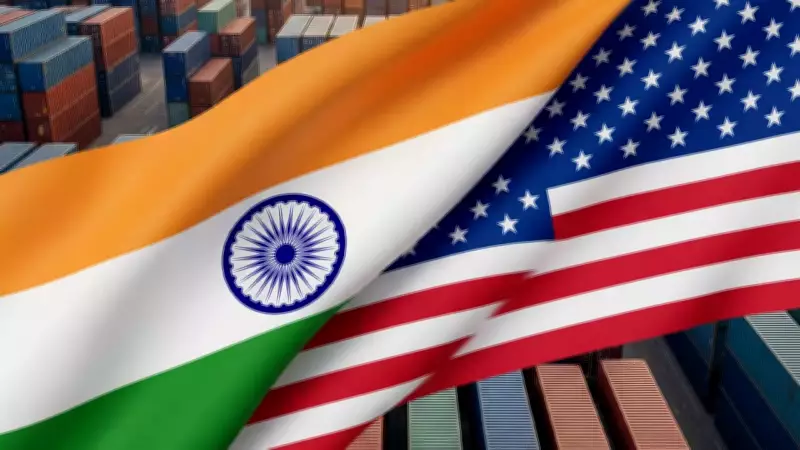
India-US Trade Deal: Relief Rally in Markets Amidst Unanswered Questions
The announcement of a trade agreement between India and the United States has sparked a welcome relief rally in domestic stock markets and brought cheer to exporters. However, significant uncertainty persists regarding the key details of this pivotal trade pact.
Immediate Tariff Reduction: The Core Announcement
The most concrete takeaway from the social media posts by US President Donald Trump and Prime Minister Narendra Modi is the immediate reduction of the reciprocal tariff on Indian exports to the United States, now set at 18%. Commerce Minister Piyush Goyal, addressing the media, confirmed that India has secured a "very good" trade agreement, positioning the nation more favorably compared to global competitors.
Goyal emphasized that sensitive sectors, particularly agriculture and dairy, will continue to be protected under the deal. This places India in a competitive stance against rival nations in labor-intensive industries, such as China and Vietnam (facing 20% tariffs), Malaysia (19%), Bangladesh (20%), and Cambodia and Thailand (both at 19%).

Unresolved Questions and Contradictory Claims
President Trump's statement on Truth Social included several bold assertions beyond the tariff cut, touching on India's oil purchase strategy, halting Russian crude imports, and significantly increasing purchases of US goods. The Indian government has not officially endorsed most of these claims, leaving several critical questions unanswered.
Will India Cease Russian Crude Oil Imports?
Trump's Claim: The US President stated that Prime Minister Modi agreed to stop buying Russian oil, instead increasing purchases from the United States and potentially Venezuela, to help end the war in Ukraine.
Current Reality: India has made no official declaration to halt Russian crude imports. Sources within the refining industry indicate that Indian refiners have received no government directive to stop these purchases and would require considerable time to wind down existing transactions.
India's imports of Russian crude peaked at approximately 2 million barrels per day in June last year but have since declined, hitting a two-year low in December. Refiners are increasingly diversifying their sources to include suppliers from the Middle East, Africa, and South America.
Regarding a potential shift to Venezuelan oil, industry officials note that only Reliance Industries and Nayara Energy possess the technical capability to process large volumes of heavy crude. State-run refiners could substitute less than 10% of their current Russian volumes with Venezuelan oil.
The Kremlin has stated that Moscow has received no official communication from India about halting crude purchases and plans to continue strengthening bilateral cooperation across all sectors.
Will India Reduce Tariffs on US Goods to Zero?
Trump's Claim: The US President asserted that India would move to reduce its tariffs and non-tariff barriers against American goods to zero.
Indian Stance: Commerce Minister Piyush Goyal has not clarified whether tariffs on US imports will be eliminated. He explained that the final details of the trade deal are still being negotiated, with a joint statement expected soon. Prime Minister Modi's social media post welcomed the tariff reduction to 18% but did not mention bringing US goods tariffs to zero.
US Trade Representative Jamieson Greer confirmed that the agreement is being formalized, noting that India will maintain protections for its agricultural sector. He added that the deal would substantially liberalize India's industrial market, with duties on manufactured products dropping to zero from the current average of 13.5%.
The $500 Billion Purchase Commitment: Aspiration or Reality?
Trump's Claim: The US President stated that India committed to "BUY AMERICAN" at a much higher level, including over $500 billion worth of US energy, technology, agricultural, coal, and other products.

Analysis and Context: Minister Goyal reiterated that the trade deal protects India's agricultural and dairy sectors, and there has been no official confirmation from India regarding specific commitments to increase purchases of US energy, technology, or coal.
According to analysis by the Global Trade Research Initiative (GTRI), India's current annual imports of goods and energy from the US are under $50 billion. Reaching a $500 billion figure would likely require more than two decades, suggesting this represents a long-term aspiration rather than a near-term binding commitment. The GTRI also notes that Trump's claims do not specify how many products are covered under India's tariff reduction commitments, and India has historically resisted opening sensitive sectors like food grains and genetically modified products.
Looking Ahead: Clarity Expected Soon
More clarity on these crucial aspects of the India-US trade deal is anticipated in the coming days. For now, exporters are breathing a sigh of relief as commercial dealings with India's largest trading partner appear back on track. The agreement marks a significant diplomatic and economic development, but its full implications will only become clear as the finer details are finalized and disclosed.