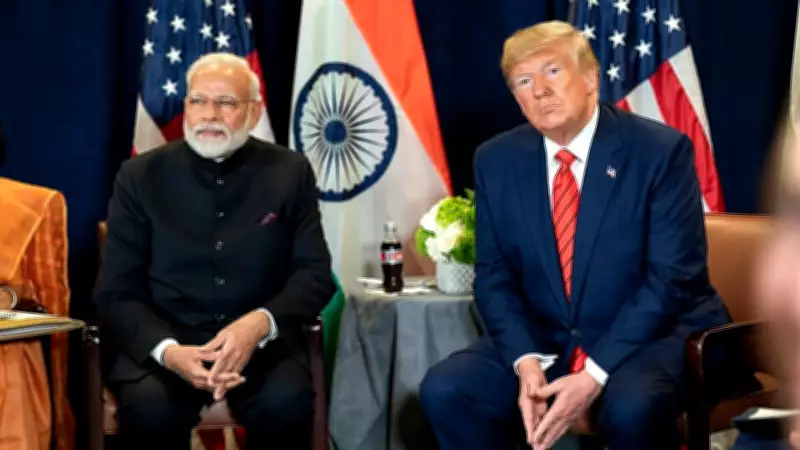
Trump Announces India's Shift from Russian Oil to US and Venezuelan Crude in Major Trade Agreement
In a significant development that could reshape global energy dynamics, US President Donald Trump has declared that India will cease its substantial imports of Russian crude oil and instead ramp up purchases from the United States and Venezuela. This announcement came as part of the long-awaited India-US trade deal, which Trump revealed following a conversation with Prime Minister Narendra Modi on Monday.
Trump's Truth Social Post Details the Agreement
Taking to his Truth Social platform, President Trump outlined the key points of the discussion with PM Modi. "We spoke about many things, including Trade, and ending the War with Russia and Ukraine. He agreed to stop buying Russian Oil, and to buy much more from the United States and, potentially, Venezuela. This will help END THE WAR in Ukraine, which is taking place right now, with thousands of people dying each and every week!" Trump wrote in his post.
Additionally, Trump stated that India has committed to purchasing over $500 billion worth of American products, encompassing energy, technology, agriculture, coal, and various other goods. This move is seen as a strategic effort to bolster economic ties between the two nations while addressing geopolitical concerns.

Background: Russian Oil Imports as a Point of Friction
India's hefty imports of Russian crude had emerged as a major point of friction for the Donald Trump administration in its relationship with New Delhi. The Trump administration has consistently held the view that by buying large quantities of Russian crude, India was indirectly helping Russia finance its war in Ukraine.
In August, Trump announced an additional 25 per cent tariff on Indian goods—on top of an earlier 25 per cent tariff—as a punitive measure against India for its continued purchases of Russian oil. This escalation highlighted the growing tensions over energy trade policies.
India's Shifting Oil Import Patterns
From being a peripheral supplier, Russia emerged as India's largest source of crude following Moscow's February 2024 invasion of Ukraine, as Western buyers reduced their imports. However, over the past couple of months, India's Russian oil imports have declined steadily to a three-year low, according to tanker data.
This decline followed US sanctions against Russia's top oil producers and exporters, Rosneft and Lukoil. Data from commodity market analytics firm Kpler shows that from a peak of 2.09 million barrels per day (bpd) in June 2025, India's Russian oil imports dropped to 1.16 million bpd in January 2026.
Meanwhile, the United States has consistently been India's fifth-largest oil supplier for several years. Industry insiders note that India has been increasing its oil imports from the US and can continue to do so, provided the pricing remains competitive. The cost of shipping oil from the US to India is currently more than double that of importing from West Asia, which poses a significant challenge.
Technical and Commercial Considerations
The shift to US crude involves key technical considerations, such as the compatibility of US crude grades with Indian refineries. Different crude grades are suitable for various petroleum products from operational and efficiency perspectives. Indian refineries are more accustomed to crudes from traditional West Asian suppliers and, more recently, Russian crude, though they possess the capability to process nearly all types of crude.
Ramping up liquefied natural gas (LNG) imports from the US would be relatively straightforward from a commercial perspective. Washington is New Delhi's second-largest supplier of LNG, after Qatar. Higher freight costs, while a factor, are less concerning for LNG than for crude oil because American gas is typically priced at a significant discount compared to other major suppliers like Qatar. This means the landed price for Indian LNG importers would often be lower despite higher transportation costs.

Venezuelan Oil: A New Opportunity for India
Venezuelan oil, which India has not been importing due to US sanctions, presents a major opportunity for Indian refiners. Trump recently indicated that India will be purchasing oil from Venezuela, with the deal or "concept of the deal" already in place to allow New Delhi to import Caracas's crude oil.
Prior to the imposition of US sanctions on Venezuela in 2019, India—specifically private sector refining giant Reliance Industries (RIL)—was a regular buyer of Venezuelan crude. Caracas was New Delhi's fifth-largest supplier of oil in 2019, providing close to 16 million tonnes of crude to Indian refiners.
After a brief resumption of imports following a sanctions waiver in October 2023, imports halted again when the waiver lapsed. RIL managed to restart Venezuelan oil imports with a specific sanctions waiver but stopped in the summer of 2025 after the Trump administration threatened higher tariffs on countries buying Venezuelan crude. No Venezuelan oil has been imported into India for months now.
Refinery Capabilities and Future Prospects
In India, private sector players like RIL and Nayara Energy have been the biggest processors of heavy crudes, similar to those produced by Venezuela. Limited heavy crude volumes are also processed occasionally by public sector refineries, such as Indian Oil's Paradip refinery and Mangalore Refinery and Petrochemicals's unit in Mangaluru.
According to a recent note by Kpler, planned investments aimed at increasing refinery complexity—such as upgrades at HPCL's Visakhapatnam and other refineries—should expand India's ability to process Venezuelan heavy crudes, gradually broadening system-wide intake capacity.
Experts believe that Venezuelan crude offers India a politically acceptable diversification option amid American pressure on India's Russian oil imports. Any increase in Venezuelan crude imports is also expected to enhance India's negotiating leverage with its traditional West Asian oil suppliers.
Conclusion: A Strategic Realignment in Energy Trade
The announcement by President Trump marks a pivotal moment in India-US relations, with energy trade at its core. By agreeing to halt Russian oil imports and boost purchases from the US and Venezuela, India is navigating complex geopolitical waters while seeking to secure its energy needs. This shift not only addresses US concerns over Russia's war in Ukraine but also opens new avenues for economic cooperation and energy diversification for India.