

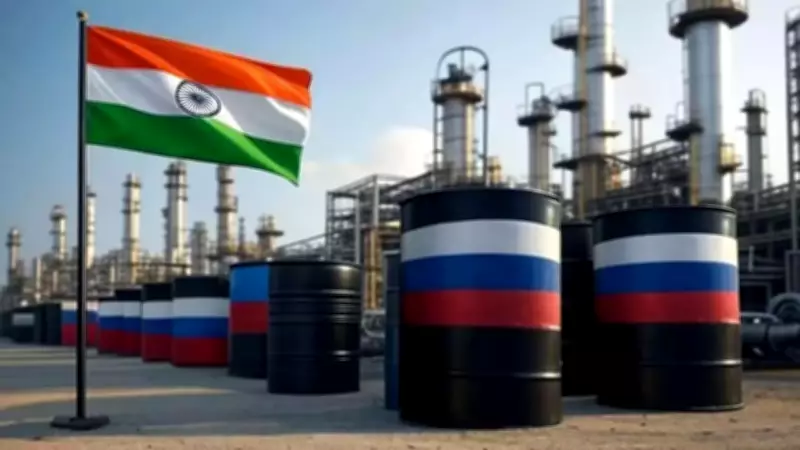
India to Restrict Russian Crude Oil Purchases Under US Trade Understanding
India has reached a significant understanding with the United States to limit its crude oil imports from Russia, according to sources quoted by news agency PTI. The move is part of a broader trade agreement aimed at securing lower tariffs on Indian exports to the US. While no immediate blanket ban is planned, Indian refiners will not place fresh orders for Russian crude once existing contractual commitments are fulfilled.
Trade Deal Details and Tariff Relief
The understanding follows US President Donald Trump's announcement that Washington would reduce reciprocal tariffs on Indian goods to 18 percent from 25 percent. Trump stated that this tariff relief is linked to India agreeing to stop buying Russian oil, lower tariff and non-tariff barriers, and commit to purchasing an additional $500 billion worth of US energy, technology, agricultural products, and other goods over time.
This agreement effectively removes an additional 25 percent punitive tariff that had been imposed over India's Russian oil purchases. As a result, the applied US tariff on Indian exports drops from 50 percent to 18 percent, providing substantial relief to Indian exporters and boosting the competitiveness of Made in India products in the American market.

Refiners to Wind Down Russian Oil Purchases
Indian refiners, which became the world's second-largest buyer of Russian crude after Moscow's invasion of Ukraine in February 2022, will continue to honor purchase commitments made before the announcement. However, they will not place new orders thereafter, as per three people with knowledge of the matter cited by PTI.
State-run refiners such as Hindustan Petroleum Corporation Ltd (HPCL), Mangalore Refinery and Petrochemicals Ltd (MRPL), and HPCL-Mittal Energy Ltd (HMEL) had already halted buying Russian oil after the US imposed sanctions last year on key Russian exporters. Others, including Indian Oil Corporation (IOC) and Bharat Petroleum Corporation Ltd (BPCL), are expected to gradually wind down their purchases.
Reliance Industries Ltd, India's biggest buyer of Russian crude, had paused purchases late last year following US sanctions on Rosneft and Lukoil. Reliance is also likely to stop buying Russian oil again after the delivery of its resumed cargo of 100,000–150,000 barrels.
Nayara Energy Likely Exception to Restrictions
The only probable exception to the restriction is Nayara Energy. Nayara has been sanctioned by the European Union and the UK due to its Russian links, with Rosneft holding a 49.13 percent stake. Because of these sanctions, other major suppliers are unwilling to transact with the company, leaving it dependent on Russian crude sourced from non-sanctioned entities, sources explained.
As per PTI, Nayara's unique position was conveyed to US trade officials during talks in December, and New Delhi may seek an exemption or special dispensation for the refinery under the no Russian oil policy. Nayara is expected to continue limited purchases in the near term, highlighting the complexities of global energy dependencies.
Trade Deal, Export Relief, and Oil Import Dynamics
Trump noted that India has also agreed to import $500 billion worth of US goods, including energy, agriculture, and technology products, over five years. In 2025, India exported $92 billion worth of goods to the US, accounting for 20 percent of total exports, while imports from the US stood at $50 billion, or about 7 percent of total imports.
India's total oil import bill was $180 billion, with approximately 30–35 percent sourced from Russia, compared with 20–30 percent from Iraq, 15 percent from Saudi Arabia, 10 percent from the UAE, and 5–10 percent from the US. This shift marks a strategic realignment in India's energy procurement strategy.
Russian Imports Already Declining
Russian oil imports have been declining since US sanctions on Rosneft and Lukoil came into force. Imports averaged 1.2 million barrels per day in December 2025, down from a peak of 2.1–2.2 million barrels per day. In January, they fell further to around 1 million barrels per day and were expected to drop below that level soon. Under the new understanding with Washington, imports could halve in the coming months.

However, market analysts see limited immediate impact. Sumit Ritolia, lead research analyst at Kpler, stated that the India–US trade deal is unlikely to result in a near-term reduction in Russian crude imports. Russian volumes remain largely locked in for the next 8–10 weeks and continue to be economically critical for India's complex refining system, Ritolia was quoted as saying by PTI, adding that imports are expected to remain in the 1.1–1.3 million barrels per day range through early Q2.
Diversification and Venezuela Option
Prashant Vasisht of Icra mentioned that the reported deal includes India stepping up purchases of US crude and potentially resuming imports from Venezuela. Russian crude accounted for less than 2 percent of Indian crude imports prior to FY2023, so replacement options exist, he said, noting that switching to market-priced crude would raise India's import bill by less than 2 percent. Venezuelan crude, being heavy and sour, could also suit Indian refineries, he added.
Russia's Response and Industry Outlook
Meanwhile, Russia has indicated that it has not received any official communication from India on halting oil purchases. Kremlin spokesman Dmitry Peskov said, So far, we haven't heard any statements from New Delhi on this matter. Prime Minister Narendra Modi, while confirming the tariff cut as a boost for Made in India exports, did not publicly mention Russian oil.
Industry sources quoted by Reuters have emphasized that refiners will need a wind-down period to meet existing contracts, underlining that any shift away from Russian oil will be gradual rather than abrupt. This phased approach aims to minimize disruptions to India's energy security and refining operations.





