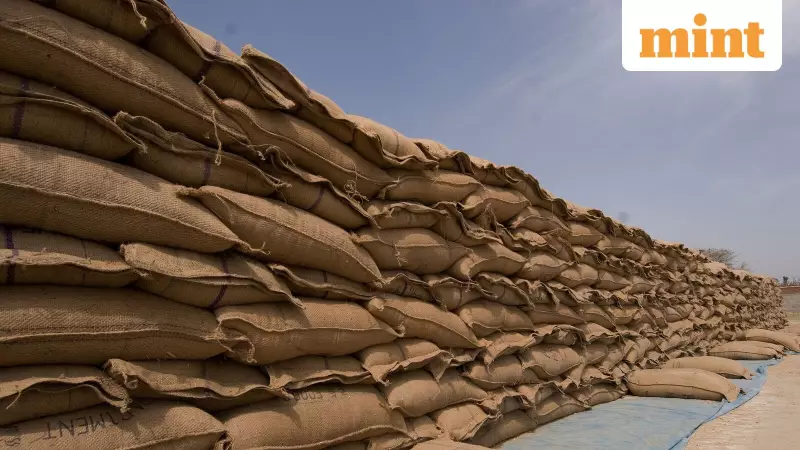
New Delhi: The Indian government has introduced a significant relaxation in its wheat export policy. The Centre now allows limited exports of wheat flour and related products under a tightly regulated authorization mechanism. This move comes even as the broader export ban on these items remains firmly in place.
Key Details of the Export Authorization
Under the amended policy, exports of wheat or meslin flour will be permitted up to a cumulative quantity of five lakh metric tonnes. This includes atta, maida, semolina (rava/suji), wholemeal atta, and resultant atta. The Directorate General of Foreign Trade (DGFT) will issue export authorizations, subject to specific conditions and procedures notified separately. However, these products will continue to remain in the "prohibited" category under the general export policy.
The DGFT notified this relaxation on Friday through an official amendment to the export policy. This was followed by a detailed public notice that lays down the eligibility criteria, application process, and allocation modalities for exporters.

Application Process and Validity
Applications for export authorization will be accepted online through the DGFT portal. The first application window opens from 21 January to 31 January 2026. After that, applications will be invited during the last ten days of each month until the permitted export quantity is fully exhausted.
Each export authorization will be valid for six months from the date of issuance. Extensions may be considered on a case-by-case basis by a special committee established for this purpose.
Eligibility Criteria for Exporters
The DGFT has specified clear eligibility requirements for applicants. Eligible entities include:
- Flour mills and processing units with valid Import Export Code (IEC) and FSSAI licences.
- Merchant exporters who have tie-ups or supply agreements with supporting manufacturers.
- EOUs, SEZ units, and Advance Authorisation holders seeking allocation over and above their imported wheat entitlements.
Exporters must submit detailed documentation as part of their application. This includes proof of production capacity, past export performance, confirmed export orders, shipment schedules, and a self-declaration certifying that domestic wheat has been sourced without diversion from the public distribution system.
Monitoring and Compliance Measures
The DGFT has clarified that these permitted exports will be over and above existing policy conditions. They will be closely monitored to ensure compliance. The agency has set a minimum threshold for applications, stating that requests for quantities below 2,500 tonnes will not be considered.
Authorizations will be non-transferable and must be utilized only by the IEC holder to whom they are issued. In cases of misdeclaration, exporters will be barred from allocation for the next three years.
Allocation Mechanism and Committee Oversight
Allocation of the export quota will be decided by a Special Export Facilitation Committee (EFC). This committee will meet at least once a month to examine applications. It will consider factors such as the applicant's export track record, processing capacity, and existence of valid contracts.
The Special EFC will also have the power to reallocate quantities from underperforming exporters to others based on periodic reviews. Exporters who receive authorizations must submit landing certificates within 30 days of completing shipments. Failure to do so may affect future allocations.
Background and Market Context
The government had restricted the export of maida, suji, and wholemeal atta in August 2022 following a decline in wheat production. These products have a strong consumer base in countries with a large Indian diaspora, including the United States, the United Kingdom, Gulf nations, and parts of Africa and Southeast Asia.

Industry representatives have welcomed the relaxation. Navneet Chitlangia, president of the Roller Flour Millers' Federation of India (RFMFI), expressed optimism about the move. He stated that lifting the ban would help reclaim market share, as Indian atta and other wheat products have developed a strong brand presence among the Indian diaspora. He noted that millers were already receiving a growing number of enquiries for wheat-based products, reflecting renewed demand and confidence in the market.
Production Estimates and Policy Clarifications
The public notice further clarifies that exports manufactured in India using domestic wheat under the new quantitative window will be counted against the 5 LMT cap. However, exports by EOUs or under Advance Authorisation using only imported wheat, governed by earlier notifications, will not be counted within this limit.
This policy adjustment comes amid record wheat production estimates. According to final estimates of crop production for 2024–25 released in November 2025, wheat production has touched a record 117.95 million tonnes. This represents an increase of 4.65 million tonnes from the previous year's 113.29 million tonnes.
Rice output has also reached an all-time high of 150.18 million tonnes, an increase of 12.36 million tonnes over last year's 137.83 million tonnes. These strong production figures provide the agricultural backdrop for the government's decision to allow limited exports while maintaining overall restrictions to ensure domestic food security.