This week's data-driven insights reveal significant developments across India's trade, infrastructure, and legal landscapes. From a landmark free trade pact concluded in record time to a major shift in rural employment funding and a colossal court penalty against a global healthcare giant, the numbers tell a compelling story of economic strategy and policy shifts.
Trade Winds and Infrastructure Investments
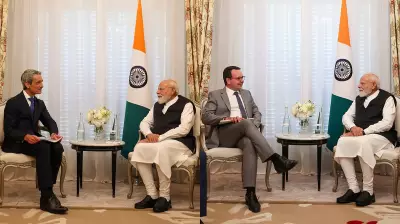
India and New Zealand have successfully wrapped up negotiations for a comprehensive Free Trade Agreement (FTA) in a remarkably short span of just nine months. The deal, set for a formal signing later, promises duty-free access for all Indian exports by eliminating tariffs on 100% of tariff lines. In return, India will liberalize duties on 70% of tariff lines, covering 95% of New Zealand's exports. New Zealand has also pledged to facilitate investments worth $20 billion into India over 15 years across sectors like manufacturing, infrastructure, and innovation. With bilateral trade at a modest $1.3 billion in FY25, the pact aims to unlock substantial growth potential.
On the domestic front, the Union government is poised to significantly ramp up spending on railway safety. The upcoming budget for FY27 is likely to allocate over ₹1.3 trillion for rail safety, marking a 12% increase from the current fiscal's ₹1.2 trillion. This heightened focus, a shift from the mere 2% increase planned for FY26, follows a tragic train collision in Bilaspur, Chhattisgarh, last month. The funds are earmarked for critical areas like rolling stock maintenance, track renewals, and the expansion of the indigenous Kavach automatic train protection system.

Policy Shifts and Economic Indicators
A major reset in the rural jobs scheme architecture is set to alter fiscal responsibilities between the Centre and states. The newly approved Viksit Bharat–Guarantee for Rozgar and Ajeevika Mission (Gramin), which replaces MGNREGS, revises the cost-sharing ratio to 60:40 (Centre:State) from the previous 90:10. A Mint analysis indicates that had this formula been applied in FY26, Uttar Pradesh would have faced the largest additional burden of ₹4,240 crore, followed by Andhra Pradesh and Tamil Nadu. This change comes as state finances grapple with rising welfare commitments.
Other key numbers from the week include a planned ₹30,000 crore equity infusion into the National Investment and Infrastructure Fund (NIIF), and data showing the Bharatiya Janata Party's political donations surged 53.5% to ₹6,088 crore in 2024-25. In a positive economic sign, growth in India's eight core industries rebounded to 1.8% in November from a contraction the previous month.
Global Ripples: Education Remittances and Legal Landmark
Data from the Reserve Bank of India points to a sustained decline in spending on overseas education. Outward remittances under the Liberalised Remittance Scheme (LRS) for education have fallen for 19 of the past 20 months through October 2025, contracting 26.2% year-on-year in October alone. This prolonged slump is attributed to tighter visa norms and stricter admission policies in key destinations like the US and Canada. Spending on overseas travel, the largest LRS category, has also shrunk for six consecutive months.
In a landmark legal decision overseas, a US jury has ordered Johnson & Johnson to pay approximately $1.56 billion to a single plaintiff, Cherie Craft, who claimed the company's talc-based baby powder caused her asbestos-linked cancer. This is the largest individual jury award in over 15 years of talc litigation against the company, which faces lawsuits from more than 67,000 plaintiffs. J&J has stated it will challenge the verdict. Notably, no such cases have been reported in India.