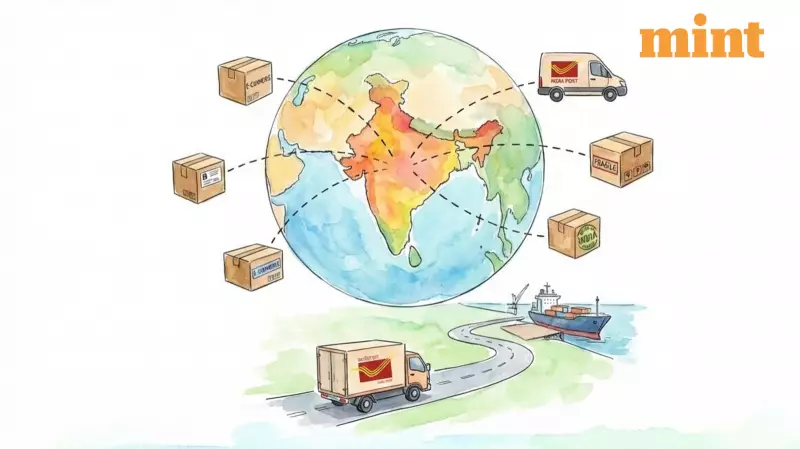
Government Overhauls Postal Export Rules to Boost E-commerce Exports
The Indian government has taken a significant step to boost e-commerce exports by extending key export incentives to goods shipped through the postal route. This move brings postal exports on par with cargo cleared through ports and airports, aiming to ease compliance for small businesses and enhance overseas sales.
Key Changes in Export Regulations
In a series of three notifications issued late on Thursday, the Department of Revenue updated electronic postal export documentation. The amendments include revisions to the Remission of Duties and Taxes on Exported Products (RoDTEP) and Rebate of State and Central Taxes and Levies (RoSCTL) schemes.
These changes align postal exports processed through the customs automated system with traditional shipping bills. This addresses a long-standing compliance gap faced by exporters who rely on the postal channel for their shipments.

Targeting Low-Value, High-Volume Exports
The government's move specifically targets low-value, high-volume exports that have grown rapidly with cross-border e-commerce. These shipments are increasingly routed through India Post and foreign postal networks.
The biggest beneficiaries of these changes are MSMEs, e-commerce sellers, artisans, and first-time exporters. These businesses rely heavily on postal services due to lower costs and simpler logistics compared to traditional shipping methods.
Expert Perspective on the Changes
Rajat Mohan, senior partner at AMRG & Associates, explained the practical impact of these amendments. "Many exporters send goods abroad through the postal route, which is legally permitted under the Customs Act. However, because export incentive rules were largely written keeping traditional shipping bills in mind, these postal exporters often faced denial or delay of benefits like duty drawback and RoDTEP," said Mohan.
"With these amendments, the government has clearly stated that electronic export entries filed for postal exports will be treated at par with normal shipping bills," he added. This brings more certainty to the export process, reduces disputes with field officers, and helps exporters plan their cash flows better.
Revised Documentation Requirements
At the core of these changes is an amendment to the Postal Export (Electronic Declaration and Processing) Regulations, 2022. The Central Board of Indirect Taxes and Customs has replaced existing postal export declaration formats with two revised electronic forms:
- PBE-III for e-commerce-driven postal exports
- PBE-IV for other postal exports
PBE stands for Postal Bills of Export. The revised forms expand disclosure requirements to include:
- Exporter and consignee details
- Parcel-level data
- Product classification
- Invoice information
- Tax and duty break-ups
- Payment identifiers
- Postal tracking numbers
Exporters must now explicitly declare their intent to claim duty drawback, RoDTEP, or RoSCTL benefits. They must also comply with record-keeping obligations under the Customs Audit Regulations, 2018.
India Post's Global Expansion
These regulatory changes come against the backdrop of the government expanding India Post's global footprint to support e-commerce exports. As first reported by Mint on 2 January, India Post has added 50 new countries across Africa, Europe, Central Asia, and West Asia under its International Tracked Packet Service (ITPS).
This expansion takes the total coverage to 135 destinations worldwide. The move reflects a broader push to use the postal network as an export enabler for small and online sellers.
Lakshmikant Dash, deputy director general (international relations and global business) at the Department of Posts, explained the strategy. "The idea is to make it easier for small-ticket e-commerce exporters to send samples and products to as many as 135 countries worldwide. This aligns with the Ministry of Commerce's objectives and the Prime Minister's 'One District One Product' initiative," said Dash.
"ODOP items and GI-tagged products, which have strong overseas demand, can be easily exported using this service," he added.

Addressing Regulatory Mismatch
Officials handling the matter said that the combined changes are meant to close a regulatory mismatch. This mismatch emerged as customs processes became digital while export incentive rules continued to reflect older, port-centric systems.
In parallel, the government has amended the RoDTEP and RoSCTL notifications issued in April 2023. These amendments now explicitly include postal exports cleared through electronic entry under Section 84 of the Customs Act.
Previously, incentive eligibility was closely tied to shipping bills or bills of export filed under Section 50. This created ambiguity for exporters using the postal route despite electronic processing being in place.
Timely Intervention Amid Global Uncertainty
These changes come at a crucial time for Indian exporters. They are facing heightened uncertainty after the United States imposed a 50% tariff on Indian goods. The US also announced an additional 25% tariff on trading partners of Iran, a category that includes India.
RoDTEP and RoSCTL are export support schemes that refund embedded taxes and levies not otherwise rebated. These schemes help Indian exporters price their goods more competitively in global markets.
Industry Relief and Future Outlook
Industry experts have welcomed these amendments as resolving a long-standing practical difficulty for exporters. The changes make the export incentive system more inclusive without creating any additional revenue burden on the government.
India Post, the world's largest postal network, operates around 165,000 post offices. This includes over 149,000 in rural areas and about 15,000 in urban centers, giving it unmatched reach for last-mile export logistics.
The postal service allows consignments of up to 2 kg to most countries and up to 5 kg to select destinations such as the UK, Canada, and the US. This capacity makes it particularly suitable for small-scale e-commerce exports.
The government's move also coincides with plans to soften its stance on e-commerce rules for exports. This includes proposals to allow foreign direct investment in inventory-based e-commerce models, but only for export purposes.
Overall, these regulatory changes represent a significant step toward making India's export ecosystem more accessible to small businesses. They particularly benefit those engaged in e-commerce who rely on postal services for their international shipments.