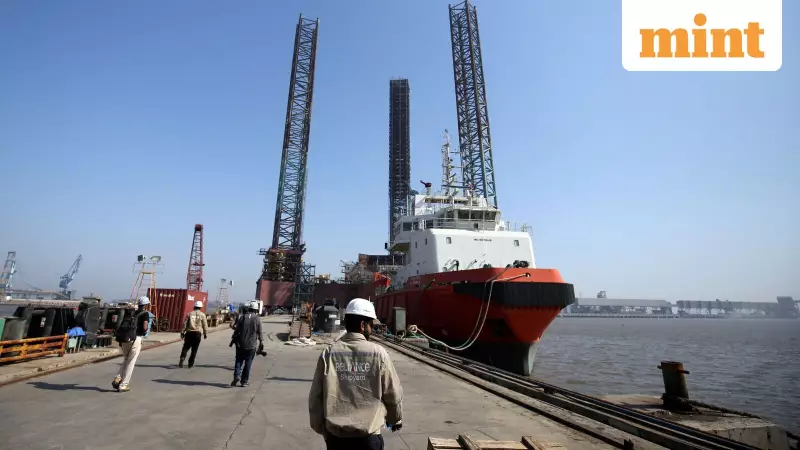
In a major push to transform India into a global maritime hub, the central government has unveiled a groundbreaking policy offering land at virtually no cost to companies investing in new shipbuilding and repair facilities. The initiative, detailed in guidelines released by the Ministry of Ports, Shipping and Waterways, aims to attract massive foreign investment and drastically reduce the entry barriers for capital-intensive shipyard projects.
Land Lease for 60 Years: The Core Incentive
The newly proposed Greenfield Shipbuilding Cluster Development Scheme is the centerpiece of this strategy. Under its guidelines, land along with common maritime infrastructure will be leased to eligible shipyards for an initial period of 60 years, with provisions for further extension. While a nominal lease rent will apply, the critical move is that both the central and state governments will absorb the land cost, not factoring it into the lease amount charged to investors.
This directly addresses a primary demand from global shipbuilding firms, who have consistently highlighted the availability and high cost of land as a major deterrent to committing greenfield investments in India. By removing this significant capital expenditure, the government hopes to substantially lower the financial risk and upfront investment required to establish a shipyard.

Blueprint for Mega Clusters and Massive Investment
The scheme envisions the creation of three to four large shipbuilding clusters across India's coastal states, with a limit of one cluster per state. Each cluster is planned to be spread over approximately 2,000 acres of land. Of this, 1,000 acres will be dedicated to one or more major shipyards, while the remaining 1,000 acres will house ancillary industries, suppliers, and institutions, creating integrated ecosystems.
Each cluster is targeted to achieve a manufacturing capacity of about 1.0 to 1.2 million Gross Tonnage (GT). The government estimates that a single greenfield shipyard with a 0.5 million GT annual capacity requires an investment of over ₹15,000 crore. Overall, the policy aims to attract a total investment of around ₹75,000 crore across the proposed clusters, as previously reported.
The execution will be managed by a Special Purpose Vehicle (SPV). Government land earmarked for a cluster will be transferred to this SPV for a token ₹1. In cases where government land is unavailable, the respective state government will acquire the necessary land at its own expense.
Industry Reaction and Strategic Vision
Industry experts have welcomed the move as a transformative structural incentive. Pushpank Kaushik, CEO of Jasper Shipping, noted that high land costs and capital intensity have long been deterrents. He stated that this policy, combined with other infrastructure support, significantly improves India's cost competitiveness against established bases like China, South Korea, and Vietnam.
However, some caution remains. An anonymous executive from a shipbuilding entity pointed out that attracting overseas investment into greenfield facilities remains challenging, as global players are deeply entrenched in specific geographies. They emphasized the need for comprehensive support, including measures to boost ship purchases.
The guidelines also set clear benchmarks for performance. At least one "Anchor Shipyard" in each cluster must have a design capacity of minimum 0.5 million GT per annum, to be achieved within ten years of commissioning. These anchor yards must also submit a binding undertaking not to divest or repurpose the facility for non-shipbuilding uses for at least ten years.
This ambitious policy is a key pillar of India's Maritime Amrit Kaal Vision 2047 (MAKV 2047). The vision sets audacious goals: to break into the global top 10 in ship ownership and shipbuilding by 2030, and the top five by 2047. This requires a monumental scale-up from India's current shipbuilding capacity of just about 100,000 GT. The target is to increase shipbuilding output 40-fold to 4.5 million GT by 2047, while also growing the Indian-flagged fleet sevenfold.

The success of this land-cost absorption scheme now hinges on seamless execution, facilitation of regulatory approvals, development of marine talent, and strong harmonization between central and state governments. If implemented effectively, it could be the catalyst that propels India from a maritime consumer to a leading global manufacturing and logistics power.