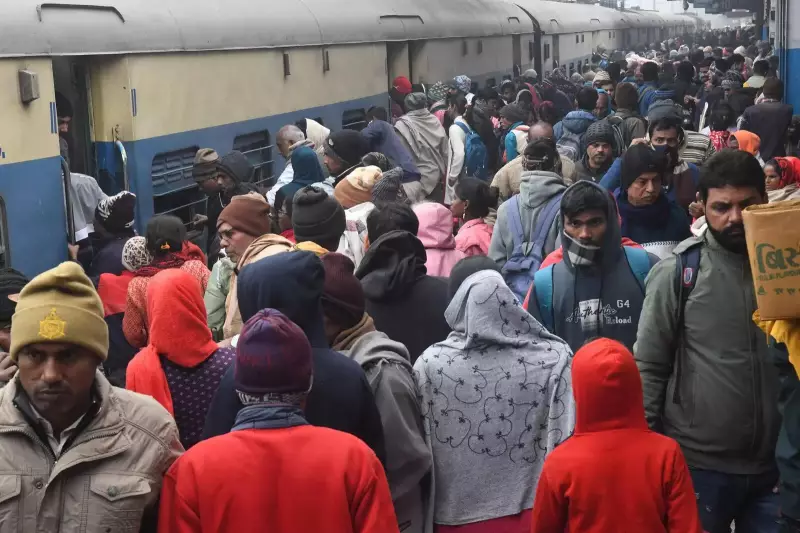
Rail passengers travelling from the national capital to Bihar's capital faced immense difficulties on Tuesday as severe fog and poor visibility brought train movement on the crucial Delhi-Patna route to a virtual standstill. The adverse weather conditions forced hundreds of travellers to endure prolonged, exhausting journeys inside delayed trains, with many premier services running several hours behind schedule.
Major Trains Hit by Extensive Delays
The disruption was widespread, affecting almost all mail, express, and premium trains arriving from Delhi. According to information from the Danapur control room, the New Delhi-Rajendra Nagar Terminal Tejas Rajdhani Express reached Patna nearly 12 hours late, causing significant inconvenience to its passengers. This was not an isolated incident.
A series of other important trains were also severely delayed. These included the New Delhi-Rajendra Nagar Terminal Sampoorn Kranti Express, the New Delhi-Rajgir Shramjeevi Express, and the Anand Vihar-Danapur Jansadharan Express. Furthermore, the New Delhi-Islampur Magadh Express, the New Delhi-Howrah Poorva Express, and the Anand Vihar-Bhagalpur Vikramshila Express all arrived at their destinations several hours behind their scheduled time.

Passenger Distress and Cascading Schedule Impact
The extended travel times caused acute distress, particularly for vulnerable groups like elderly passengers, children, and families. Many struggled with uncertainty, exhaustion, and a notable lack of timely information. "We were completely unprepared for such a long delay. Managing food, rest and children became extremely difficult," shared R K Srivastava, a passenger from Patna.
The abnormal delays had a cascading effect on the entire schedule. To manage the resulting congestion, railways were compelled to reschedule several outbound services from Patna, Ara, and Danapur. A Danapur railway official confirmed that departures of trains like the Patna-New Delhi Amrit Bharat Express, Ara-Ranchi Express, Danapur-Anand Vihar Jansadharan Express, and the Islampur-Hatia Express were pushed back late into Tuesday night or early Wednesday morning.
Safety Measures and Passenger Grievances
Railway officials stated that train speeds had to be drastically reduced as a safety precaution due to visibility dropping to dangerously low levels along several stretches. While this was necessary, it significantly increased travel time, leaving passengers physically drained and mentally stressed.
On the provision of amenities, IRCTC Patna joint general manager Rajesh Kumar stated that passengers on the heavily delayed Tejas Rajdhani Express were served snacks, tea, coffee, and meals in line with Railway Board guidelines for such situations. However, this response was deemed insufficient by many travellers. Several passengers, including those in premium classes, complained that these arrangements did little to compensate for the extreme discomfort and inconvenience caused by the prolonged delays.
The incident highlights the recurring challenges faced by Indian Railways and passengers during the winter fog season, raising questions about crisis communication and contingency planning for such widespread disruptions.