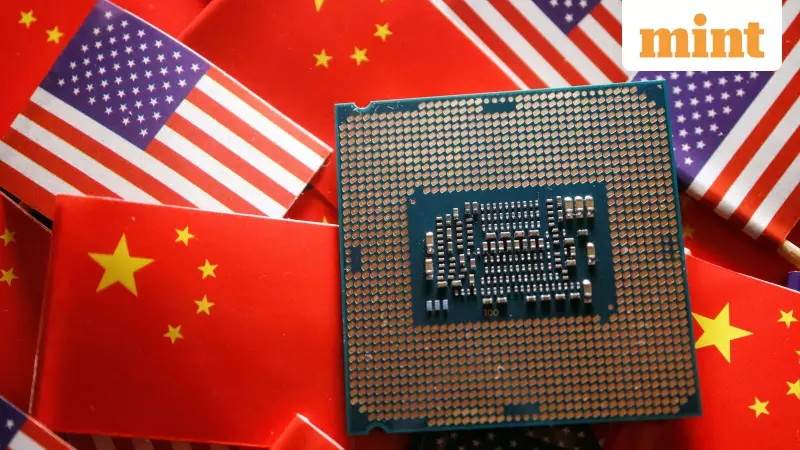
The performance of China's economy and its stock market in the coming year is set to be heavily influenced by external factors, particularly the health of the United States economy and global spending on artificial intelligence. Despite a surprisingly strong 2025, analysts point to a complex mix of domestic challenges and international dependencies that will shape the trajectory of the world's second-largest economy in 2026.
The Dual Economy: New Tech Boom vs. Old Economy Slump
A clear divergence defines China's current economic landscape. On one hand, the "new economy" sectors—encompassing artificial intelligence, biotech, robotics, semiconductors, and clean tech—are witnessing significant investor enthusiasm. This surge is partly driven by the buzz around models like DeepSeek and the persistent national priority under leader Xi Jinping to achieve greater technological self-reliance.
This momentum is reflected in the markets. The MSCI China exchange-traded fund delivered an impressive 29% gain in 2025, outperforming the S&P 500's 18% rise. Fund managers, including Vivian Lin Thurston of William Blair’s Emerging Markets Growth fund, see a favourable setup for these sectors, expecting further gains as rising earnings keep valuations attractive.

However, this dynamism contrasts sharply with a struggling "old economy," which still constitutes about 80% of China's GDP. The property sector remains a significant drag, with prices declining for four consecutive years. Recent months have seen investment and sales fall by double digits compared to the previous year. Retail sales growth slowed to a mere 1.3% in November 2025, the weakest pace since 2022, hampered by a weak job market and diminished household wealth from the property slump.
Investment Drought and the Critical Role of US Demand
A major concern is the sharp decline in investment, traditionally the lifeblood of China's growth. Spending on fixed assets fell by 2.6% year-on-year from January through November 2025, marking the worst contraction in decades. Analysts like Charlene Chu of Autonomous Research attribute this corporate hesitancy to weak demand, deflationary pressures hurting profit margins, and recent Beijing policies aimed at tackling excess capacity.
This is where the United States becomes pivotal. For China's economy to "muddle along," as Chu states, the US economy needs to remain robust and continue purchasing Chinese goods, even if routed through third countries like Vietnam or Malaysia. The first half of 2025 saw stronger-than-expected growth largely due to US companies stockpiling ahead of anticipated tariffs. China's trade surplus hit a record $1 trillion in the first 11 months of 2025, underscoring the continued importance of exports.
The October 2025 détente between Xi Jinping and US President Donald Trump, with plans for multiple meetings in 2026, has fostered hopes of avoiding a major escalation in tensions. This diplomatic thaw allows both leaders to focus on pressing domestic issues.
Potential Spoilers and a Shift in Strategy
The outlook is not without significant risks. Thurston warns that a burst of the AI-stock bubble in the US would inevitably hit Chinese tech stocks as well. Furthermore, if the US Federal Reserve maintains higher-than-expected interest rates, it could sap momentum from riskier assets globally, including Chinese equities.
Recognizing the over-reliance on exports and investment, there are signals Beijing may be preparing a strategic pivot. A collection of commentaries by Xi Jinping published in the policy magazine Qiushi in December 2025, titled "Expanding domestic demand is a strategic choice," has sparked optimism about potential government action. Rory Green of TS Lombard views boosting consumption as not just an economic imperative but a potential national security issue, crucial for social stability.

Brendan Ahern of KraneShares notes that such a shift could help address international calls for China to rely more on its own consumers. However, any meaningful change will take time. In the near term, analysts expect smaller-scale measures, such as subsidies for births, free kindergarten, and initiatives to develop domestic travel and entertainment to encourage spending from older citizens with ample savings.
For investors cautiously returning to Chinese markets, companies positioned to benefit from both the AI revolution and a potential consumption drive appear attractive. This includes internet giants like Alibaba, Tencent, and Baidu, as well as e-commerce leaders such as JD.com and PDD. Ultimately, China's 2026 story will be one of balancing internal transformation against the unpredictable winds of global demand and technological trends.