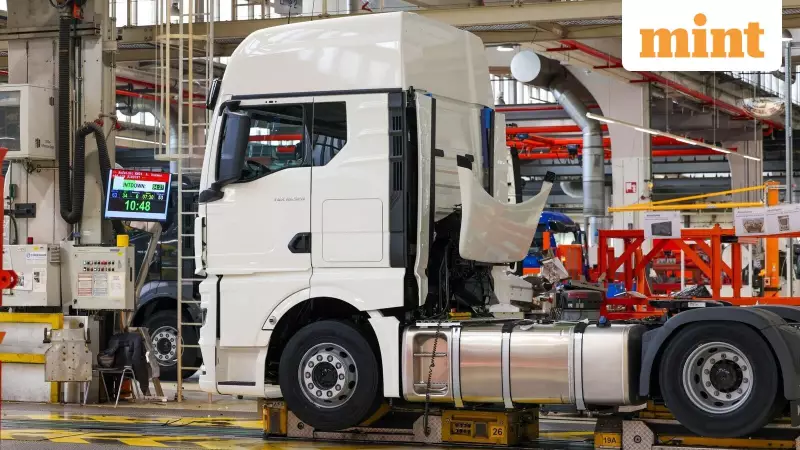
Fresh from concluding India's largest electric bus tender, the government's demand aggregation agency is now setting its sights on electrifying the country's freight transport. Convergence Energy Services Ltd (CESL) has reportedly asked the Centre to designate it as the nodal agency for tendering electric trucks under the ambitious PM E-Drive scheme.
From E-Buses to E-Trucks: CESL's Expanding EV Mandate
This strategic move comes less than two weeks after CESL successfully wrapped up a massive tender for 10,900 electric buses under the same ₹10,900-crore PM E-Drive initiative. The scheme's core objective is to accelerate electric mobility adoption, with a focus on public transport, freight, and ambulances to curb carbon emissions. According to sources familiar with the matter, CESL's plan for trucks mirrors its bus strategy: reducing the high upfront cost of these vehicles and establishing necessary EV chargers by creating large-scale demand through aggregation.
"CESL is looking to become the nodal agency for e-trucks also, now that the e-bus tender is done," revealed one of the two persons who spoke on condition of anonymity. The agency, a subsidiary of Energy Efficiency Services Ltd (EESL), has already initiated preliminary discussions with major Indian ports, which are significant hubs for thousands of trucks moving goods daily.

Building Scale in a Challenging Market
The push for electric trucks gains urgency as incentives for two- and three-wheelers under the PM E-Drive scheme are scheduled to end in March 2026. The government, through the Ministry of Heavy Industries (MHI), has identified ports, steel, cement, and logistics as key sectors to generate demand for these vehicles.
Amit Bhatt, India Director at the International Council on Clean Transportation (ICCT), emphasized the critical need for scale. "In a freight sector where buyers and operators are private sector entities, gathering demand to create scale is of the essence, as it could lead to lower prices being discovered. The value is in volume when it comes to electric trucks," he stated. He highlighted the affordability challenge, noting that electric trucks remain 2 to 2.5 times more expensive than their diesel equivalents.
CESL's prior experience in tendering electric buses under central schemes is seen as a major advantage. This experience has helped the agency build relationships with manufacturers like Tata Motors and Ashok Leyland, which also produce electric trucks.
High Costs, Localization Hurdles, and Slow Adoption
The government has allocated ₹500 crore under the PM E-Drive scheme specifically to lower the procurement cost of approximately 5,500 e-trucks. This subsidy could reduce the price of each truck by ₹2 to ₹9 lakh, a crucial intervention given that a heavy-duty electric truck can cost over ₹1 crore. This marks the first direct financial support from the government for e-truck adoption.
However, the path is fraught with challenges. Incentives under the scheme are tied to strict localization norms designed to boost domestic manufacturing. The phased manufacturing programme set a cutoff date of 1 September 2025 for importing components like HVAC systems, brake compressors, charging inlets, and battery management systems, with some extensions until 1 March 2026.
Manufacturers have faced difficulties meeting these guidelines, especially after China's export controls on rare earth magnets in April last year. These magnets are vital for traction motor sub-assemblies in electric trucks, and importing complete sub-assemblies instead of just magnets could disqualify companies from receiving incentives.
Adoption figures underscore the slow pace of change. According to the Vahan portal, only about 560 medium and heavy-duty e-trucks were sold in India in 2025, up from 220 in 2024. Notably, the official dashboard for the PM E-Drive scheme showed that no e-trucks had received incentives as of 5 January 2026.

CESL's bid to lead this transition occurs against the backdrop of its parent company, EESL, facing financial constraints and exiting several joint ventures. Despite these headwinds, the agency's focus on aggregating demand for electric trucks represents a pivotal effort to jumpstart a cleaner future for India's crucial freight transportation sector.