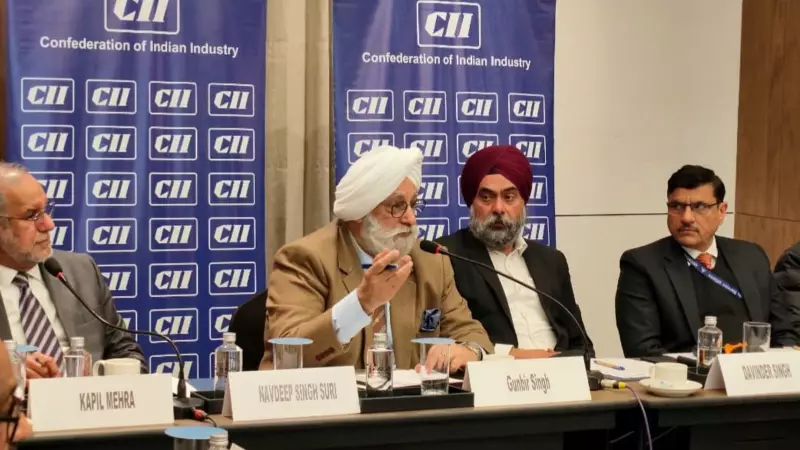
A high-level meeting convened by the Confederation of Indian Industry (CII) Amritsar Zonal Council has identified air exports of agricultural produce as a critical economic catalyst for the region, with a specific focus on enhancing trade with Afghanistan. The session, held on Wednesday, January 7, 2026, brought together key stakeholders to strategize on leveraging the Sri Guru Ram Dass International Airport as a major cargo gateway.
Unlocking Dormant Potential at Amritsar Airport
The discussions were anchored by a review conducted by the Indo-Afghan Business Commission (I-ABC), led by its former Punjab chairman, Gunbir Singh. The review followed extensive interactions with various stakeholders in the trade ecosystem. A glaring gap was highlighted by current cargo statistics: the airport handled a mere 236 metric tonnes of imports and 972 metric tonnes of exports in the last year. This is despite the facility having a dedicated holding capacity of 250 tonnes for perishable and non-perishable goods, as revealed by Airport Director Bhupinder Singh.
Bhupinder Singh committed to immediate and full support for the trading community to bridge this significant gap. "He offered his complete commitment to assist the trading community in sorting out any gaps forthwith to reach the potential which is manifold," the council noted in its proceedings.

Expert Insights on Barriers and Opportunities
Prominent experts provided granular insights into the challenges and opportunities. Former Indian ambassador Navdeep Suri praised the session as the "finest granular interaction on trade" he had witnessed within Indian business chambers. He proposed an ambitious Amritsar-Kabul-Dubai trade axis, facilitated by frequent wide-bodied flights, to capitalize on the geographic and economic logic.
On the ground, practical hurdles were flagged by exporter and farmer Sahib Singh Bajwa, who returned from Canada to work in Punjab. He pointed to ample opportunities for local produce but cited critical delays caused by limited aircraft space, restrictive customs operating hours, and frequent holidays that disrupt the cold chain for perishables.
RahatCargo MD Sunil Kohli presented a tangible business proposition, agreeing to underwrite 1,500 to 1,800 tonnes of weekly cargo. However, this commitment is contingent upon swift customs clearances and the availability of suitable flight operations.
A Call for Coordination and Competitive Action
Convenor Gunbir Singh framed the opportunity in stark, competitive terms. "Lahore, just 35 miles away, exports twenty times as much cargo as Amritsar," he stated, underscoring the urgent need for action. He emphasized the transformative impact perishable exports could have on the regional farm economy, further amplified by value-added products, textiles, and pharmaceuticals. He also highlighted the need for balanced trade, noting that airlines would require import loads to keep freight charges optimal for exporters.
Concluding the meeting, CII Amritsar Zonal Council chairman Davinder Singh pinpointed the core requirement for success. He stated that tapping into the vast potential of perishable exports demands significantly better coordination among the airport authorities, customs agencies, and cargo handlers. "We will work towards this with cooperation of all stakeholders," he affirmed, setting a collaborative agenda for the future.
The consensus from the meeting is clear: with coordinated policy support, infrastructure tweaks, and airline partnerships, Amritsar Airport can evolve from an underperforming asset into a powerful economic force multiplier for Punjab's border region and its agricultural sector.