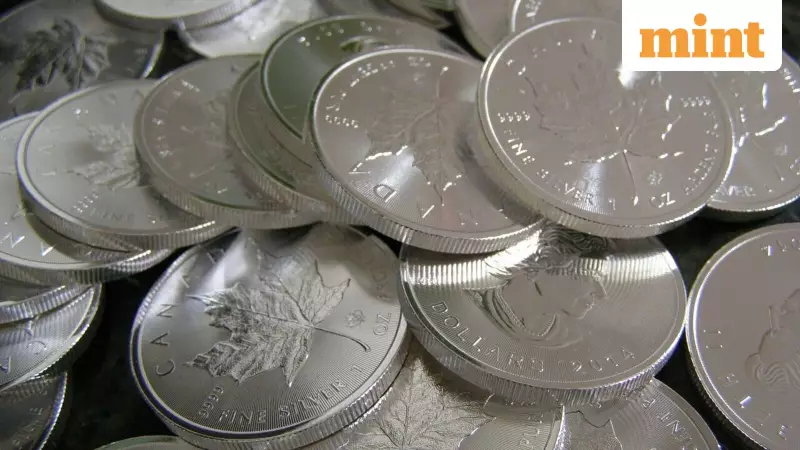
The white metal's spectacular rally in 2025 hit a dramatic pause this week. After scaling an unprecedented peak of $82.670 per ounce in the international market on Monday, the COMEX silver price witnessed a sharp correction, closing at $71.300 per ounce. This represents a steep single-day drop of $11.37 per ounce or 13.75% from its record high. The plunge follows an astonishing 180% surge in 2025, driven primarily by a tightening demand-supply scenario.
What Drove the Rally and the Sudden Fall?
The silver market's bull run was fueled by a confluence of factors. A significant trigger was the announcement by tech giant Samsung to transition from lithium-ion to solid-state batteries, which sharply increased projected industrial demand for silver. This was compounded by structural supply disruptions, including export issues from Peru and Chad due to escalating US-Venezuela tensions. A looming shadow ban on silver exports from China, effective January 1, 2026, further supported prices at lower levels after initial profit-taking began.
However, the very price rally that created records is now threatening the metal's industrial utility. Market experts are sounding the alarm, suggesting that prices have reached a level where industrial demand is becoming jeopardised.

Industry Shifts from Silver to Copper
Experts warn that no industry can indefinitely absorb rising raw material costs. Amit Goel, Chief Global Strategist at Pace 360, highlights a critical shift already underway. "Amid skyrocketing silver prices, some of the industrial demand for silver has already been jeopardised," he states. The photovoltaic and solar panel sectors have successfully moved from silver to copper. A similar transition is in progress for solid-state batteries, where companies in Israel, Taiwan, Australia, and China are actively working to replace silver coil binding with copper coil binding.
This search for alternatives is a direct response to cost pressures. "An industry can digest a raw material only until it is economically viable for business survival," Goel explains. Tesla CEO Elon Musk's recent warnings about material costs add weight to these concerns.
Price Targets: Can Silver Touch $100 or Crash 60%?
The immediate future of silver is a tale of two scenarios, both outlined by experts. The current rebound from lows is attributed to short-covering by major institutions like BofA and Citibank. This could propel prices higher temporarily.
Goel believes silver prices have either already peaked at $82.67 or may see a final surge. "I personally believe that silver prices... can either touch $100 per ounce by February 2026 or end up coming close to $100 levels," he said. However, this rally is expected to be short-lived.
The long-term outlook turns decidedly bearish. By the end of the 2026-27 financial year (FY27), experts predict a severe correction. If silver peaks near $100, the COMEX price could fall to around $40 per ounce. If the peak was already reached at $82.67, the decline could be even steeper, potentially bringing prices down to $35 per ounce—a crash of up to 60% from the projected peak.
A History of Volatility: Lessons for Investors
This boom-and-bust pattern is not new for silver. Anuj Gupta, Director at Ya Wealth, advises investors to look at history. Silver has a tendency to crash heavily after a strong bull trend. A famous example is 1980, when actions by the Hunt Brothers led to a price collapse from around $49.50 to $11 per ounce. A similar event occurred in 2011, when prices fell 75% after peaking near $48.
Gupta points out that exchanges have already begun increasing margin requirements—a move reminiscent of past crashes—with CDX raising margins by 25%.

Given this volatile and uncertain outlook, the unanimous advice from analysts is clear. Retail investors are strongly advised to consider booking profits on long positions and avoid entering new ones. The consensus is that the silver market is entering a dangerous phase where the risks of a major downturn significantly outweigh the potential for further gains.
Disclaimer: This story is for educational purposes only. The views and recommendations above are those of individual analysts or broking companies. We advise investors to check with certified experts before making any investment decisions.