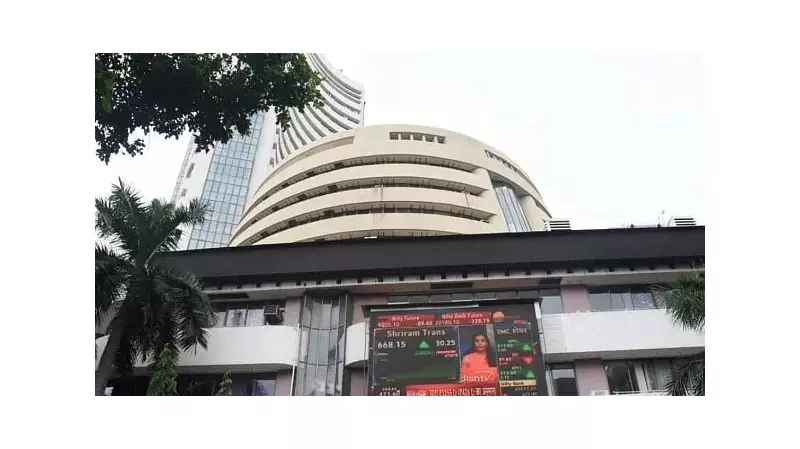
Indian equity benchmarks witnessed a sharp decline during early trading hours on Wednesday, mirroring the negative sentiment prevailing across global financial markets. Both the benchmark Sensex and Nifty opened in the red, extending the previous session's losses as investors remained cautious about the broader economic outlook.
Market Performance Details
The 30-share BSE Sensex opened weak and continued to slide, trading 277.21 points or 0.37 percent lower at 73,904.44 during the initial hours. Similarly, the broader NSE Nifty faced significant pressure, declining by 77.85 points or 0.34 percent to 22,466.90. Market analysts attributed this downward movement to multiple factors, including weak global cues and profit-booking after recent gains.
Among the Sensex constituents, several major companies witnessed substantial selling pressure. Mahindra & Mahindra, IndusInd Bank, HCL Technologies, Tech Mahindra, and Tata Steel emerged as the top laggards, dragging the index lower. The banking sector particularly struggled, with both private and public sector banks showing weakness in early deals.

Global Market Influence
The negative trend in Indian markets largely reflected the weak performance of global peers. Asian markets displayed mixed but generally negative sentiment, with Seoul, Tokyo, and Hong Kong trading lower while Shanghai quoted in positive territory. The cautious approach among international investors stemmed from ongoing concerns about interest rate trajectories and geopolitical tensions.
European markets had set a negative precedent on Tuesday, closing mostly in the red, while US markets ended with significant losses. This global weakness created an unfavorable environment for risk assets worldwide, including emerging markets like India. The market sentiment was further dampened by foreign portfolio investors turning net sellers in recent sessions.
Sectoral Performance and Expert Analysis
Analysis of sectoral indices revealed broad-based weakness across multiple segments. The BSE largecap index declined by 0.31 percent, while the midcap gauge fell by 0.24 percent. Smallcap companies showed relative resilience, dropping only 0.08 percent. Among specific sectors, real estate and utilities managed to buck the trend, posting modest gains.
Market experts suggested that the decline represented a technical correction after recent rallies rather than a fundamental shift in market dynamics. They noted that domestic institutional investors continued to provide support, partially offsetting foreign selling pressure. The underlying strength of the Indian economy and corporate earnings growth expectations remained intact, providing a foundation for potential recovery.
Trading activity indicated healthy participation levels, with the BSE benchmark recording a volume of 24.77 lakh shares. The total market capitalization of BSE-listed firms stood at approximately ₹402.43 lakh crore, reflecting the substantial value erosion during the session. Analysts recommended that investors focus on quality stocks with strong fundamentals during such corrective phases.