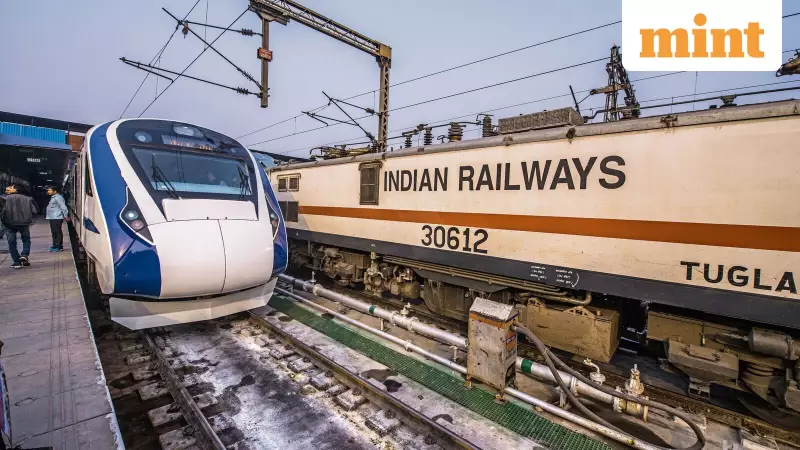
Shares of major railway public sector undertakings (PSUs) witnessed a significant uptick during Monday's trading session, December 22, driven by renewed investor interest. This rally was a direct response to the Indian Railways' announcement of a rationalization of passenger fares, a move designed to address rising operational costs.
Details of the Fare Revision
The revised fare structure, which will come into effect from Friday, December 26, introduces a marginal increase across various travel classes. For journeys exceeding 215 kilometers in the ordinary class, fares will rise by one paise per kilometer. Passengers traveling in Mail and Express non-air-conditioned (non-AC) categories will see an increase of 2 paise per kilometer. Similarly, all air-conditioned (AC) classes will also witness a uniform hike of 2 paise per kilometer.
The Ministry of Railways has emphasized that the financial impact on passengers will be minimal. To illustrate, a 500-kilometer journey in a non-AC coach will cost only ₹10 more under the new pricing. Despite the modest per-kilometer increase, this rationalization is projected to generate substantial additional revenue of approximately ₹600 crore for the national transporter in the remaining period of the current fiscal year.

Context and Financial Sustainability
This marks the second fare adjustment in the current financial year. The previous increase occurred on 1 July 2025, when fares for ordinary second class, sleeper (non-AC), and first-class travel were raised by half a paise per km. That hike was the first since the COVID-19 pandemic. Prior to that, in January 2020, fares were increased by two paise per km for non-AC and four paise per km for AC chair car and AC-3 tier categories.
The ministry stated that this latest rationalization aims to streamline tariff structures and enhance the financial sustainability of passenger services. It is a critical step as Indian Railways incurs losses on passenger transport across all classes, with passenger fares currently set about 45% below the actual cost of operations. These losses have traditionally been cross-subsidized by higher freight charges.
Impact on Operating Efficiency and Stocks
The fare revision is strategically timed ahead of the Union Budget for FY2027. It is expected to aid the Railways in improving its operating ratio, a key metric of efficiency. For the current fiscal year (2025-26), the operating ratio is projected at 98.43%. This ratio represents working expenses as a proportion of traffic earnings; a lower ratio indicates better financial health.
Following the announcement, railway stocks experienced a sharp rally. Companies like RailTel Corporation of India, Rail Vikas Nigam, Ircon International, Indian Railway Finance Corporation (IRFC), and Indian Railway Catering & Tourism Corporation (IRCTC) saw their share prices climb between 1% and 5%. Investors appear to be betting on improved revenue visibility and financial metrics for these railway-linked PSUs as a result of the fare rationalization policy.
Disclaimer: Investors are advised to consult certified financial experts before making any investment decisions.