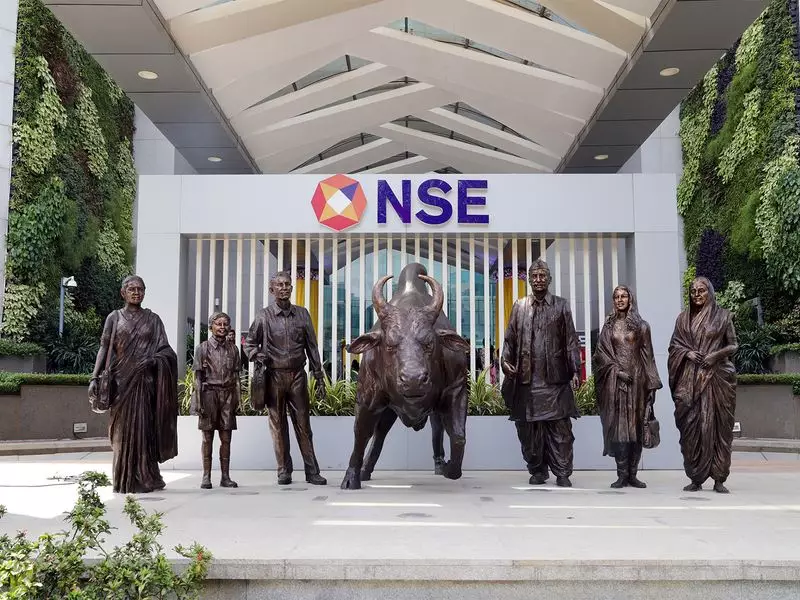
In a clear demonstration of market leadership, the Nifty 50 index has solidified its position as the premier performer on the National Stock Exchange (NSE) over the past year. Data reveals that the flagship index delivered a robust return of 10.5 percent, significantly outpacing its broader counterpart.
A Tale of Two Indices: Performance Divergence
The performance gap between India's two most-watched equity benchmarks has become strikingly evident. While the Nifty 50 soared, the Nifty Next 50 index, which comprises the 50 companies succeeding the Nifty 50 in terms of market capitalization, managed a meager gain of only 2 percent for the same 12-month period ending recently. This stark contrast highlights a concentrated rally driven primarily by the largest blue-chip stocks.
This trend is not an isolated event but part of a longer-term pattern. Over a three-year horizon, the Nifty 50 has surged by an impressive 59.5 percent. In comparison, the Nifty Next 50 has grown by 44.5 percent. The five-year picture further cements the dominance of the top-tier index, with the Nifty 50 registering a formidable 98.5 percent return against the Next 50's 61 percent.

What's Driving the Nifty 50's Outperformance?
Analysts point to several key factors behind this sustained outperformance. The Nifty 50, being the core benchmark, has benefited immensely from strong foreign institutional investor (FII) flows into large-cap stocks, which are perceived as safer havens during global volatility. Furthermore, sectors heavily represented in the Nifty 50, such as banking, IT, and Reliance Industries, have seen consistent buying interest.
The composition and investor behavior play crucial roles. The Nifty 50 is often the first port of call for both domestic and international funds seeking exposure to Indian equities. This creates a self-reinforcing cycle of liquidity and demand for its constituents. On the other hand, the Nifty Next 50, while consisting of excellent companies, often faces higher volatility and relatively lower liquidity, making it less attractive to risk-averse capital in uncertain times.
Implications for Investors and the Market
This widening performance gap sends a clear signal to the investment community. It underscores a market where premium valuations are being accorded to the largest, most liquid names, often at the expense of the next rung of companies. For retail and institutional investors, this emphasizes the importance of index selection and the potential risks of a broad-brush approach to equity investing.
The data suggests that a simple strategy of investing in a Nifty 50 index fund or ETF would have yielded superior risk-adjusted returns compared to one tracking the Next 50 over these periods. However, market cycles are dynamic. Historically, periods of large-cap dominance are often followed by phases where mid-cap stocks, like those in the Next 50, catch up and outperform.
The current scenario presents a critical question for portfolio strategy: Is the concentration risk in the top 50 stocks becoming excessive, or is this the new normal for Indian markets? Fund managers and analysts will be watching closely to see if the valuation gap triggers a mean-reversion trade, bringing money back into the quality names within the Nifty Next 50 basket.
In conclusion, the NSE's performance data paints a picture of a two-tiered market. The Nifty 50, with its 10.5 percent annual return, has firmly worn the crown, leaving the Nifty Next 50 and its 2 percent gain far behind. This divergence is a powerful reminder of the forces of liquidity, safety, and momentum that drive modern equity markets.