

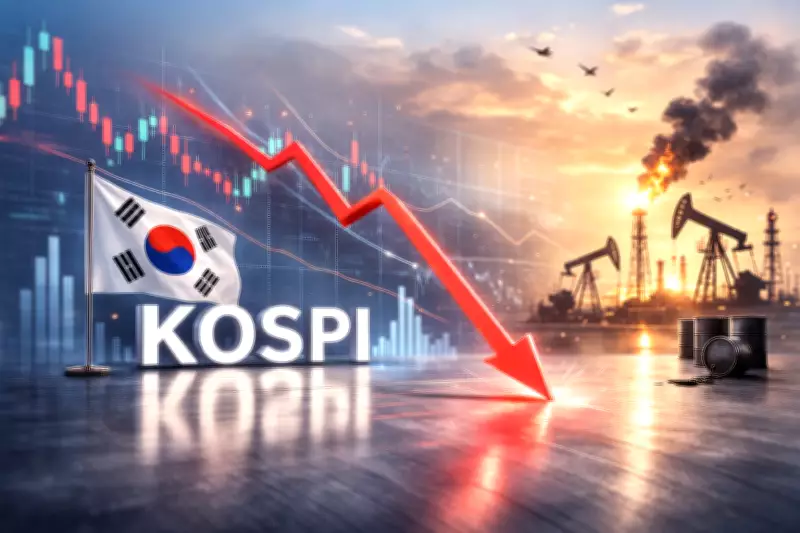
South Korea's Kospi Index Plunges 13% as Middle East Crisis Triggers Market Meltdown
South Korea's Kospi index, which had been one of the world's hottest-performing markets over the past year with a staggering 36% gain, hit a dramatic roadblock on Wednesday. The benchmark tumbled as much as 13% in a single session, marking a sharp reversal from its recent record highs. This sell-off followed a 7.2% decline in the previous session, directly linked to escalating tensions in the Middle East.
Circuit Breakers Triggered as Heavyweights Lead Sell-Off
The sell-off was led by market heavyweights that had powered the Kospi's gains until last month, including Samsung Electronics, SK Hynix, and Hyundai Motor. Trading in both Kospi and Kosdaq shares was halted for 20 minutes after losses exceeded 8%, activating circuit breaker mechanisms designed to curb panic selling.
The benchmark fell sharply as heavy selling in these index giants dragged the entire market lower. This came after a prolonged AI-driven rally had left valuations stretched and vulnerable to external shocks. Rising oil prices amid Middle East tensions further dampened sentiment, with South Korea's status as the world's eighth-largest crude consumer making energy costs a critical factor.

Global Risk Aversion Intensifies Market Pressure
Simultaneously, global investors moved aggressively to cut risk exposure. Foreign funds turned net sellers, while retail participation weakened significantly. A spike in volatility intensified the sell-off, with the Kospi 200 Volatility Index surging to its highest level since March 2020.
"Moves are too extreme so forecasting feels almost impossible – analysis doesn't really help," said An Hyungjin, CEO of Seoul-based Billionfold Asset Management. "Retail investors seem to hesitate as well, bids are fading since yesterday. While we are picking quality names and hedging, this isn't a clear opportunity."
AI Boom Fuels Historic Rally Before Crisis Hits
South Korea's stock surge had been fueled primarily by the artificial intelligence boom, with the Kospi climbing nearly 50% this year at its peak. Over the past year, South Korean equities often bucked regional trends, rising even when other markets fell. Strong demand for memory chips drove multi-fold gains in Samsung and SK Hynix, while government-led corporate reforms spurred a market re-rating.
In February, the South Korean benchmark had hit a fresh record high, rising 3% to close at 5,677.25. Before the Middle East crisis broke out, Goldman Sachs had predicted a bright rally ahead, forecasting 120% earnings growth for Korean equities in 2026.
Defense Stocks Buck the Trend Amid Geopolitical Uncertainty
Not all sectors were hit equally hard. Defense stocks continued to rise amid expectations that instability in the Middle East will persist. LIG Nex1 and Hanwha Systems each climbed more than 25% at their intraday highs, highlighting how geopolitical tensions create divergent market opportunities.
"This may create select opportunities to build positions in companies and industries that are now trading at attractive prices," said Park Sojung, a portfolio manager at Matthews Asia. "South Korean industrials such as defense and shipbuilding may again be highlighted as beneficiaries of global instability, constrained supply, and South Korea's growing strategic importance."
Investors Debate: Temporary Pause or Fundamental Turning Point?
Investors are now actively debating whether the recent turbulence signals a turning point or merely a pause before the market resumes its upward trajectory. The uncertainty surrounding US Federal Reserve easing policies adds another layer of complexity to the outlook.
"This reads like a positioning unwind more than a South Korea-specific fundamental break," Dave Mazza, CEO of Roundhill Investments, told Bloomberg. "When global risk appetite turns and energy and foreign exchange volatility jump, you get fast de-risking in the biggest, most liquid index names."

Foreign investors were net sellers of Kospi stocks in morning trading, while retail and local institutional investors increased positions. The dramatic reversal serves as a stark reminder of how quickly geopolitical events can unravel even the strongest market rallies, particularly when valuations have become extended after prolonged gains.





