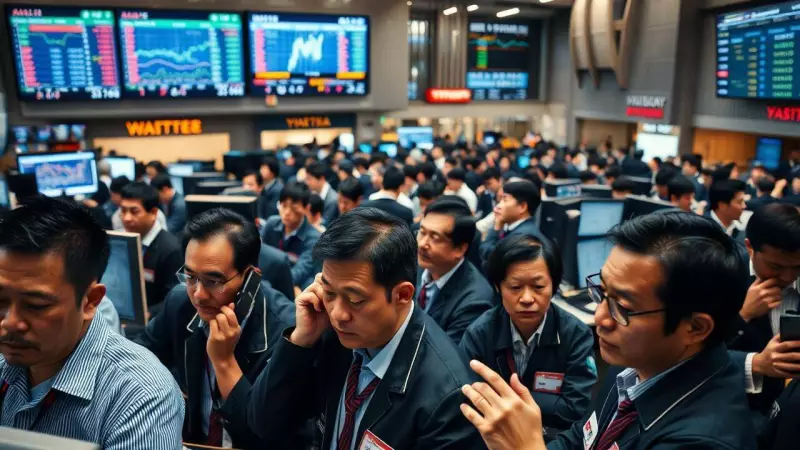
Global financial markets presented a divergent picture on Wednesday, with Asian indices showing mixed performances, tempering the record-breaking momentum witnessed recently on Wall Street. The trading sentiment was influenced by geopolitical developments, notably in Venezuela, and the overarching trend of global interest rates.
Asian Markets Retreat from Highs
Key Asian benchmarks stepped back from their previous day's records. Japan's Nikkei 225 declined by 0.9 per cent to settle at 52,041.97. Similarly, South Korea's Kospi fell 0.5 per cent to 4,503.23. In contrast, Australia's S&P/ASX 200 managed a gain of 0.3 per cent, closing at 8,708.50. Hong Kong's market witnessed a decline, while Shanghai posted modest gains for the session.
Analysts pointed to rising global uncertainties as a key dampener. "Global uncertainty continues to deepen," remarked Tan Boon Heng of Mizuho Bank in Singapore. He highlighted the dramatic political developments in Venezuela and the unusual situation concerning Greenland as reported by AP, which captured significant trader attention.

Wall Street Defies Gravity, Commodities Slip
Defying the cautious mood in Asia, Wall Street continued its upward trajectory, posting fresh historic records. The S&P 500 climbed 0.6 per cent to reach 6,944.82. The Dow Jones Industrial Average rose a solid 1 per cent to 49,462.08. The technology-focused Nasdaq Composite added 0.6 per cent, ending at 23,547.17. Small-cap stocks outperformed, with the Russell 2000 index jumping 1.4 per cent.
In the commodities market, oil prices retreated. US crude oil dropped 78 cents to $56.35 per barrel. Traditional safe-haven assets like gold and silver also saw declines, despite their strong performance over the past year amid persistent global tensions.
Investors Await Fed's Next Move
Currency and bond markets saw minor adjustments. The US dollar edged up slightly against the Japanese yen, while the euro made small gains. Yields on bonds rose, with the key 10-year Treasury yield climbing to 4.16 per cent.
The focus for investors is now squarely on the future path of interest rates. Market participants are eagerly awaiting the next meeting of the US Federal Reserve scheduled for late January. This meeting is crucial as it follows three interest rate cuts implemented in the year 2025, setting the stage for the central bank's policy direction in the coming months.
The interplay between robust US market performance, mixed Asian signals, and unfolding geopolitical events underscores a complex global financial landscape where traders are navigating multiple crosscurrents.