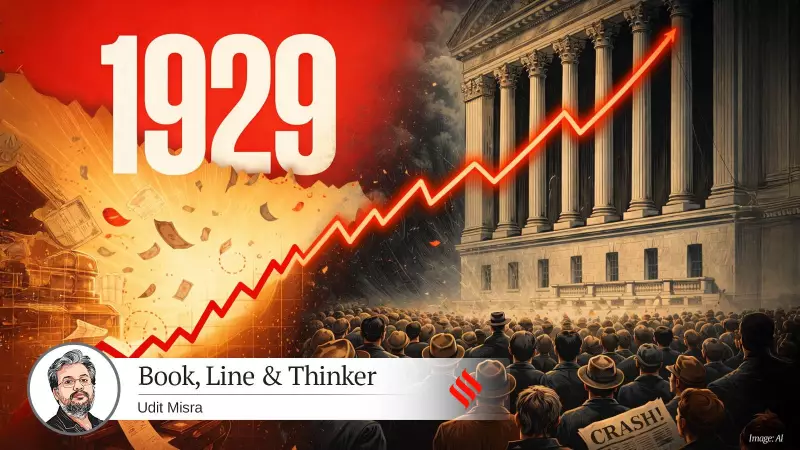
As the world witnesses an unprecedented surge in artificial intelligence and cryptocurrency valuations, a chilling question emerges from the pages of history: are we standing on a similarly fragile foundation that led to the catastrophic Wall Street collapse of 1929? Acclaimed journalist Andrew Ross Sorkin's latest book delivers a gripping, minute-by-minute reconstruction of that fateful period, forcing readers to confront unsettling parallels with our current economic climate.
The Anatomy of a Catastrophe: Unpacking 1929
The Great Depression, which began with the stock market crash of October 1929, remains the most severe economic downturn of the modern era. Sorkin's narrative reveals how the US Gross Domestic Product (GDP) plummeted by a staggering 30%, while unemployment soared to an unprecedented 25%. The domino effect was devastating, leading to the failure of approximately 9,000 banks. This wasn't just an American crisis; tethered by the gold standard and global trade, the economic shockwaves wrecked economies and lives worldwide.
The Roaring Twenties that preceded the crash were marked by a "massive bifurcation" of society. Technological shifts disrupted farming, while credit-fuelled urban growth created vast inequality between city elites and rural populations. Under President Calvin Coolidge, regulation was sidelined for laissez-faire policies, and businesses operated with minimal oversight. An explosion of credit allowed everything from stocks to home appliances to be bought on borrowed money. The stock market, driven by rampant speculation and a blind belief that "this time is different," became the economy's precarious engine.

Sorkin's Masterful Storytelling: A Fly-on-the-Wall View
While the facts of 1929 are well-known, Sorkin's achievement lies in his immersive storytelling. Moving beyond a dry historical account, he constructs the drama like a screenplay, with chapters titled by specific dates. He places the reader in the room with key decision-makers like Thomas Lamont of JP Morgan and Charles Mitchell of National City Bank, and even alongside peripheral figures like Evangeline Adams, a famous astrologer known as the "stock market seer."
His meticulous research, drawing from hundreds of sources including private letters, architectural plans, and oral histories, breathes life into the past. Describing the dawn of Black Thursday, October 24, 1929, he writes of sunlight glancing off the New York Stock Exchange's marble columns, forcing the gathered crowds to squint—a vivid detail that underscores the profound normalcy just before the world changed. This human-centric approach empowers readers to draw their own conclusions about the causes of the collapse.
Eerie Parallels: Is Today's World on a Similar Brink?
Finishing the book, the parallels to the present day are impossible to ignore. Today's world is fractured by geopolitical tensions, such as between the US and China, and by rising internal populism and anti-immigrant sentiment. Crucially, unlike a century ago, governments are already overleveraged from pandemic-era stimulus and war-related supply chain interventions, leaving them with diminished capacity to absorb another major financial shock.
Into this fragile environment steps the dizzying boom in AI and cryptocurrencies. AI promises to fundamentally reshape work, life, and policy, but its immense energy demands and societal disruptions pose unquantified risks. Cryptocurrencies, often lacking tangible underlying assets, represent a new frontier of speculative uncertainty. The borrowing patterns and interlinkages of giants like Nvidia, OpenAI, and Meta become critical stress points. Furthermore, policies like former President Donald Trump's push for tariffs add friction to the global economic machinery.
Sorkin, who previously chronicled the 2008 crisis in "Too Big to Fail," intended this book as a prequel, hoping to emulate the definitive account of the Titanic's sinking. His work serves as a stark warning. As we marvel at today's technological revolutions, his reconstruction of 1929 compels us to ask: What is the current AI and crypto boom really built on? The hope is that by understanding the human folly and systemic failures of the past, we might avoid necessitating a sequel about a future crash.