

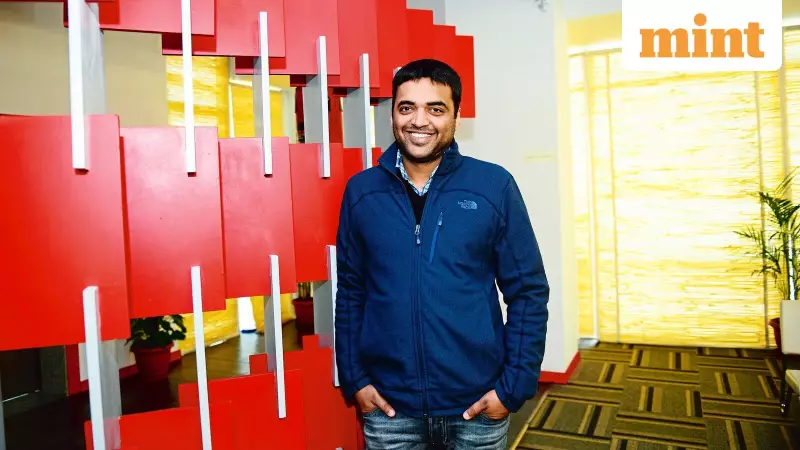
The founder and CEO of Zomato, Deepinder Goyal, has firmly rejected allegations that the intense rush for 10-minute deliveries is leading to the exploitation and endangerment of delivery workers. Goyal asserted that the quick-commerce model operates without imposing strict time pressures on its delivery partners.
No Fixed Timelines for Delivery Partners, Says Goyal
Speaking on a podcast hosted by Raj Shamani, Goyal clarified the mechanics behind Blinkit's rapid delivery promise. He emphasized that the 10-minute target is not achieved by forcing riders to drive recklessly. "Our delivery partners are not given any fixed timeline that they must deliver the food by a certain time," Goyal stated. He explained that the system is enabled by the high density of dark stores, which are small warehouses located close to customers.
"10 minutes is not enabled through us asking people to drive fast; 10 minutes is enabled by density of stores," he said. Highlighting the scale, Goyal noted that the Delhi NCR region alone has over 400 Blinkit stores. He broke down the timeline: average packing time is about 1 minute and 40 seconds, leaving approximately 8 minutes to cover a distance that is typically under one kilometre due to the proximity of the store.

Goyal further revealed that the countdown timer visible to customers during delivery is not shown to the delivery executive. The partner simply receives a job to pick up and drop an order, a process he described as a "shuffling job." He addressed scenarios where deliveries are delayed, stating that the team calls the partner to check on their well-being. "If we realise there is a problem, we help them. Otherwise, sometimes they are just relaxing or having a smoke, and we tell them, 'Please do that later—go and complete the delivery first,'" Goyal shared.
Political Call to End 'Cruelty' of Quick Commerce
This defence comes amid growing political scrutiny of the working conditions in India's gig economy. Last month, Aam Aadmi Party (AAP) Member of Parliament Raghav Chadha brought the issue to the forefront, seeking an end to what he termed the "cruelty of 10-minute delivery."
Chadha highlighted the plight of delivery personnel from platforms like Zomato, Swiggy, Blinkit, Zepto, and others, calling them the "invisible wheels" of the Indian economy. He acknowledged that quick commerce has transformed daily life but argued it relies on a workforce that toils in all conditions and frequently risks their lives to meet demanding speed expectations.
"Companies are earning in billions because of these workers, and many upped their valuations and became unicorns. But the conditions of the gig workers are worse off than daily wage labourers," the Punjab MP asserted in Parliament. He appealed for dignity, proper protection, and fair wages for these workers, reminding the House that "these people are not robots."
The Core of the Debate: Efficiency vs. Welfare
The contrasting narratives from a top tech CEO and a parliamentarian underscore a critical debate in India's booming digital economy. On one side, companies like Blinkit argue their operational model is built on logistical efficiency and proximity, not human exploitation. On the other, lawmakers and activists point to the immense pressure, lack of social security, and safety risks faced by the millions who form the backbone of this convenience.
While Goyal's comments aim to dispel notions of systemic pressure, Chadha's intervention ensures that the welfare of gig workers remains a pressing issue for public and policy discourse. The outcome of this debate could shape future regulations for India's rapidly expanding quick-commerce and gig work sectors.






