

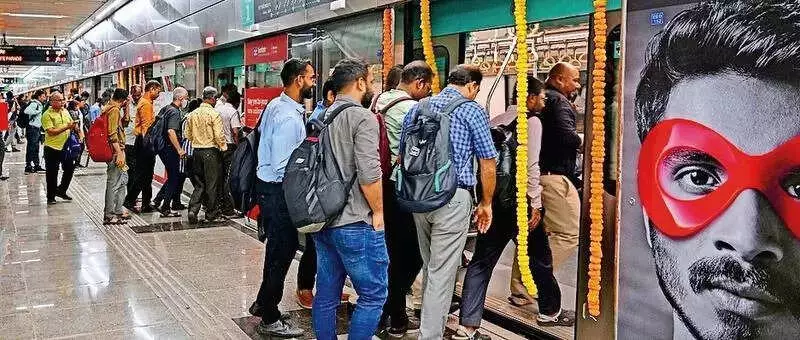
For senior citizens like Ovita and Ajit Parulekar, residing near Shivaji Park, the rhythm of life in Mumbai has changed dramatically. Their evenings, once constrained by relentless traffic jams and road closures, have found a new, vibrant pace. The catalyst for this transformation is none other than the recently operational Metro 3, popularly known as the Aqua Line.
A New Lease on Social Life for Mumbai's Seniors
"Our social life has improved tremendously. We now go out more frequently because travelling to BKC or South Mumbai on the Aqua Line is so easy," shares Ajit Parulekar, a former state-level hockey and basketball player who retired from SBI. He emphasizes the comfort and safety the metro offers, even during late-night journeys, a relief from their previous dependence on app-based cabs.
The Parulekars have also been freed from a peculiar urban anxiety: the parking space gamble. Earlier, they hesitated to drive their car, fearing they would lose their precious parking spot on their street. The metro has effectively parked that worry away, granting them newfound mobility.

Professionals Reclaim Time and Hobbies
The benefits of Mumbai's infrastructure push in 2025, which saw the launch and extension of projects like the Aqua Line, the Santacruz-Chembur Link Road (SCLR), the Vikhroli East-West Flyover, and the Coastal Road's northbound connector, extend far beyond simple commute reduction.
Khushi Rawat, a PR professional who moved from Kota to Mumbai four years ago, strategically relocated to Ghatkopar to tap into the metro network. "Ghatkopar is well-connected to all three metro lines, making travel to south Mumbai and western suburbs easy," says Rawat, who works in Saki Naka. Her one-way commute has been slashed from over an hour to just about 30 minutes. "I've stretched my living budget, but it's worth it for the easier life," she adds.
For Krishnaprasad K, another PR professional, the Aqua Line has an unexpected perk. The poor mobile network in the underground sections has turned into an opportunity. He now uses his travel time from Mahalaxmi to Saki Naka to read more books than ever before.
Commendation and Criticism: The Full Picture
While commuters applaud the metro, they are vocal about its shortcomings. Poor mobile connectivity is a universal grievance, making coordination difficult. Ovita Parulekar points out another issue for seniors: the long walking distance from the station entrance to the platform, which can be challenging for the elderly.
The advantages of new infrastructure sometimes ripple out to those who don't even use it directly. Marketing professional Anand Vaidya's life improved thanks to the SCLR, which decongested Nehru Road in Vakola where he lives. His drive to Lower Parel now takes about 40 minutes, saving him an additional 40 minutes previously spent just covering the 300-meter crawl from the Western Express Highway to his home.
Madhvendra Das, who runs a communications consulting firm, likens this current phase of development to the quantum leap in commuting witnessed in the late 1990s and early 2000s with projects like the Bandra-Worli Sea Link. "It's one big liberating moment," he observes.
However, transportation analyst Sudhir Badami offers a sobering counterpoint. He notes that much of the new infrastructure primarily serves those with access to private, four-wheeler transport, creating an impression that the government values their time more than that of the larger population travelling in often miserable conditions. A member of the CM's task force for public transport integration, Badami advocates for an equitable system featuring a Bus Rapid Transit network, better last-mile connectivity, and fair pricing. "Ultimately, you must have a transport system that caters to every section of society," he asserts.
The Metro 3 line saw a significant surge in passenger traffic in the week leading up to December 31, even running special post-midnight services for New Year revellers, underscoring its rapid integration into the city's social fabric. For many Mumbaikars, the battle of the daily commute is finally seeing a turning tide.






