

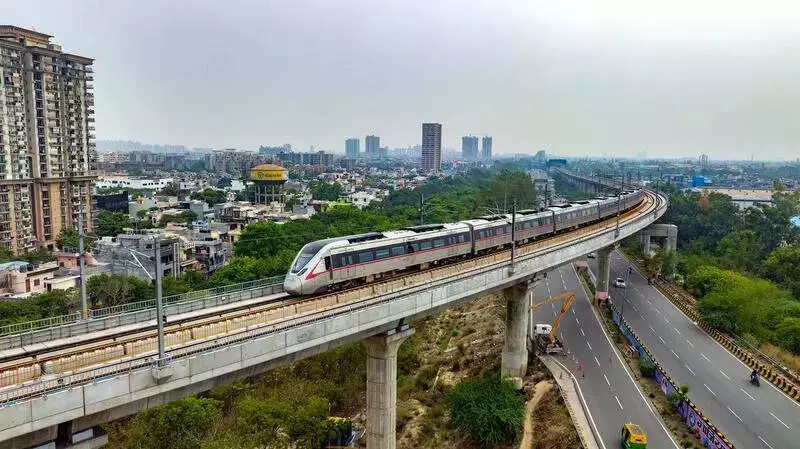
The National Capital Region Transport Corporation (NCRTC) has formally presented a draft Detailed Project Report (DPR) to the Haryana government for a major new rapid rail corridor. This proposed line aims to directly connect IFFCO Chowk in Gurgaon with Surajpur in Greater Noida, promising to slash travel times across the National Capital Region.
Route Details and Strategic Importance
The estimated cost for this transformative project is around Rs 15,000 crore. The proposed alignment is designed to bypass Delhi entirely. Starting from IFFCO Chowk, the corridor will pass through Sector 54, enter Faridabad at Bata Chowk, move via the Sector 85-86 intersection, proceed towards Noida sector 142/168, and finally terminate at Surajpur. The plan includes six stations along this route.
This corridor is a critical piece in a larger connectivity puzzle. It is envisioned to eventually form part of a high-speed rail link between Delhi's Indira Gandhi International (IGI) Airport and the upcoming Noida International Airport in Jewar. The Gurgaon-Noida line will integrate with other RRTS corridors, linking with the Delhi-Bawal line at IFFCO Chowk and the proposed Ghaziabad-Jewar corridor at Surajpur.

Underground vs. Elevated: A Key Debate
A significant point of discussion emerged during a recent meeting involving officials from NCRTC, HSVP, GMDA, HMRTC, and other agencies. While the NCRTC has planned the corridor as an elevated line, the Haryana government has strongly advocated for an underground section within Gurgaon. Officials cite the city's high land costs and dense urban fabric as primary reasons.
Senior Haryana government officials argue that an elevated track with only one or two stations in Gurgaon would offer limited benefit to local commuters. They also warn it could permanently hinder future road expansions and mobility upgrades. "An elevated viaduct will permanently limit surface-level upgrades and cause years of traffic disruption during construction," one official noted. The underground alternative, they contend, preserves valuable surface land for the city's future needs.
Broader RRTS Network and Expert Insights
This Gurgaon-Noida corridor represents the third major RRTS project planned for Haryana. The other two—the Delhi-Gurgaon-Manesar-Bawal (93 km, ~Rs 32,000 crore) and Delhi-Panipat-Karnal (136 km, ~Rs 33,000 crore) corridors—have already received approval from the public investment board and await the Union Cabinet's final nod.
Urban mobility consultant Ashok Bhattacharjee emphasized that the choice between underground and elevated systems is now a matter of cost and urban context, not technology. He stressed a crucial point for the project's success: the need for multiple stations within city limits. "A large working population in Gurgaon will only move to public transport if stations are easily accessible. The focus should not be on merely running a system, but on serving people," he cautioned, adding that sparse station coverage would fail to attract riders away from private vehicles.
The DPR is currently with the Haryana government for its feedback. NCRTC officials have stated that discussions are at a preliminary stage, with inputs being sought from all stakeholders. The project's final configuration, including the alignment type and station count, will be shaped by these ongoing consultations.






