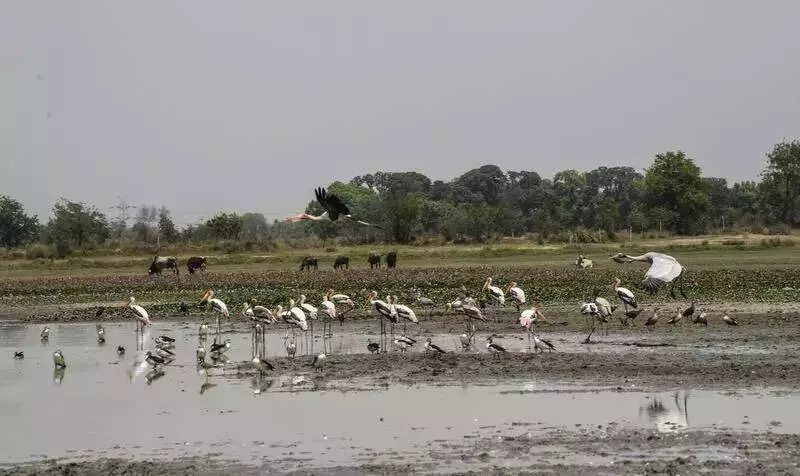
In a significant policy shift, the Uttar Pradesh government has decided against pursuing a prestigious Ramsar site designation for the ecologically rich Dhanauri wetland in Gautam Buddh Nagar. Instead, the Yamuna Expressway Industrial Development Authority (YEIDA) will develop the area into a sprawling biodiversity park spanning 112 hectares.
Why the Ramsar Tag Was Abandoned
The decision, confirmed by officials, is primarily driven by the wetland's proximity to residential sectors and the upcoming Noida International Airport. A Ramsar designation, while granting international recognition and strict protection, would have imposed a near-total ban on construction within a one-kilometre radius. This was deemed incompatible with existing urban development and aviation safety, as large bird congregations—a key criterion for Ramsar status—could pose a risk to flight paths.
YEIDA CEO R K Singh stated that the wetland has now been fully incorporated into the master plan, legally preventing any construction within the notified area. The biodiversity park proposal will adhere to safeguards laid down by the Supreme Court and the National Green Tribunal (NGT) for wetland conservation.

The Plan for the Biodiversity Park
The project will see the existing 45.6 hectares of marshland remain completely untouched and preserved. YEIDA plans to add approximately 30 more hectares to this core. The authority already holds about 25 hectares, and an additional 12 hectares belonging to the gram sabha will be integrated into the project.
Officials emphasized that the biodiversity park model offers a more practical solution for an area encircled by development. While it safeguards the landscape through planning controls, it does not impose the legally binding, wide-ranging construction ban associated with a Ramsar notification. Shailendra Bhatia, YEIDA OSD, noted that a Ramsar tag would have effectively created a no-construction zone within one kilometre.
Under the new plan, traditional rights of local communities will be respected. "Farmers will continue to exercise their traditional rights. For instance, if fishing has been practised by local farmers for generations, it will not be stopped," CEO Singh assured.
Long-Standing Demand and Legal Challenges
The move marks a departure from a long-standing demand by environmentalists. Home to nearly 217 bird species, including the state bird sarus crane, Dhanauri has for years been a strong contender for Ramsar status. The Centre had asked the UP government to propose the site in June 2019, but the state never filed a formal nomination.
Despite meeting Ramsar criteria—hosting over 20,000 waterbirds annually and supporting more than 1% of the sarus crane population—the process stalled and eventually reached the NGT in 2023. Environmentalist Anand Arya, a petitioner before the NGT who has campaigned for the Ramsar tag, has expressed strong opposition to the new plan.
Calling the biodiversity park proposal "entirely new," Arya cited the environment clearance for the Noida airport, which included a condition for the wetland's conservation and sanctuary development. "If they backtrack now, we will approach the NGT and, if necessary, the Supreme Court," he stated, indicating a readiness to challenge YEIDA's position at the next NGT hearing on December 12.
YEIDA officials, however, maintain that obtaining the Ramsar tag was never a compulsory directive. "There was never a compulsory direction to obtain a Ramsar tag. We were asked for updates, and we responded. The tag was never binding on us," a YEIDA official clarified.
The authority is now focusing on integrating the core wetland, its buffers, and new green areas into a regulated ecological precinct. While the core will remain undisturbed, officials are exploring limited, non-intrusive monetisation options on the periphery to fund the park's upkeep without harming its ecological integrity.