Few European pharmaceutical companies boast a heritage as extensive and intricate as Novartis. Established in 1996 via the merger of Ciba-Geigy and Sandoz, this Swiss entity consolidated enterprises with roots tracing back over two centuries, initially in dyes, chemicals, and nutrition before pivoting to medicines. Over the last thirty years, Novartis has methodically distanced itself from its conglomerate origins to emerge as one of Europe's premier and most impactful pharmaceutical firms, now concentrating almost exclusively on pioneering medicines targeting critical unmet global health needs.
India's Emergence as a Strategic Pillar
This corporate metamorphosis has been paralleled by a significant realignment in how and where Novartis cultivates its competencies. Previously centered on Europe and the United States, its research and development framework has transitioned into a globally dispersed network, with India ascending as a cornerstone. Presently, approximately two-thirds of Novartis' global capability centre personnel are stationed in India, underscoring its pivotal role.
From Humble Beginnings to a Major Hub
"In 2001, we commenced with a mere team of 20 individuals in Mumbai," recounts Ganpat Anchaliya, site head of the Novartis Corporate Centre in Hyderabad. "Initially, it was an experiment to validate the model's viability, focusing on rudimentary drug development and data tasks." A quarter-century later, this cautious venture has blossomed into Novartis' largest global capability centre, employing close to 9,000 staff in Hyderabad alone.

Anchaliya, who joined in 2008 during a pivotal expansion phase, recalls the centre housing around 250 people in Hyderabad at that time. Between 2009 and 2012, growth accelerated, fueled by abundant local talent and global cost pressures post-patent expiries like Gleevec. "Cost was initially a motivator," Anchaliya concedes, "but after a year or two, cost advantages diminish. What endures is capability and expertise, where India truly excels."
Wet Lab Operations and R&D Integration
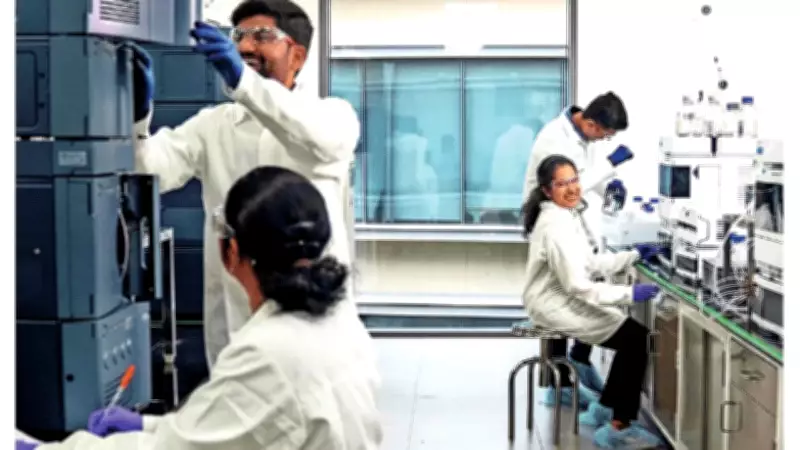
A landmark achievement was the inauguration of wet lab facilities at Genome Valley in Hyderabad's outskirts. Early endeavors to establish such labs in India faced regulatory and logistical challenges, but by the early 2010s, Novartis' enhanced operational scale and administrative acumen led to success. Starting with 25 personnel in 5,000 square feet, the unit expanded to about 350 scientists within five to seven years.
These laboratories are now integral to Novartis' worldwide R&D machinery, conducting formulation development, stability studies, and analytical research. "Every molecule transformed into a Novartis medication bears Hyderabad's imprint," Anchaliya asserts, "either directly from the lab or through contributions across the development pathway."
Drug Development and Safety Operations
Drug development constitutes the Hyderabad centre's largest segment, engaging roughly 3,000 professionals. Teams devise clinical protocols, formulate site strategies, handle clinical data, and execute biostatistical analyses. Additionally, they supervise global clinical trial operations, tracking patient enrollment across numerous sites and relaying insights to international study leads. Pharmacovigilance and patient safety have also become fundamental, with nearly 90% of Novartis' global drug safety management originating from Hyderabad.
Expansion into Enterprise Functions
As trust in the Indian operations solidified, Novartis extended beyond R&D into comprehensive commercial roles. From approximately 2012, Hyderabad assumed global duties in marketing analytics, salesforce planning, incentive design, competitive intelligence, and launch strategy. "It began as a straightforward transfer," Anchaliya notes, "but as teams gained cross-country visibility, they identified process inefficiencies, sparking genuine transformation."

Finance and Other Key Domains
Finance mirrored this progression, with Anchaliya spearheading its development to about 800 staff, encompassing accounting, reporting, forecasting, controls, compliance, and later, digital finance integrating automation and analytics. Other functions gradually migrated, with an estimated 70–80% of Novartis' global quality experts now based in Hyderabad, managing regulatory submissions and compliance. Supply chain engineering, technical operations, procurement, and human resources—with around 400 specialists—further augment the centre's scope. "Hyderabad nearly replicates Novartis globally," Anchaliya remarks, "with 95% of major functions represented here, demonstrating depth and maturity."
Biomedical Research Advancements
The most emblematic shift in recent years involves core biomedical research. Over the past four years, Novartis has assembled a 200-member biomedical research unit in Hyderabad, predominantly staffed by PhDs and scientists skilled in chemistry, biochemistry, and clinical research. "This entails early-stage research, including pre-clinical work, animal studies, and first-in-human documentation," Anchaliya explains. "While still nascent, the foundation is robust, aligning with the decade-plus maturation timeline for global functions."
Strategic Alignment and Ecosystem Impact
This evolution reflects Novartis' own strategic overhaul over the past decade, as it divested consumer health, generics, and other non-core ventures to concentrate on innovative medicines. Hyderabad, Anchaliya contends, has been instrumental in this shift. "Strategy is set by the Board and executive committee," he says, "but we significantly aid execution by fostering leanness, efficiency, and innovation focus."
Beyond internal benefits, the Hyderabad centre has influenced the city's broader life sciences ecosystem. Novartis serves as both a key employer and a benchmark, training thousands of scientists, engineers, and quality professionals who now enrich regional labs, startups, and global pharmaceutical operations. "Weekly, we advise companies seeking insights from our experience," Anchaliya shares. "If our journey fortifies the ecosystem and elevates high-caliber science and innovation in India, we regard that as a meaningful contribution."