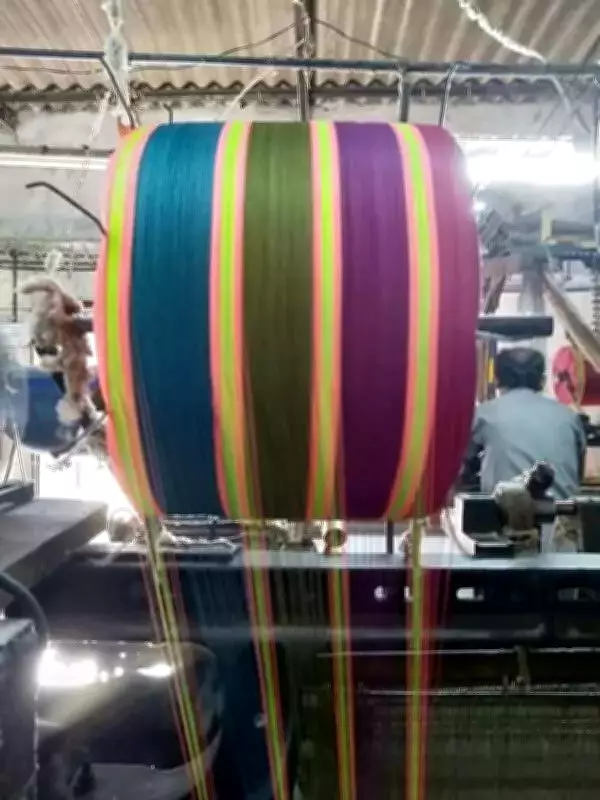
Maharashtra's Plain Powerlooms Face Extinction as Budget Pushes Tech Upgrade
The era of plain textile powerlooms in Maharashtra appears to be drawing to a close following the Centre's announcement of financial assistance in the Union Budget 2026-27 to upgrade them with sophisticated and advanced machinery. This move aims to significantly increase production capacity and enhance the quality of textiles across the state.
Widespread Impact Across Key Hubs
There are more than 1 lakh plain powerlooms in Ichalkaranji alone, and approximately 3 lakh spread across Maharashtra. Historically, the government had encouraged textile operators to adopt advanced machines, such as air jet and rapier looms, but those schemes were discontinued. For the first time, direct encouragement is being extended to existing plain powerloom units to modernize their operations.
Chandrakant Patil, the president of the Ichalkaranji Powerloom Association, emphasized the benefits of this shift. "Advanced machinery is five times more effective, and the quality of the garment is also much smoother and longer-lasting in comparison to plain powerlooms," he stated. The Centre plans to launch an integrated scheme for the textile sector, which includes a crucial component to encourage powerloom operators to upgrade. Capital support for machinery and technology upgradation is a long-demanded aspect of this initiative.

Textile Sector's Economic Significance
The textile sector plays a vital role in Maharashtra's economy, serving as the second-largest employment generator after agriculture. The state accounts for 10.4% of India's total textile and apparel production and 10.2% of total employment in this sector. Additionally, Maharashtra produces 272 million kg of yarn, representing roughly 12% of the country's gross production.
Malegaon, one of Maharashtra's largest textile hubs, is home to over 12,000 powerloom units operating more than 3 lakh powerloom machines. The town predominantly produces grey cloth, with a daily output of around 1.5 lakh metres supplied to major textile markets in Rajasthan, Gujarat, Tamil Nadu, and other states. However, these units mainly consist of plain powerlooms that have seen minimal technological upgradation over the years.
Industry Concerns and Demands
Local industry representatives have expressed mixed reactions to the Budget announcements. While broader measures for the textile sector were introduced, the specific needs of the plain powerloom segment, which forms the backbone of Malegaon's textile economy, were reportedly overlooked. "The plain powerloom sector needs dedicated schemes and financial support to modernize. Unfortunately, there is nothing substantial for us in this Budget," said Sajid Ansari, the president of the Malegaon Powerloom Udyog Vikas Samiti.
According to Ansari, earlier schemes supporting modernization were discontinued. A program offering assistance to upgrade plain powerlooms stopped in 2021, while another central scheme providing a 20% subsidy on project costs for advanced looms was discontinued in 2023. "Central government must take steps to revive support and enable technological upgradation of plain powerlooms. Without this, small and medium powerloom units will struggle to stay competitive," he added.
Focus on Technical Textiles
Among technical textiles, the Budget highlighted the Centre's intention to boost sports textiles, which include items such as sports shirts, towels, mats, and various other products. Solapur, being the hub of terry towel manufacturing, stands to benefit from this boost.
Raju Rathi, the president of the Solapur Chamber of Commerce and Industry, noted, "Solapur-based units produce world-class towels. They are frequently sought for big sporting events because the towels can soak sweat effectively." Chandrakant Patil mentioned that technical textiles are gradually growing in Ichalkaranji, with around 22 operators currently producing items ranging from sports and medical textiles to bulletproof jackets.
The transition from plain to advanced powerlooms marks a significant shift in Maharashtra's textile landscape, promising enhanced productivity and quality, yet raising concerns about the support available for smaller, traditional units in the process.