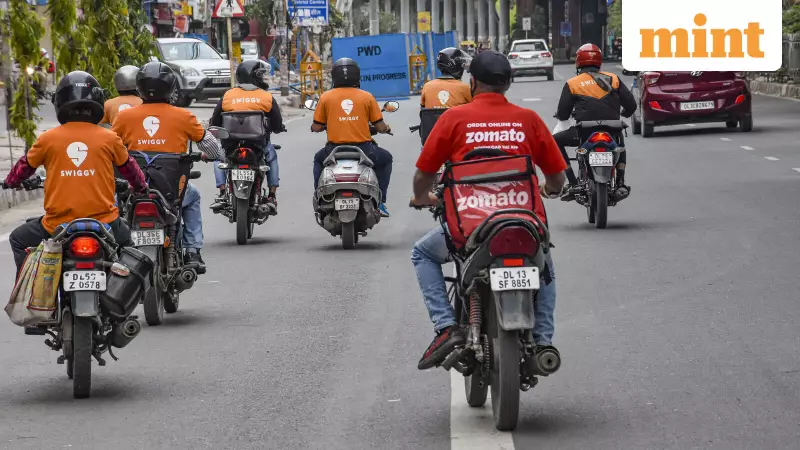
A recent study reveals a significant surge in employment within India's food delivery sector, but this growth masks a troubling reality of job distress and economic pressure for the workers powering this boom.
Rapid Growth in Jobs and Economic Value
According to a joint study by the National Council of Applied Economic Research (NCAER) and investment group Prosus, the food delivery sector directly employed 1.37 million workers in 2023-24. This marks a sharp 27% increase from the 1.08 million workers recorded in 2021-22, translating to a compound annual growth rate (CAGR) of 12.3%.
This expansion comfortably outpaced India's overall employment growth rate of 7.9% over the same period. The sector's economic footprint also widened substantially. The study estimated the gross value of output (GVO) at a staggering ₹1.2 trillion in 2023-24, more than doubling from ₹613 billion two years prior.

The Hidden Malaise Behind the Numbers
Despite the impressive statistics, worker representatives and policy experts caution that these numbers reflect economic distress rather than robust opportunity. They argue that the influx into gig work is a direct consequence of rising unemployment, forcing people into roles with poor working conditions.
Sunand, president of the Delhi-based Rajdhani App Workers’ Union (RAWU), stated that employment claims hide the grim reality. "Food delivery workers continue to work for up to 12–14 hours a day with abysmally low incomes and continuous cuts in rate cards by platform companies," he said.
An anonymous policy expert echoed this, noting that demand for gig work spiked post-pandemic due to job scarcity, especially among educated youth. The expert explained that while initial wages were better when companies were flush with venture capital, the pressure to turn profitable has led to declining rate cards and wages for workers.
This context is set against a backdrop of a national unemployment rate of 5.2% in September, with urban joblessness at 6.8%, indicating strain in city labour markets.
From Temporary Gig to Full-Time Grind
The nature of the work is also changing. Bornali Bhandari, a professor at NCAER, noted that food delivery is increasingly becoming a full-time occupation rather than temporary gig work. A 2022 study found a roughly equal split between part-time and full-time workers, but the share of those working full-time has since grown.
However, incomes remain a critical concern. While the report did not provide specific income estimates, Balasubramanian Anantha Narayanan of TeamLease Services estimates monthly take-home pay for riders between ₹20,000 to ₹25,000. Bhandari cited recent work showing average monthly incomes around ₹20,000, noting that while falling fuel costs and EV adoption have helped net earnings, broader macroeconomic pressures persist.
The sector is characterized by easy entry and high churn. With low barriers—requiring primarily a smartphone, a two-wheeler, and a small kit cost—workers often join fresh out of college or between jobs. The average worker tenure is only about 14 months, and the average age is 29 years. The sector is dominated by Swiggy, with 515,000 active delivery partners in FY25, and Zomato (Eternal Ltd), with 473,000.
A New Social Safety Net Emerges
A potential ray of hope for gig workers arrived last month with the government rolling out new labour rules. For the first time, gig and platform workers are being brought under a formal social security net.
Under the Code on Social Security, 2020, online platforms must contribute 1-2% of their annual turnover (capped at 5% of worker payouts) to a welfare fund. This will make workers eligible for benefits including:

- Accident and life insurance
- Disability benefits
- Maternity support
- Old-age protection
The government plans to deliver these benefits through existing systems like Ayushman Bharat and state welfare boards. This development is crucial as India's overall gig workforce, currently at 10 million, is projected to swell to 23.5 million by 2029-30.
While the food delivery sector shows remarkable growth in job creation and economic contribution, the debate now centers on ensuring this expansion translates into sustainable livelihoods and not just survivalist employment for India's urban workforce.