Times of India Budget Dialogues 2026 Unfold in New Delhi
The Times of India Budget Dialogues 2026 commenced in New Delhi on Tuesday, creating a significant platform for policymakers, economists, industry leaders, and opinion-makers to thoroughly decode the priorities, promises, and pressures embedded within the Union Budget. This event set the stage for extensive discussions on India's economic roadmap during a period marked by global uncertainty and strong domestic aspirations.
Opening Address Sets the Tone
Prasad Sanyal, Group Business Head of Times Internet, delivered the opening address, emphasizing the critical importance of informed public discourse surrounding the budget and its profound impact on growth, governance, and everyday lives. He stated that the TOI Budget Dialogue aims to move beyond mere headlines and spreadsheets to decode the underlying intent, direction, and long-term implications of fiscal policies.
"The conversation must not end with initial reactions; it must bring clarity, incorporate diverse viewpoints, and, above all, help translate policy into practical perspective," Sanyal remarked. Anchored in the theme "March towards Viksit Bharat," the dialogue focused on developments encompassing resilience and opportunity, rather than growth alone.

Digital and AI Future in Focus
Following the opening address, Abhishek Singh, Additional Secretary at the Ministry of Electronics and Information Technology, engaged in a conversation with TOI Senior Editor Pankaj Doval on 'India's Fiscal Vision for a Digital and AI Future.' Singh highlighted the robust nature of India-US relations in the technology domain, noting that the recent trade deal between the two nations would significantly bolster India's ambitions in technology and artificial intelligence.
"This development will have greater ramifications for the upcoming India AI Summit scheduled for later in February," Singh added. He characterized the bilateral tech relationship as "they lead in tech, we lead in talent, and between tech and talent, we build trust."
Panel Discussion: 'Budget Uncluttered'
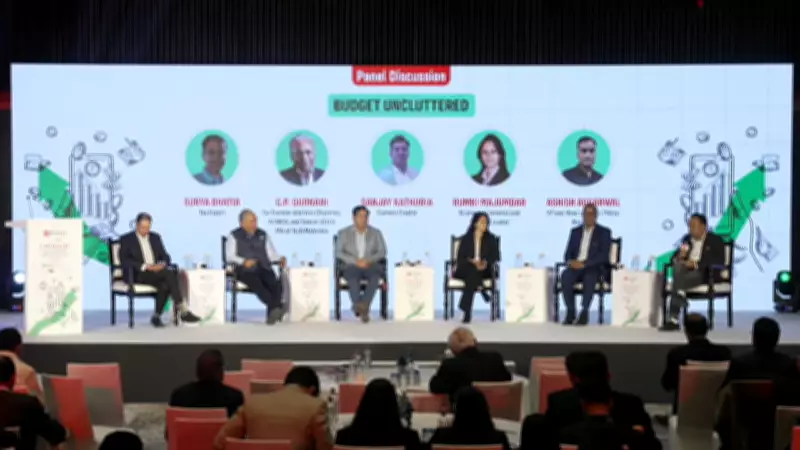
The event progressed with Panel 1, titled 'Budget Uncluttered,' moderated by Pankaj Doval. The panel featured diverse experts including Surya Bhatia, a tax expert; CP Gurnani, Co-founder and Vice Chairman of AIONOS and former CEO & MD of Tech Mahindra; Sanjay Kathuria, a content creator; Ashish Aggarwal, Vice President and Head of Public Policy at Nasscom; and Rumki Majumdar, a business economist and thought leader.
The discussion initiated with observations on how budget perceptions are increasingly shaped by social media. Sanjay Kathuria pointed out the perceived muted reaction to the Budget announcement on social platforms, noting that "the people judging it there are not the policymakers but those affected by it." Addressing middle-class discontent on social media, he compared Indian and US budgets, highlighting that India has provided tax relief to ordinary citizens multiple times over the past decade, unlike the US.
CP Gurnani described the government's approach as a "very responsible budget," emphasizing its balanced nature. "In the US, they are just increasing the deficit, but we are controlling it," he stated. Gurnani further stressed the importance of both stated and unstated communications in the budget, particularly regarding physical and digital infrastructure performance, with AI currently being a focal point.
Rumki Majumdar labeled it a "Budget for long term and Viksit Bharat," noting a shift from crisis-response budgets of recent years to one building on economic resilience. She emphasized that policies from AI to startups are ultimately meant for ordinary people, incentivizing manufacturing, job creation, and growth.
Ashish Aggarwal discussed digital infrastructure and innovation, stating, "The opportunity is the shift to leapfrogging from catching up. That is the real dividend from technology, and our biggest asset is our talent, which is helping us leapfrog." Surya Bhatia added perspective on expectations, urging a move away from anticipating "big bang" budgets every time and acknowledging the regular process followed by the government, including in taxation.

Critical Juncture for the Indian Economy
The Union Budget 2026 arrives at a critical juncture for the Indian economy, as the government navigates fiscal consolidation with growth imperatives amidst a slowing global economy, geopolitical tensions, and evolving trade dynamics. With key focus areas including inflation management, job creation, infrastructure push, and welfare spending, expectations from the budget remain high across various sectors.
As India positions itself as a resilient growth engine among major economies, stakeholders are keen to assess how policy choices align with long-term goals of sustainability, competitiveness, and inclusive development. Against this backdrop, the TOI Budget Dialogues 2026 served as a vital forum to examine the budget's fine print, assess its implications across sectors, and debate its alignment with the government's stated economic vision.